Paperlayer: Free AI Reading Layer for arXiv Papers
paperlayer.ai · checked 9 Oct 2026
Paperlayer offers a free, browser-based way to read public research papers with summaries and notes tied to evidence.
How it plugs in
Signal on Text Summarization Software6.2#8 of 24
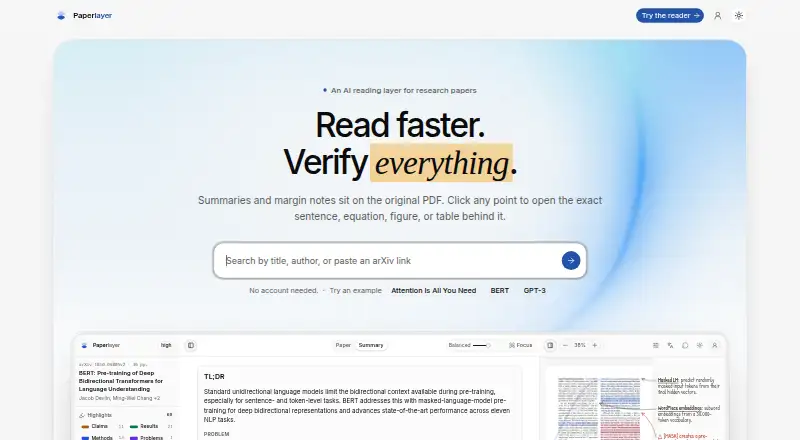
As an AI reading layer on the web, Paperlayer works with public arXiv papers. Its overview covers each paper’s problem, method, results, and caveats, connecting those points to passages in the PDF. Readers can tune highlight density, open explanations in the margin, look up papers by title or author, and read summaries or notes in multiple languages. The current service is a free public demo.
Review
In a line
For public arXiv research, Paperlayer adds an AI reading layer to the web reader, placing summaries, source links, highlights, and margin notes beside the original PDF.
What it does
A paper can be located by title or author; you can also enter its arXiv ID or paste an arXiv link. Its summary addresses the problem, method, results, and caveats, connecting every point with relevant passages.
The reader marks claims, methods, results, problems, and caveats. Highlight density is adjustable, while margin notes put terms, equations, and figures into context. Korean, Japanese, Chinese, Spanish, French, and German are available for summaries and notes. J and K keys move through a paper.
How it connects
Paperlayer fetches verified, version-pinned PDFs from arXiv. Google sign-in is optional and can sync saved papers and reading preferences across devices.
It runs on the web and does not accept file uploads. During live AI processing, public paper material and the request are transmitted to OpenAI through an encrypted connection, with no intentional inclusion of account, cookie, or anonymous identifiers. Paper chat is marked “Soon” and, if available, is intended for questions about public papers.
Good fit
Paperlayer suits readers who work with public arXiv papers and want a guided way to scan methods, findings, claims, and caveats. It can help when you need explanations of technical terms, equations, or figures without leaving the paper.
Watch for
The current demo covers public arXiv papers only. Private or unpublished documents cannot be uploaded, and there is no file-upload option.
AI text and automatically chosen evidence can be wrong or linked incorrectly. Check important details in the original paper. Paper chat is not available yet, and the service is described as a public demo rather than a paid product.
Pricing
Paperlayer’s Public demo plan is free. It covers public arXiv papers and excludes private or unpublished document uploads. There is no free trial because the service is already free, and the terms say no purchase or paid subscription is currently offered.
Verdict
Choose Paperlayer if your reading centers on public arXiv research and you value summaries that point back to source passages. Its language options, adjustable highlights, and in-context notes can make dense papers easier to navigate.
Look elsewhere if you need to bring in private files, work outside arXiv, or rely on AI output without checking the source. Since the tool is a free public demo and paper chat is still marked “Soon,” confirm that its current scope matches your workflow.
Our take
Paperlayer is a no-cost option for exploring public arXiv papers with structured summaries and explanations beside the source. Its strongest fit is quick orientation: you can locate a paper, see its main points, and follow links to supporting evidence. The service is not suited to confidential research because it accepts no private uploads. Treat its AI notes and evidence links as aids, not final authority, and verify important claims in the PDF. Readers who need chat now, broader document support, or a paid service with defined plans should wait or choose another tool.
- Free public demo with no paid subscription currently offered
- Summaries connect key points with evidence in the original PDF
- Explanations for terms, equations, and figures appear beside the paper
- Summaries and notes work in six additional languages
- Optional Google sign-in syncs saved papers and preferences
- Only public arXiv papers are supported
- Private or unpublished document uploads are not accepted
- AI output and evidence links may be inaccurate
- Paper chat is labeled “Soon”
- Important details still need checking in the original paper
- Pick it ifReaders scanning public arXiv research; People seeking source-linked summaries and explanations in the margin; Users who need multilingual notes
- Skip it ifYou need to upload private or unpublished papers; Your documents are not on public arXiv; You require available paper chat or a paid plan
Pricing
The only listed plan is a free Public demo for public arXiv papers. No purchase or paid subscription is currently offered.
- Public demoPublic arXiv papers · No private or unpublished document uploads · No purchase or paid subscriptionFree
As paperlayer.ai lists them, checked 9 Oct 2026.
Questions
Is Paperlayer free?
Yes. Its Public demo plan is free, and the terms say no purchase or paid subscription is currently offered.
What papers can Paperlayer read?
The current demo covers public arXiv papers. Papers can be found by title or author, with an arXiv ID, or by pasting an arXiv link.
Can I upload a private PDF?
No. Paperlayer has no file-upload option and does not accept private or unpublished document uploads.
How does Paperlayer use AI?
It provides summaries and margin notes, while the reader marks highlights. For live processing, public paper and request content is sent to OpenAI over an encrypted connection.
Can Paperlayer explain equations and figures?
Yes. Its margin notes explain terms, equations, and figures alongside the paper.
Is paper chat available?
Not yet. The homepage labels paper chat “Soon”; the terms say that, if available, it should be used only for questions about public papers.
Should I trust its summaries?
No AI aid is guaranteed correct. Paperlayer warns that output and selected evidence may be inaccurate or incorrectly linked, so verify important details in the original paper.