Photomosaic: Free Open-Source Photo Mosaic Tool
danielballan.github.io · checked 9 Oct 2026
Open-source Linux tool that builds large-photo mosaics from your own image collection.
How it plugs in
Signal on Photo Mosaic Software6.3#4 of 24
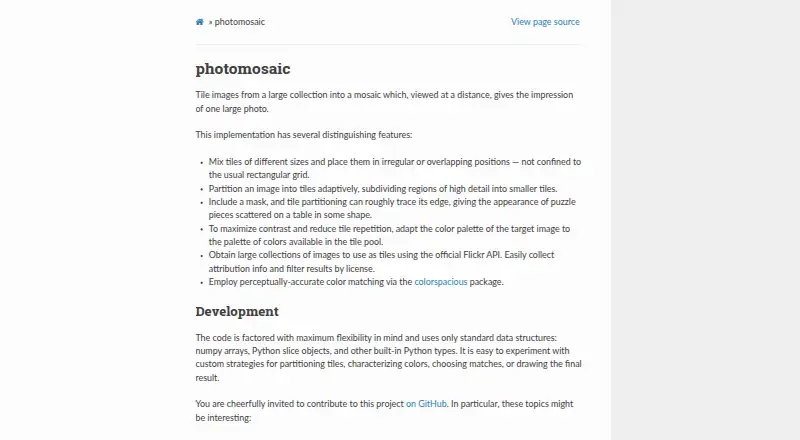
Photomosaic is a free Python package released as open-source software for Linux. It turns a target image and a tile collection into a mosaic that resembles the original from a distance. It supports mixed tile sizes, overlaps, irregular layouts, masks, adaptive detail, color adjustment, and Flickr downloads through the public API. Finished mosaics can be written as PNG or JPG images.
Review
In a line
This Linux Python package assembles many smaller images into one larger picture. Viewed from a distance, the tile arrangement resembles the target photo.
What it does
You provide a target image and a tile pool. The package matches tiles to the target, can reuse tiles, and can divide detailed areas into smaller pieces.
Tiles do not have to form a regular grid. They can vary in size, overlap, and follow an irregular arrangement. A mask can make the partition approximately trace an edge, and color matching can shift the target palette toward colors present in the tile pool.
How it connects
Photomosaic is open-source software under the BSD-3-Clause license. Install it with pip or from source on Linux; Python 3.5 or newer is required. Experimental parallelism is available through an optional parallel extra.
Its tools can retrieve tile images from Flickr search results or albums via Flickr's public API. Each download comes with JSON attribution information, and license filters are available for search queries. Album downloads do not automatically check licenses.
You can use your own tile library and experiment with custom partitioning, color, matching, and drawing methods. A generated mosaic can be written to PNG or JPG or shown with matplotlib.
Good fit
Photomosaic suits Linux users who want to create mosaics from a custom image collection and control how tiles are divided, matched, and drawn. It is also useful when Flickr is a source for tile images and attribution records are needed.
Watch for
The documentation indicates that good results generally require at least roughly 300 tile images. Drawing is usually the slowest step, although reusing a cache of resized pool images can speed up repeated draws.
Check your Python version and Linux setup before installing. License verification is not performed programmatically for Flickr album downloads, so you must check those rights yourself. The newest release note listed in the documentation is version 0.3.1 from June 21, 2019.
Pricing
Photomosaic is free, with no paid plan and no free trial. The package is open source and can be installed with pip or from source.
Verdict
Choose Photomosaic if you want a no-cost, source-available tool for building photo mosaics on Linux and are willing to install a Python package. Its irregular layouts, masks, adaptive detail, and custom strategies give you control beyond a basic rectangular grid.
Look elsewhere if you need a Windows or macOS package, a hosted service, or a ready-made workflow that does not require managing image pools, Python dependencies, and image licensing.
Our take
Photomosaic is a sensible pick for technically inclined Linux users who want to build mosaics from their own pictures or Flickr downloads without paying for software. Its open code and customizable processing suit experiments with tile shapes, matching, and partitioning. The tradeoff is setup and maintenance: you need Python, a sizable tile collection, and attention to Flickr licensing. Slow drawing and the dated 2019 release note also make it less suitable for buyers seeking a current, turnkey desktop app.
- Free and open-source under the BSD-3-Clause license
- Supports mixed sizes, overlaps, masks, and adaptive detail
- Can use custom tile libraries and reuse tiles
- Downloads Flickr images with attribution JSON
- Exports PNG and JPG files
- Linux only, with Python 3.5 or later required
- Roughly 300 tile images are generally needed for good results
- Drawing is usually the slowest processing step
- Flickr album downloads do not automatically check licenses
- Newest listed release note dates to June 21, 2019
- Pick it ifLinux users creating custom photo mosaics; People comfortable installing Python packages and managing image rights
- Skip it ifYou need a hosted or cross-platform app; You do not want to assemble a large tile collection or review album licenses
Pricing
Photomosaic costs nothing. There is no paid tier or trial; install the open-source Python package with pip or from source.
- photomosaicPython package; install with pip or from sourceFree
As danielballan.github.io lists them, checked 9 Oct 2026.
Questions
What is Photomosaic?
It is a Linux-based Python package that combines smaller images into a larger target picture recognizable from a distance.
Does Photomosaic require a regular grid?
No. It can mix tile sizes and place tiles in irregular or overlapping positions. High-detail areas can be split into smaller tiles.
Can it download images from Flickr?
Yes. Its tools use Flickr's public API to download search results or albums and save JSON attribution information.
Does Photomosaic check image licenses?
Searches on Flickr support license filtering, but album downloads are not checked programmatically for licenses.
How many tile images are needed?
The documentation indicates that good results usually need about 300 tile images at minimum.
What files can it create?
The tutorial shows saving mosaics as PNG or JPG image files, or displaying them with matplotlib.
How much does Photomosaic cost?
It is free and open source. There is no paid plan and no free trial.
Near it
All alternatives →- P
 PicTiler#3 on this board
- AAndreaMosaic#5 on this board
- EEasyMoza#2 on this board
- PMPicture Mosaics Online Mosaic Tool#6 on this board
- Pphomo#1 on this board
- PAPhotoMosaic-Artifact#7 on this board
- RMRapid-Mosaic#8 on this board
- PAPhotoMosaic.ai#9 on this board
- PW
 Photomosaic.work#10 on this board
- MXMosaizer XVi#11 on this board