Pymute Python Mutation Testing Tool
github.com · checked 8 Oct 2026
Free mutation testing for Python projects on Linux, with pytest or tox support.
How it plugs in
Signal on Mutation Testing Tools6.3#9 of 25
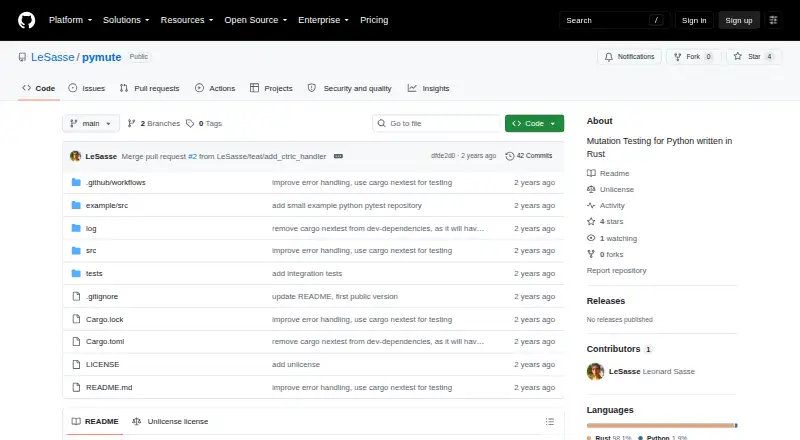
Written in Rust, pymute tests Python code by generating mutants and running pytest or tox. Each mutant gets a temporary directory, where mutations are inserted by editing Python text. Module, test, mutation-type, thread, and mutant-count controls shape a run. Installation needs Rust and Cargo.
Review
In a line
Pymute provides free mutation testing for Python projects. The tool runs on Linux and is written in Rust.
What it does
For every mutant, pymute makes a temporary directory and edits Python file text to introduce a change. It then runs the tests so you can see which mutations are caught and which remain.
Documented operators include mathematical symbols, conjunctions, booleans, control flow, comparisons, and numbers. Pytest runs by default, while tox is available too.
Module globs can narrow files; you can also pick tests and mutation types, adjust parallel threads, and limit the mutant total. A random sample is used when max-mutants sets the cap.
How it connects
Both pytest and tox can serve as pymute's test runners. For pytest, execution must start at the project root, use independent project copies, and exercise the local copy rather than an installed package.
Tox prepares a virtual environment and installs the package anew for each mutant, so environment setup makes this route considerably slower. Cargo can install pymute from crates.io or straight from GitHub, with Rust and Cargo required.
The normal report contains mutants whose tests passed and therefore survived. Additional verbosity levels expose caught mutants or output from the underlying process.
Good fit
Pymute suits Python developers who want mutation testing alongside pytest or tox on Linux. It is useful when you need to focus on selected modules or tests, run mutants in parallel, or sample a limited number of mutants.
When module filtering is used, files called test_* and files ending in *_test.py are omitted automatically.
Watch for
Every parallel thread consumes temporary disk space, and a run may fail if /tmp runs out. Tox takes longer because it creates an environment and installs the package for each mutant.
Pytest projects must use the project-root and local-copy arrangement described in the README. Rust and Cargo are also needed for installation. Mutations are made by editing Python text, not by operating on the abstract syntax tree.
Pricing
Pymute is free. Its free plan is installed with Cargo from crates.io or GitHub and requires Rust and Cargo.
Verdict
Choose pymute if you run Python tests on Linux and want a no-cost way to see whether pytest or tox catches deliberate code changes. Its filters, sampling, and parallel runs help tailor the workload.
Look elsewhere if your project cannot use Rust and Cargo, needs a platform other than Linux, or cannot handle temporary copies and the pytest layout rules. Tox users should expect longer runs because environments are rebuilt for each mutant.
Our take
Pymute is a practical fit for Linux-based Python projects that already use pytest or tox and can install Rust tooling. It offers focused runs through module, test, mutation-type, thread, and mutant-count settings, plus reports for both surviving and caught changes. The main costs are setup and disk use: Rust and Cargo are mandatory, each parallel worker needs temporary space, and tox can be slow. Pytest projects must test local copies from the project root. Teams on other operating systems or with different project layouts should skip it.
- Free to install and use
- Supports pytest and tox
- Filters modules, tests, mutation types, and mutant count
- Runs mutants in parallel
- Reports surviving and caught mutants
- Runs on Linux
- Requires Rust and Cargo
- Parallel runs consume temporary disk space
- Tox mode is considerably slower
- Pytest requires a specific project-copy layout
- Pick it ifLinux Python projects using pytest; Teams wanting focused or sampled mutation runs; Users comfortable installing Rust and Cargo
- Skip it ifYou need Windows or macOS support; Your pytest setup cannot run local copies from the project root; You lack temporary disk space for parallel workers
Pricing
Pymute has a free plan. Install it with Cargo from crates.io or GitHub; Rust and Cargo are required.
- Free/open-sourceInstall with Cargo; requires Rust and CargoFree
As github.com lists them, checked 8 Oct 2026.
Questions
What is pymute?
Pymute is a free tool for mutation testing Python code with pytest or tox on Linux. It is written in Rust.
Which test runners does pymute support?
Pytest serves as the default, and tox can be used as well.
How does pymute make mutants?
A temporary directory is made for each mutant, and pymute edits Python file text to insert mutations instead of operating on the abstract syntax tree.
Can I limit what pymute runs?
Yes. Module globs, selected tests, mutation types, thread count, and a mutant cap can all narrow a run; the cap uses random sampling.
What does pymute show in its output?
Its standard report shows mutants that survived because the tests passed. Other output levels reveal caught mutants or underlying process output.
What does pymute require?
Pymute runs on Linux, and installing it from crates.io or GitHub through Cargo requires Rust and Cargo.
Why might a tox run take longer?
For each mutant, tox sets up a separate virtual environment and installs the package, making it considerably slower.
What should pytest projects check before using pymute?
Tests should start from the project root, run in independent copies, and exercise the local copy instead of an installed package.