pytest-gremlins software review
github.com · checked 7 Oct 2026
A free pytest extension that introduces tiny code alterations to test whether your suite notices them.
How it plugs in
Signal on Mutation Testing Tools6.3#7 of 25
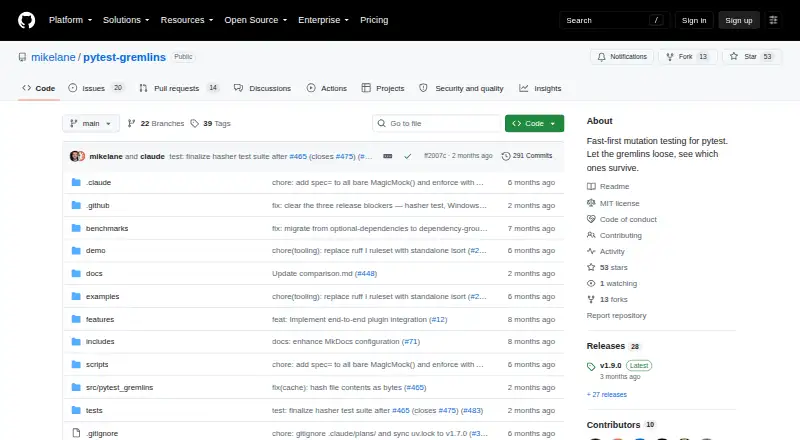
This plugin brings mutation analysis into pytest. It alters Python statements in controlled ways and observes whether the current tests flag those alterations. Linux projects need Python 3.11 or newer, pytest 7 or newer, and tests already in place. Reports, CI workflows, parallel execution, and incremental analysis are available.
Review
In a line
pytest-gremlins brings mutation analysis to pytest projects. It inserts deliberate code variations, known as mutations, and checks whether the test suite fails appropriately.
What it does
You run it against an existing pytest suite to find tests that miss defects. You can begin by installing `pytest-gremlins` with pip and invoking `pytest --gremlins`.
Its mutation operators cover comparisons, boundaries, Boolean logic, arithmetic, and return values. Coverage-guided test selection, mutation switching, incremental analysis, and parallel execution help manage the work. Results can show surviving mutations and support a mutation-score quality gate.
How it connects
The package is open source under the MIT license and works with Python projects that use pytest. Compatibility with pytest-xdist includes parallel runs such as `-n auto`.
A composite GitHub Action can install the project, run mutation tests, and fail a workflow when the score is below a chosen threshold. Documentation also covers manual CI examples for GitHub Actions, GitLab CI, CircleCI, and Dagger.
You can produce console, HTML, or JSON reports, including more than one format in a run. Settings can live in `pyproject.toml` or command-line flags, and an inline `# gremlin: pardon[reason]` pragma can suppress a mutation.
Good fit
pytest-gremlins suits Python teams with an established pytest suite that want to check whether tests catch realistic code changes. Its guide points to business logic, security-sensitive code, and financial calculations as useful targets.
It can fit continuous-integration checks when you want a score threshold, and its reports give different ways to review surviving mutations.
Watch for
The package needs Python 3.11 or newer, pytest 7.0 or newer, an existing test suite, and Linux. Its package metadata marks the project as Alpha.
A baseline mutation-analysis run can require 10 to 100 times the duration of an ordinary test run. Caching can shorten later runs, but the extra processing still matters for large suites.
Equivalent mutations can make a 100% mutation score impossible and may not be worth chasing. The MIT license provides the software “AS IS” without warranty.
Pricing
pytest-gremlins is free. This MIT-licensed Python package has neither a paid plan nor a trial period.
Verdict
Choose pytest-gremlins if your Python project already relies on pytest and you need evidence that tests detect changes in important logic. Linux support, CI examples, multiple report formats, and score thresholds cover common review workflows.
Look elsewhere if you cannot use Python 3.11+, need a non-Linux setup, or cannot allow mutation runs that may take much longer than regular tests. For broader comparisons, see mutation testing tools.
Our take
pytest-gremlins is a practical match for Python projects with mature pytest coverage and a reason to measure whether tests catch altered behavior. Its free MIT license removes purchase barriers, while CI actions, report formats, and parallel execution help teams fit it into existing checks. The main trade-offs are the Linux and Python-version requirements, Alpha status, and potentially much slower first runs. Use the score as an indicator, not an absolute 100% objective, because some equivalent changes cannot be meaningfully tested.
- Free and MIT licensed
- Works with existing pytest suites
- Supports CI score thresholds
- Console, HTML, and JSON output formats
- Incremental and parallel analysis
- Linux only
- Python 3.11 or newer required
- Initial runs can take 10–100 times longer
- Alpha development status
- Equivalent mutations can block a 100% score
- Pick it ifPython teams using pytest; Mutation checks in CI workflows; Testing business or security-critical logic
- Skip it ifYou need Windows or macOS support; Your project uses an older Python or pytest version; Long mutation-testing runs do not fit your workflow
Pricing
Free and open source, with no paid tier or trial. The MIT-licensed package needs Python 3.11 or newer.
- pytest-gremlinsMIT-licensed Python package · requires Python 3.11+Free
As github.com lists them, checked 7 Oct 2026.
Questions
What is pytest-gremlins?
It extends pytest by introducing controlled code changes and checking whether the tests notice them.
What does it require?
The getting-started instructions call for Python 3.11 or newer, pytest 7.0 or newer, an existing test suite, and Linux.
How do I start a run?
Use pip to add `pytest-gremlins`, then invoke the plugin with `pytest --gremlins`.
Can it run in CI?
Yes. The docs describe a GitHub Action and manual workflow examples for GitHub Actions, GitLab CI, CircleCI, and Dagger.
How long does mutation testing take?
The initial analysis can last 10–100 times longer than a regular test run, while caching may speed subsequent runs.
What reports are available?
Output is available in console, HTML, and JSON forms, and one run can emit multiple formats.
Is pytest-gremlins free?
Yes. It is open-source software under the MIT license and has no free trial.