RelayHQ webhook routing and delivery
relayhq.org · checked 15 Oct 2026
Cloud webhook routing with queues, retries, logs, replay, and rules for sending events to several services.
How it plugs in
Signal on Webhook Management Software6.7#4 of 29
RelayHQ is a cloud service for receiving webhooks, placing them in a queue, and forwarding them to configured destinations. It offers permanent inbound URLs, routing rules, delivery logs, retries on paid plans, and manual replay. A REST API and local tunnel support development. Plans range from a free tier to Team, with annual discounts.
Review
In a line
RelayHQ receives webhooks from providers such as Stripe, GitHub, and Shopify, then sends those events to configured services. It runs as a cloud service on global infrastructure listed in US East (IAD).
What it does
Each endpoint gets a permanent inbound URL. RelayHQ can forward one webhook to multiple destinations at the same time, add custom authorization headers, API keys, or signatures, and show request details in a dashboard.
Routing rules can inspect JSON paths or HTTP headers. Rules support conditions such as equals, contains, starts with, ends with, and exists, combined with AND or OR logic.
Failed paid-plan deliveries can retry up to five times with increasing delays. Stored requests can be replayed from the dashboard or through the replay API. The dashboard shows status codes, response times, retry counts, and delivery attempts.
How it connects
RelayHQ names Stripe, GitHub, and Shopify as webhook sources and forwards events to destinations you configure. Its documented REST API uses JSON and covers workspaces, endpoints, destinations, routing rules, requests, delivery attempts, and API keys. API calls use workspace-scoped bearer keys; the dashboard uses a session cookie.
The Free plan includes a CLI tunnel for local development. The CLI runs with npx relayhq-cli or through npm, requires Node.js 18 or newer, and supports macOS, Linux, and Windows. RelayHQ documents quick starts, API references, CLI guides, and dashboard instructions.
Good fit
Starter is described for indie developers and small production projects. Pro targets teams running several production apps, while Team is aimed at engineering groups that need SSO, audit logs, and service-level agreements.
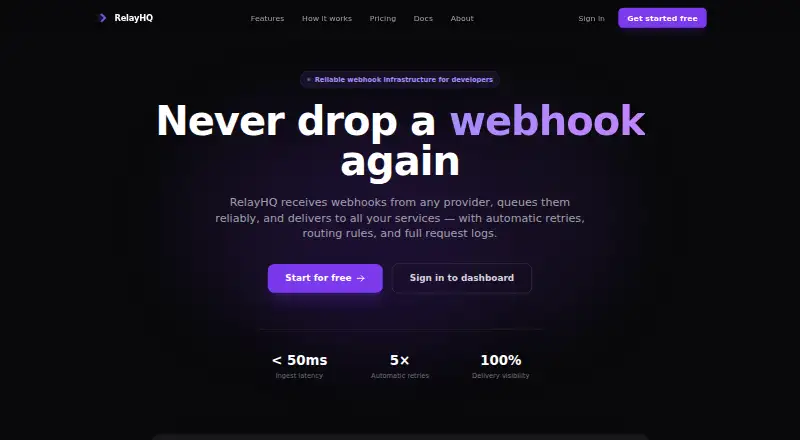
RelayHQ suits workflows that need one webhook entry point, filtering, fanout to several services, request inspection, and replay. Its advertised ingest acknowledgement is below 50 milliseconds.
Watch for
The Free plan has three endpoints, 500 requests per month, one destination per endpoint, 24-hour logs, a 256 KB body limit, 60 requests per minute, and no automatic retries or routing rules. Paid plans increase these limits.
Log retention varies by plan: seven days on Free, 30 on Starter, 90 on Pro, and one year on Team. Check body limits, request volumes, rate limits, and retention before choosing a plan.
RelayHQ states that transmitted data uses TLS 1.2 or newer, API keys are hashed before storage, and passwords use bcrypt. It says webhook payloads are used only to deliver them to configured destinations and that personal information is not sold. The terms target 99.9% monthly uptime for the ingest layer, with higher paid-plan targets.
Pricing
RelayHQ has a free plan at $0/mo. It includes three endpoints, 500 requests per month, one destination per endpoint, 24-hour log history, and a 256 KB body limit.
Starter costs $29/mo, or $23/mo billed annually. Pro is $79/mo, or $63/mo billed annually. Team is $199/mo, or $159/mo billed annually. Higher plans add capacity, longer logs, more destinations, retries, routing, support, and business controls.
Starter includes 10 endpoints and 50,000 requests per month. Pro includes unlimited endpoints, 500,000 requests per month, five seats, priority email support, and a 99.9% SLA. Team includes unlimited requests and seats, SAML 2.0/Okta SSO, audit logs, dedicated Slack support, custom retention, invoice billing, and a 99.95% SLA.
Verdict
Choose RelayHQ if your systems depend on webhooks and you want hosted queues, permanent URLs, filtering, fanout, inspection, and replay without running message-broker infrastructure. The local tunnel and REST API also fit development workflows.
The free tier is suitable for small volumes and basic forwarding, but it omits automatic retries and routing. Teams should compare the plan limits, retention periods, body sizes, support options, and uptime commitments with their operational needs before committing.
Our take
RelayHQ is a sensible choice for teams that need a managed place to receive and route webhook traffic. It combines permanent endpoints with filtering, fanout, request inspection, and replay, while its API and local tunnel cover programmatic and development use. The free plan can handle small experiments, but its low volume, short log history, and lack of retries or rules are meaningful limits. Starter, Pro, and Team add capacity and operational features at clearly stated monthly or annual prices. Choose a higher tier when retention, support, access control, or uptime commitments matter.
- Permanent inbound webhook URLs
- Fanout to multiple destinations
- Routing rules for JSON paths and headers
- Manual replay and delivery inspection
- REST API and local-development CLI
- Free plan has no automatic retries or routing rules
- Free tier allows 500 requests per month
- Log retention ranges from 7 days to one year
- CLI requires Node.js 18 or newer
- Pick it ifDevelopers routing provider webhooks to several services; Teams needing retries, logs, replay, and routing
- Skip it ifYou need more than 500 Free-plan requests per month; You require long log retention or team controls at no cost
Pricing
A free $0/mo tier is available.
- Free$0/mo · 3 endpoints · 500 requests/month · 1 destination per endpoint · 24-hour log history · 256 KB body · 60 req/min · no auto-retry · no routing rulesFree
- Starter$29/mo; or $23/mo billed annually · 10 endpoints · 50,000 requests/month · 3 destinations/endpoint · 30-day logs · 5 retries · conditional routing · Slack/email alerts · 1 MB body · 600 req/min$29/mo
- Pro$79/mo; or $63/mo billed annually · Unlimited endpoints · 500,000 requests/month · unlimited destinations · 90-day logs · 5 seats · unlimited routing · 5 MB body · priority email support · 99.9% SLA$79/mo
- Team$199/mo; or $159/mo billed annually · Unlimited requests · unlimited seats · 1-year logs · SAML 2.0/Okta SSO · audit log · 10 MB body · custom rate limits · dedicated Slack support · 99.95% SLA · custom retention · invoice billing$199/mo
As relayhq.org lists them, checked 15 Oct 2026.
Questions
Does RelayHQ have a free plan?
Yes. Free costs $0/mo and includes three endpoints, 500 requests per month, one destination per endpoint, and 24-hour log history.
Which webhook providers are named?
RelayHQ names Stripe, GitHub, and Shopify as webhook sources.
Can RelayHQ send one webhook to several services?
Yes. A webhook can be forwarded to multiple configured destinations at the same time.
Does it retry failed deliveries?
Paid plans can retry failed deliveries up to five times with increasing delays. The Free plan has no automatic retries.
Can I replay an old request?
Yes. Requests can be replayed from the dashboard or through the replay API endpoint.
Is there an API?
Yes. RelayHQ documents a REST API at api.relayhq.org. Calls use workspace-scoped bearer API keys.
What does the local CLI require?
The CLI works on macOS, Linux, and Windows and requires Node.js 18 or newer.
How long are webhook logs kept?
Retention is seven days on Free, 30 days on Starter, 90 days on Pro, and one year on Team.