
Rudder software review
rudder.io · checked 14 Oct 2026
Infrastructure security automation for cloud, on-premises and hybrid environments, with an open-source core.
How it plugs in
Signal on IT Automation Software7.6#5 of 77
Rudder oversees configuration, patching, vulnerability assessment and compliance on Linux and Windows. It can inspect settings or continually repair drift, with dashboards, inventory-based groups and a public REST API. Rudder is self-hosted and open source, with free and paid per-node plans. Paid tiers extend the offering with patch and vulnerability management, compliance capabilities, support and service commitments.
Review
In a line
Rudder is an infrastructure security automation platform for managing and securing IT systems in cloud, on-premises and hybrid environments. It runs as self-hosted software with agents on managed machines.
What it does
Rudder checks system settings in audit mode or keeps correcting unwanted changes in enforce mode. You can set that behavior globally, for a system, or for an individual configuration.
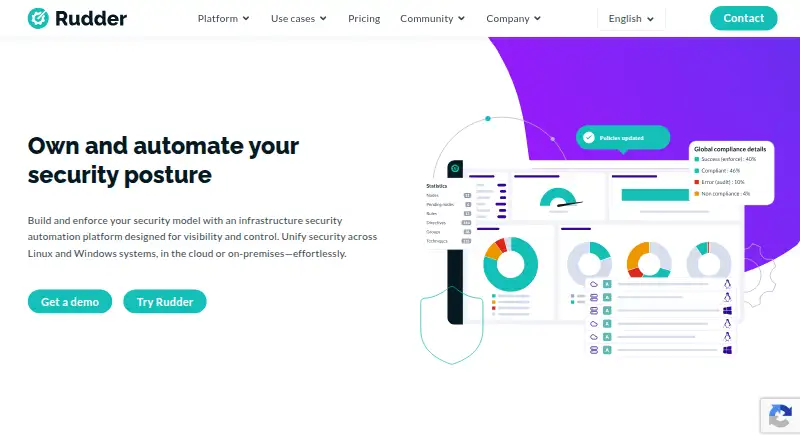
Its live dashboards and Rudder Score summarize system health, security and compliance. Agents collect hardware, network, operating-system and installed-software details, which can drive targeting rules and place newly discovered machines in dynamic groups.
The platform checks operating-system and application updates, evaluates CVEs, provides filterable vulnerability data via its API and can start patching or remediation campaigns. Ready-made CIS benchmark material, configurable policies and OpenSCAP audit collection are included. Configurations can be built graphically or in YAML, reused as modules and rolled out in stages. Agents continue enforcing the desired state during network outages and report back after reconnecting.
How it connects
Rudder supports Linux and Windows systems in cloud or on-premises infrastructure, and its feature list includes Raspberry Pi agents. Core packages support Debian, Ubuntu, RHEL-like systems, SLES and Amazon Linux; subscription agents also support Windows Server and Windows 10/11.
The public Rudder codebase is licensed under GPLv3, while an exception allows either proprietary or open-source plugins. Rudder can stay installed on your premises so infrastructure data remains there.
A documented REST API authenticates with API keys sent in an X-API-Token header. Through it, you can work with nodes, groups, directives, rules, parameters, techniques, compliance and change requests. Version 9.1 removed the old command-line and Python client; the project points users to OpenAPI-generated clients or standard HTTP tooling.
Listed integrations include Centreon, Consul, ELK, GLPI, OpenSCAP, Vault, Zabbix, Ansible AWX, iTop and Rundeck. TLS 1.3 encrypts communications, and agents and the server or relay authenticate each other with certificates.
Good fit
Rudder fits teams seeking centralized control of configuration, patching, vulnerabilities and compliance across mixed infrastructure. It can target machines from inventory data, apply policies continuously and stage changes across larger environments.
It is also a fit for organizations that want self-hosting, open-source code, CIS or SecNumCloud audits, and API access for their own tools.
Watch for
The platform needs a current browser, OpenJDK 17 or later, and PostgreSQL 13 or later. During an agent run, documentation estimates around 90 MB of memory, a few kilobytes of network traffic and roughly 100 MB of disk space.
Paid licenses are charged per node, and the maker says onboarding, training, setup and optional integrations can add costs. Monthly plans may have initial fees and node limits.
G2 reviewers report limited reporting or analytics depth and restricted role or permission customization. Check those areas if detailed reporting or finely tuned access controls matter to your team.
Pricing
Rudder Core is free and open source. A free trial is also available.
Starter - Essential is $4 per node each month for security configuration management below 500 nodes, with an initial fee. Security Suite - Premium is $23 per node each month and includes security configuration management, patch and vulnerability management, policy and benchmark compliance, and a premium SLA; it also has an initial fee.
Annual choices include Starter - Essential at $40 per node, Security Suite - Standard at $200 per node, and Security Suite - Premium at $225 per node. The yearly plans differ in node limits, included features and service terms.
Enterprise and Corporate Security Suite have annual per-node licenses priced on request. Enterprise includes unlimited standard support; Corporate adds all Rudder solutions, unlimited premium support and a dedicated customer success manager.
Verdict
Choose Rudder when you need policy-based control of Linux and Windows machines and want audit and enforcement modes in the same self-hosted system. Its inventory, staged rollouts, vulnerability work and compliance content provide several operations capabilities within the platform.
The free core edition gives open-source users a starting point, while paid tiers add patching, compliance packages and support. Confirm database, Java and browser requirements, API-client plans and reporting needs before signing a contract. Organizations wanting vendor-managed hosting or highly customizable reporting should evaluate those requirements separately.
Our take
Rudder is a practical choice for teams managing mixed Linux and Windows fleets that need continuous configuration control, patch campaigns and compliance checks. The open-source core and self-hosted model suit organizations that must keep infrastructure data on site. Paid tiers make sense when you need vulnerability management, benchmark content, service-level terms or premium support. Budget for per-node licensing and possible onboarding or setup fees. Before buying, verify that its reporting depth, permission controls and technical prerequisites fit your environment.
- Open-source core with a free plan and free trial
- Audit or continuously enforce settings at several scopes
- Patch, CVE and compliance features in one platform
- Public REST API and many listed integrations
- Self-hosted support for cloud and on-premises systems
- Paid plans are charged per node and may have initial fees
- OpenJDK 17 or later and PostgreSQL 13 or later are required
- Reviewers report limited reporting and analytics depth
- Role and permission customization may be restricted
- The former CLI and Python SDK were removed in version 9.1
- Pick it ifTeams operating mixed Linux and Windows fleets; Organizations needing self-hosted compliance and configuration control; Buyers wanting open-source software with paid support tiers
- Skip it ifYou need vendor-hosted deployment instead of self-hosting; You require highly customizable reporting or permissions; Per-node licensing and possible setup fees do not fit your budget
Pricing
Rudder Core is free and open source. Paid plans use per-node billing, either monthly or yearly, and some carry initial fees. Enterprise and Corporate Security Suite use annual per-node pricing on request; onboarding, training, setup and optional integrations may cost extra.
- Rudder CoreOpen source softwareFree
- Rudder Starter - Essential (Monthly)per node · Security Configuration Management · under 500 nodes · initial fees apply$4/mo
- Rudder Security Suite - Premium (Monthly)per node · Security Configuration Management · Patch and Vulnerability Management · Policy and Benchmark Compliance · Premium SLA · initial fee applies$23/mo
- Rudder Starter - Essential (Yearly)per node · Security Configuration Management · enterprise features · under 500 nodes · 1 production and 2 non-production instances$40/yr
- Rudder Security Suite - Standard (Yearly)per node · Security Configuration Management · Patch and Vulnerability Management · Policy and Benchmark Compliance · under 2,000 nodes$200/yr
- Rudder Security Suite - Premium (Yearly)per node · Security Configuration Management · Patch and Vulnerability Management · Policy and Benchmark Compliance · Premium SLA$225/yr
- Rudder Enterpriseannual per-node license · Linux and Windows · Security configuration management · Choose Patch & vulnerability management or Policy & benchmark compliance · Unlimited standard support · Security patches for 18 months · 6-month update windowOn request
- Rudder Corporate Security Suiteannual per-node license · Includes Enterprise and all Rudder solutions · Unlimited premium support · Guaranteed fix or workaround times · Security patches for 24 months · 9-month update window · Dedicated customer success managerOn request
As rudder.io lists them, checked 30 Sept 2026.
Questions
Is Rudder open source?
Yes. Rudder Core is free and open source under GPLv3, with an exception allowing proprietary or open-source plugins.
What operating systems does Rudder support?
Core packages support Debian 12/13, Ubuntu 24.04, RHEL-like 9/10, SLES 15 SP6+ and Amazon Linux 2023. Subscription agents also support Windows Server and Windows 10/11.
Does Rudder have an API?
Yes. Its documented REST API accepts API keys in an X-API-Token header and supports node, group, directive, rule, parameter, technique, compliance and change-request operations.
Can Rudder manage patches and vulnerabilities?
The platform checks operating-system and application updates, evaluates CVEs, provides filterable reports through its API and can start patch or remediation campaigns.
Can Rudder run on premises?
Yes. Rudder is self-hosted and can be installed on premises so infrastructure data remains physically on site.
How is Rudder priced?
Rudder Core has no charge. Paid plans bill per node: Starter and Security Suite offer monthly or annual options, while Enterprise and Corporate pricing is available on request.
Near it
All alternatives →- C
 CFEngine#4 on this board
- P
 PatchMon#6 on this board
- O
 OPSI#3 on this board
- CM
 Canonical MAAS#7 on this board
- RRundeck#2 on this board
- U
 Uyuni#8 on this board
- P
 Puppet#1 on this board
- MM
 ManageEngine Mobile Device Manager Plus#9 on this board
- MP
 ManageEngine Patch Manager Plus#10 on this board
- CI
 Chef Infra#11 on this board