
Sigstore Software Review
sigstore.dev · checked 15 Oct 2026
Open-source signing and verification for software artifacts and supply-chain records.
How it plugs in
Signal on Code Signing Software7.7#1 of 28
Sigstore helps developers sign and check release files, container images, binaries, software bills of materials, and attestations at no cost. It uses short-lived keys, identity checks, and a public tamper-resistant log. It runs through web, API, Linux, macOS, Windows, and self-hosted setups, with CI tools and language clients.
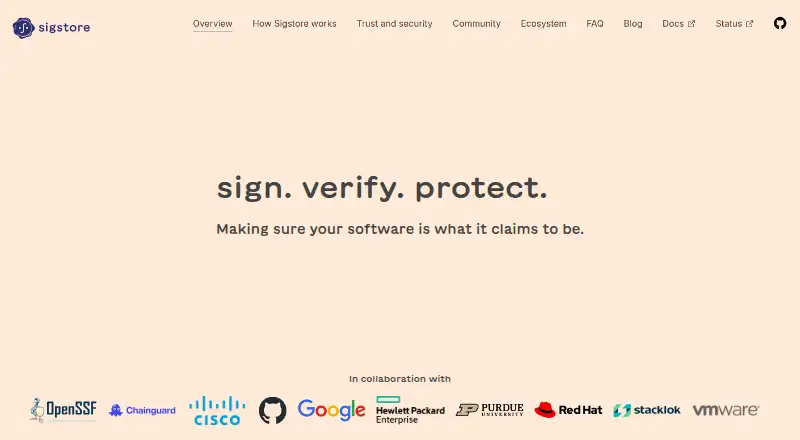
Review
In a line
Sigstore is an open-source project that helps improve software supply-chain security by signing and verifying software artifacts. It is available through web, API, Linux, macOS, Windows, and self-hosted deployments.
What it does
Developers can use it to sign and verify release files, container images, binaries, software bills of materials, and other artifacts. Cosign handles signatures for containers and other files, while the Policy Controller can require valid container signatures or attestations before Kubernetes deployment.
Signing uses short-lived keys, so users do not manage permanent private keys. OpenID Connect links a signing event to an email address, service account, or CI workflow. Verification checks the signature, certificate identity, trust root, and proof that the event appears in Rekor's public log.
How it connects
The open-source Sigstore project brings together Cosign, Fulcio, Rekor, OpenID Connect, and Policy Controller. GitHub Actions can install Cosign and create signatures, and GitLab CI installation is documented. Language clients are officially available for Go, Java, JavaScript, Python, Ruby, and Rust.
Fulcio issues temporary certificates, and Rekor stores signed metadata and attestations in a searchable ledger. Sigstore documents client APIs and supports self-hosting the full stack in Kubernetes, including KinD, with Google Cloud Terraform modules. Cosign can also use privately operated services and custom trust roots.
Its code uses the Apache License 2.0. Cosign offers no promise of API stability, does not follow semantic versioning, and is not recommended for application integration because of its dependencies. Interfaces are marked Experimental, Beta, or Generally Available, with different deprecation notice periods.
Good fit
Sigstore suits developers, software providers, and teams that need artifact signing, provenance attestations, SBOM handling, build provenance, or release policy gates. It fits CI workflows, package-manager and registry workflows, and Kubernetes deployments.
Watch for
The public staging environment has no service-level objective guarantees and weaker protection for its TUF root key. Documentation says not to use it in production.
Valid-looking provenance does not prove that software is safe. A reported 2026 npm supply-chain attack involved a compromised maintainer token and malicious dependency code despite Sigstore provenance badges.
Check API maturity before building an application around Cosign. Also review current client requirements; one Go client release rolled back to a commit requiring Go 1.25.0, while a planned later release was to require Go 1.27.0.
Pricing
Sigstore is free to use for all developers and software providers. The public-good service includes the public Fulcio certificate authority, public Rekor transparency log, and public OpenID Connect issuer.
Verdict
Choose Sigstore if you need free signing and verification across artifacts, CI pipelines, registries, or Kubernetes and want open-source code with self-hosting options. Its identity-based, short-lived-key model reduces private-key administration, while Rekor provides an audit trail.
Do not treat a valid Sigstore record as proof that code is harmless, and avoid the public staging service for production. Teams embedding Cosign into an application should first assess its unstable API policy and dependency requirements.
Our take
Sigstore is a practical choice for teams that want no-cost artifact signing, identity-linked records, and public transparency without maintaining long-lived signing keys. It covers common supply-chain items and supports CI, package tooling, Kubernetes controls, and self-hosted installations. The main caution is scope: provenance confirms how a record was signed, not whether the underlying code is safe. Production users should also avoid the staging environment and account for changing interface maturity, especially when integrating Cosign directly into an application.
- Free for developers and software providers
- Open-source projects under the Apache License 2.0
- Short-lived keys reduce private-key management
- Public Rekor log supports audit checks
- Supports CI, Kubernetes, SBOMs, and attestations
- Cosign's interface offers no API stability guarantees
- Public staging is not for production use
- Valid provenance does not prove code is safe
- Self-hosting requires Kubernetes or related infrastructure
- Pick it ifTeams signing releases, containers, binaries, and SBOMs; CI and Kubernetes supply-chain controls; Organizations wanting open-source or self-hosted tooling
- Skip it ifYou need a stable Cosign API for direct application integration; You expect provenance alone to prove software is safe; You plan to use Sigstore's public staging service in production
Pricing
The service and its public Fulcio, Rekor, and OpenID Connect components are free, with no paid plan listed in the facts.
- Freefree to use for all developers and software providersFree
- Public-good Sigstore servicePublic Fulcio certificate authority · Public Rekor transparency log · Public OIDC issuerFree
As linuxfoundation.org lists them, checked 30 Sept 2026.
Questions
What is Sigstore used for?
It provides signing and verification for release files, container images, binaries, software bills of materials, attestations, and other software artifacts.
Does Sigstore cost anything?
No. Sigstore is free for developers and software providers, including its public Fulcio, Rekor, and OpenID Connect services.
Does Sigstore require managing private keys?
Its normal workflow uses short-lived signing keys, reducing the need to manage permanent private keys.
Can Sigstore work with GitHub Actions?
Yes. Sigstore publishes a Python signing action and a Cosign installer action for CI workflows.
Can Sigstore be self-hosted?
Yes. It provides Kubernetes scaffolding, including KinD, Google Cloud Terraform modules, and options for private services and custom trust roots.
Is Sigstore provenance proof that software is safe?
No. A valid-looking provenance record can still accompany software published after a compromised account or malicious dependency change.
Is Cosign's API stable?
Cosign provides no assurance of a stable API. It also does not use semantic versioning and is not recommended for application integration because of its dependencies.