File Integrity Monitoring Software
Vigil Baseline: Linux File-Integrity Monitor
github.com · checked 7 Oct 2026
Linux desktop tool for detecting changes to monitored files.
How it plugs in
Signal on File Integrity Monitoring Software6.3#7 of 34
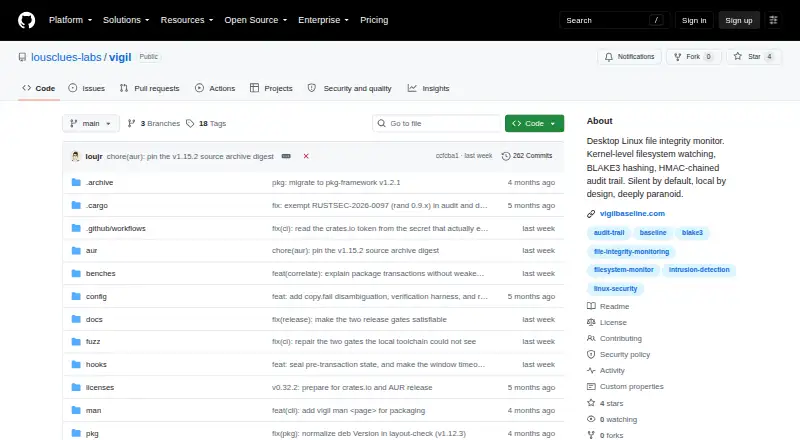
Vigil Baseline provides free, on-premises file-integrity monitoring for a single Linux desktop or laptop. It creates a trusted baseline, observes filesystem activity, and reports modifications to monitored files. File hashes use BLAKE3, while chained audit records help preserve a change history. The tool neither blocks, quarantines, nor terminates processes, and it lacks fleet management and centralized reporting.
Review
In a line
On one Linux desktop, Vigil Baseline watches selected files and reports modifications. It is free software for desktop Linux distributions including Arch, Debian, Ubuntu, and Fedora.
What it does
Vigil creates a trusted snapshot with file hashes, permissions, ownership, inode details, capabilities, extended attributes, and SELinux or AppArmor context. Filesystem activity is then checked against that reference.
Linux fanotify provides the primary event stream, with inotify available as a fallback. FID-capable Linux 5.1 and later kernels receive real-time coverage across event classes; some event types on older kernels are found by scheduled scans.
Until a monitored file is altered, the monitor remains quiet. Optional notify-send support can display desktop notifications. A crash-safe write-ahead log and an HMAC-linked audit log record the resulting changes.
How it connects
The project runs on premises and reports no network calls, telemetry, or automatic updates. Its only integration points are a signal socket and webhook; both start disabled and send data outward only if enabled.
Signed packages and repository metadata accompany package-manager updates. After repository setup, apt or dnf can install the vigil-baseline package.
Source code is available under GNU GPL v3.0 only, or under a commercial license for proprietary use.
Good fit
Vigil targets a single person overseeing file integrity on a Linux desktop or laptop. The maker lists Arch, Debian, Ubuntu, Fedora, and similar desktop distributions as supported.
It can document unexpected file modifications locally without telemetry or a central service. Interactive welcome configuration takes about ninety seconds and may be safely rerun.
Watch for
Vigil is not an EDR. It cannot terminate processes, quarantine files, or prevent execution, so detected changes receive no automatic containment.
Its scope is one Linux desktop rather than servers, headless hosts, containers, Kubernetes, fleets, multi-tenant systems, or remote control. Fleet administration and centralized reporting are not provided.
Check kernel support and response requirements before selecting it. Scheduled scans cover some event types on older kernels, and integrations stay off until enabled.
Pricing
Vigil Baseline is free. Most users receive the software under GPL v3.0, while proprietary use can use a commercial license.
There is no free trial because the software itself is free.
Verdict
Choose Vigil Baseline when a single Linux desktop needs a local record of file changes and you prefer no telemetry or automatic network activity. Signed packages, detailed baselines, and chained logs aid auditing.
Do not choose it for centralized oversight, many machines, server environments, or automatic containment.
Our take
For one Linux desktop user, Vigil Baseline combines local file-change alerts with an audit trail and no telemetry or automatic updates. GPL licensing keeps the standard offering free, with a commercial route for proprietary use. Its deliberate limits are one machine, no central reporting, and no process blocking or quarantine. Kernel age influences discovery speed for some event types. Pick it for desktop integrity checks; look elsewhere for server coverage, fleet control, or automated incident response.
- Free GPL v3.0 plan, with a commercial license option
- Real-time file-change alerts on supported Linux 5.1+ kernels
- BLAKE3 hashes and HMAC-chained audit logs
- No telemetry, auto-updates, or network calls
- Signed packages and repository metadata
- Limited to one Linux desktop or laptop
- No process killing, quarantine, or execution blocking
- No fleet management, central reporting, or remote control
- Older kernels use scheduled scans for some event types
- Pick it ifOne person monitoring file integrity on a Linux desktop; Arch, Debian, Ubuntu, Fedora, or similar desktop systems; Local auditing without telemetry or network activity
- Skip it ifYou need servers, containers, Kubernetes, fleets, or multi-tenant coverage; You require central reporting or remote control; You need automatic process blocking or quarantine
Pricing
Vigil Baseline is free under GPL v3.0 for most users. A commercial license is available for proprietary use.
- Vigil BaselineGPL v3.0 for most users · commercial license available for proprietary useFree
As github.com lists them, checked 7 Oct 2026.
Questions
What does Vigil Baseline monitor?
On one Linux desktop, it monitors files, compares activity with a trusted baseline, and reports changes.
Which Linux systems are supported?
The project names desktop distributions including Arch, Debian, Ubuntu, Fedora, and similar Linux desktops.
Does Vigil Baseline stop threats automatically?
No. It cannot terminate processes, quarantine files, or block execution, and the project does not describe it as an EDR.
Does it send telemetry or make network calls?
The project says it has no telemetry, automatic updates, or network calls. A signal socket and webhook are available, but each is disabled by default.
How much does Vigil Baseline cost?
It is free under GPL v3.0 for most users. A commercial license is available for proprietary use.
Can I manage many computers with Vigil?
No. It targets one Linux desktop or laptop and does not provide fleet management, central reporting, or remote control.
Near it
All alternatives →- KEKaspersky Endpoint Security for Business#6 on this board
- SSamhain#8 on this board
- PF
 PA File Sight#5 on this board
- EFEventSentry File Monitoring#9 on this board
- PP
 Paessler PRTG Network Monitor#4 on this board
- FFileAudit#10 on this board
- AAvidemux#3 on this board
- ES
 Elastic Security#11 on this board
- O
 OSSEC#2 on this board
- F
 FIM#12 on this board