Allure Report: Open-Source Test Reporting
allurereport.org · checked 14 Oct 2026
Open-source test reporting that turns execution data into interactive HTML views.
How it plugs in
Signal on Test Analytics Software7.7#1 of 30
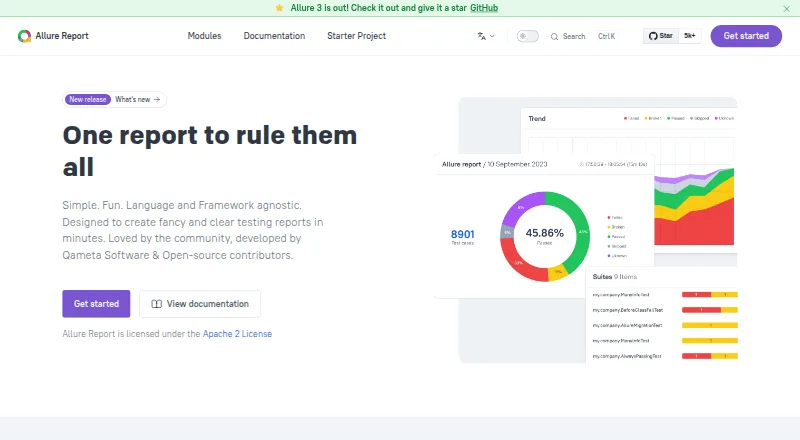
Allure Report turns test-run data into interactive HTML pages for examining results. Unit, API, and end-to-end tests are supported, with steps, attachments, timings, logs, screenshots, history, retries, charts, and flaky-test analysis. Reports are static sites that can run locally, be archived, or served from a web server.
Review
In a line
Allure Report is free, open-source software that transforms test execution data into interactive HTML pages. It is developed by Qameta Software with help from the open-source community.
What it does
Test integrations place result files in an allure-results folder. Allure's command-line utility reads those files and produces a report for browser viewing or web-server hosting.
Reports can show named test steps, screenshots, logs, videos, other attachments, timings, and metadata. They also connect retries and earlier runs, display status history, and provide charts, trends, filtering, and sorting.
Allure can compare runs to identify unstable tests and group flaky failures. Allure 3 adds rerun grouping, reports covering multiple environments, real-time reporting, quality gates, CSV export, process-level error capture, and combining data from several pipeline stages.
How it connects
More than 50 testing tools and frameworks are represented in the integrations directory. Documentation covers more than 30 frameworks across JavaScript, Java, Python, .NET, and other languages, with support spanning eleven programming languages.
Connections documented for the product include Jenkins, GitHub Actions, Azure DevOps, JetBrains IDEs, Visual Studio Code, Bamboo, and TeamCity. Framework APIs can add steps, attachments, test groupings, metadata, and other report details.
Reports are static HTML, so they can stay on a local machine, be archived, or be published through a web server or CI system. Test collection and report creation can both happen locally, with no network transmission required.
Allure Report Storage is a free service under Apache-2.0 that can run in a Docker container or as a Cloudflare Worker. Allure 3 also supports configurable plugins and additional npm plugins.
Good fit
Automation QA, manual QA, developers, and project managers can use the reports to inspect failures and share test results.
Teams seeking a unified view of unit, API, and end-to-end tests may benefit, particularly when they need history, retry details, trend charts, or flaky-test tracking.
The software runs through official installations for Windows, macOS, Linux, and Node.js on any system. Self-hosted deployment keeps generated reports under your control.
Watch for
Allure creates reports from structured result files produced by integrations, so your test framework needs a supported integration or a way to write that data.
Java build requirements vary: Maven requires JDK 17 or later plus Maven 3.1.1 or later, while Gradle requires Gradle 8.11 or later together with Java 17 or later. Allure Java 3 requires Java 17 or later; its Karate and jOOQ modules require Java 21 or later.
Allure Report is separate from the paid Allure TestOps product. Check whether your team needs only report generation or a different product scope.
Pricing
Allure Report is free and released under the open-source Apache-2.0 license. The free plan supports local or self-hosted report generation.
Because the product is free, no trial period is offered. Allure TestOps is a separate paid product.
Verdict
Choose Allure Report if you want shareable browser reports from automated tests without sending collected data to an outside service. Its broad framework coverage, run history, attachments, visual trends, and flaky-test views cover common failure-analysis needs.
It is a weaker fit when your tools cannot produce Allure result files, or when your team needs a hosted product rather than static HTML that you operate. Review the Java and build-tool requirements before adopting those integrations, and separate the free report generator from Allure TestOps when comparing products.
Our take
Allure Report makes sense for teams that want an open-source way to turn test runs into pages people can inspect and share. It covers many frameworks and can keep processing on local or self-hosted systems. Historical results, retry links, trend charts, and unstable-test detection add useful context beyond a single pass-or-fail view. Plan for integration setup and the stated Java or build-tool versions. Teams seeking a managed service or features outside report generation should evaluate whether the separate Allure TestOps product is the right scope.
- Free, Apache-2.0-licensed open-source project
- Handles unit, API, and end-to-end test reports
- Shows history, retries, attachments, charts, and flaky tests
- Runs locally or as self-hosted static HTML
- Connects with more than 50 testing tools and frameworks
- Requires supported integrations or structured Allure result files
- Some Java integrations require newer Java and build-tool versions
- Reports are static HTML that your team must host or share
- Allure TestOps is a separate paid product
- Pick it ifTeams needing self-hosted reports across many test frameworks; QA, developers, and managers reviewing failures and test trends; Projects tracking retries and unstable tests over time
- Skip it ifYour test tools cannot produce Allure result data; You need a managed hosted service instead of static HTML; You are comparing a full test-management product rather than reporting
Pricing
The report generator is free and open source, with local or self-hosted use. No trial period is provided, and Allure TestOps is a separate paid product.
- Allure Reportopen-source test-report generation · self-hosted/local operation · Allure TestOps is separate paid productFree
As testomat.io lists them, checked 14 Oct 2026.
Questions
Is Allure Report free?
Yes. Allure Report offers a free plan and uses the Apache-2.0 open-source license.
What tests can it report?
Integrations let it report on unit, API, and end-to-end tests across many frameworks.
Where can reports run?
Generated reports are static HTML websites that you can open in a browser, keep locally, archive, or serve from a web server.
Does Allure detect flaky tests?
Yes. Comparing runs reveals unstable tests and lets the report categorize flaky failures.
Can it work with CI systems?
Documentation lists integrations for Jenkins, GitHub Actions, Azure DevOps, Bamboo, and TeamCity.
Does it send test data online?
Test collection and report generation can run locally without sending data over the network.
What is Allure TestOps?
Allure TestOps is a separate paid product; Allure Report itself is the free report-generation project.