Auphonic: Automated Audio Post-Production
auphonic.com · checked 14 Oct 2026
Automated post-production for spoken audio and related recordings.
How it plugs in
Signal on AI Podcast Editing Software6.7#1 of 26
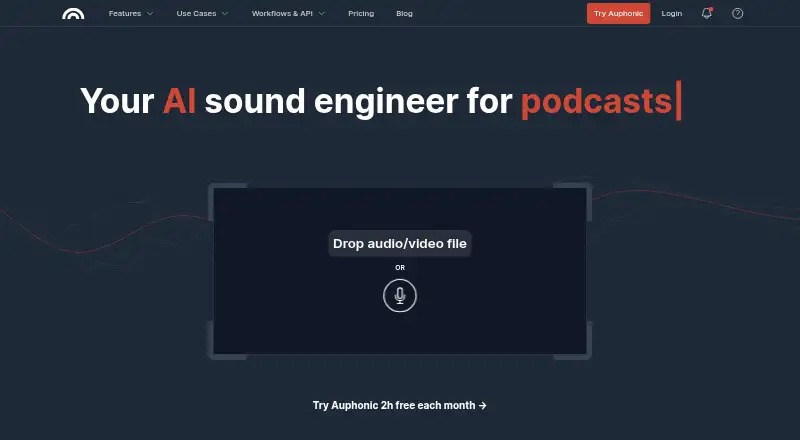
Auphonic is a web-based service for cleaning, balancing and publishing recordings. It handles noise, reverb, loudness and filler-word removal, with multitrack mixing, speech-to-text, chapters and subtitles. It connects to storage, hosting and automation services, offers an API and CLI, and has a free plan with limits.
Review
In a line
Auphonic automatically post-processes material such as podcasts, broadcasts, radio programs, interviews, audiobooks and lectures. It operates online and provides command-line tools for several platforms.
What it does
Auphonic combines noise and reverb reduction with speaker leveling, filtering, enhancement, loudness-target compliance and automatic removal of filler words, coughs and silence. Its Intelligent Leveler keeps speech, music and multiple speakers in balance automatically.
For multitrack projects, it can create an optimized mixdown using automatic ducking, noise gates and microphone-bleed removal. Audio and video inputs can be turned into encoded files carrying metadata and chapters.
Speech features offer multilingual transcripts, automatic shownotes and chapters, together with a shareable transcript editor. Other outputs include waveform audiograms and styled subtitles burned into video.
How it connects
Auphonic connects with FTP, SFTP, Dropbox, Google Drive, OneDrive, Amazon S3, YouTube, Libsyn, Spreaker, SoundCloud, PodBean, Zapier, n8n and several speech-recognition services. It can publish finished files automatically.
For automation, it offers watch folders, batch productions, webhooks and a REST API with Simple API and full JSON API options. The API accepts API keys, HTTP Basic Authentication or OAuth 2.0.
A free command-line interface provides dependency-free binaries for Linux, macOS and Windows. It handles common audio and video formats and can export MP3, Opus, AAC/MP4, Ogg Vorbis, ALAC, FLAC and WAV.
Good fit
Auphonic serves producers of podcasts, radio, interviews, audiobooks, lectures and other spoken-word material seeking automated cleanup and consistent loudness.
It is also useful for multitrack sessions, recurring publishing workflows and teams that need transcripts, chapters, subtitles or connections to storage and hosting services.
Watch for
Free accounts support multitrack productions under 20 minutes, while multilingual speech recognition, automatic shownotes and chapters, watch folders and batch productions are unavailable. Free productions carry an Auphonic jingle.
Charges use processed audio duration, with at least three minutes billed for each production. Auphonic does not provide a free trial.
Audio and API productions are normally deleted after 21 days; video productions are deleted after seven days. Data is primarily hosted in Germany, while Cloudflare R2 handles media storage and delivery.
Pricing
Auphonic Free costs nothing and includes two hours of processed audio each month, AI algorithms and the jingle applied to free productions.
Monthly recurring options provide 9 hours for $11 (S), 21 hours for $24 (M), 45 hours for $49 (L), 100 hours for $99 (XL) or 250 hours for $290 (XXL). Recurring allowances reset monthly; XXL credits that go unused do not roll over.
Annual options are Auphonic S at $132, Auphonic M at $300, Auphonic L at $624 and Auphonic XL at $1356. Each provides its stated monthly allowance and yearly billing saves 20%. Business pricing is on request and includes priority processing, priority support, team accounts and custom contracts.
Verdict
Auphonic suits workflows that need repeatable cleanup, loudness control or publishing links without manual adjustment of every recording. Its API, CLI, batch tools and storage connections also fit automated production setups.
Check the free-plan exclusions, three-minute billing minimum and short file-retention periods before committing. If you need included speech recognition or batch features, budget for a paid plan. The free tier is mainly suited to shorter multitrack jobs and occasional processing.
Our take
Auphonic is a practical choice for spoken-word producers who want automatic leveling, noise and reverb reduction, loudness targets and publishing connections. Its multitrack tools, transcripts, subtitles, API and CLI cover both one-off and recurring workflows. The free plan gives two hours monthly but omits several automation and speech features, while paid plans charge by processed time and delete files after a set period. Pick it when those limits fit your workflow; look elsewhere if you need a free trial or longer retention.
- Automated noise, reverb, leveling and loudness processing
- Multitrack mixdowns with ducking, noise gates and bleed removal
- Speech-to-text, shownotes, chapters and subtitle support
- Developer API, command-line tools, watch folders and batch workflows
- Connections to storage, hosting and workflow services
- Free plan excludes speech recognition, shownotes, chapters and automation tools
- No free trial
- Three-minute minimum charge per production
- Files are normally deleted after 21 days for audio and seven for video
- Only the XXL plan states that unused credits expire
- Pick it ifPodcast and spoken-word production; Automated publishing and batch workflows; Teams needing transcripts, chapters or subtitles
- Skip it ifYou need a free trial or retention beyond the stated deletion periods; You require included automation and speech features on the free plan; Your jobs are shorter than three minutes but still incur the minimum charge
Pricing
A free plan includes two hours monthly. Paid allowances range from 9 to 250 hours per month, with monthly or annual billing; yearly plans state 20% savings. Business pricing is custom.
- Auphonic Freefree · 2 hours processed audio per month · AI algorithms · free productions include Auphonic jingleFree
- S Recurring$11/month · 9 hours per month · no jingle · credits reset monthly$11/mo
- Auphonic Smonthly · 9 h/month · credits reset monthly · unused credits do not roll over$13/mo
- M Recurring$24/month · 21 hours per month · no jingle · credits reset monthly$24/mo
- Auphonic Mmonthly · 21 h/month · credits reset monthly · unused credits do not roll over$30/mo
- L Recurring$49/month · 45 hours per month · no jingle · credits reset monthly$49/mo
- Auphonic Lmonthly · 45 h/month · credits reset monthly · unused credits do not roll over$64/mo
- XL Recurring$99/month · 100 hours per month · no jingle · credits reset monthly$99/mo
As auphonic.com lists them, checked 14 Oct 2026.
Questions
Does Auphonic have a free plan?
Yes. The free tier provides two hours of processed audio per month, AI algorithms and an Auphonic jingle on free productions.
What does the free plan leave out?
Free accounts do not include multilingual speech recognition, automatic shownotes and chapters, watch folders or batch productions. Multitrack productions must be under 20 minutes.
How does Auphonic charge for processing?
Processing is billed by audio duration, with a three-minute minimum for each production. Recurring allowances reset monthly; only the XXL plan specifies that unused credits do not roll over.
Which services can Auphonic connect to?
Supported services include Dropbox, Google Drive, OneDrive, Amazon S3, YouTube, Libsyn, Spreaker, SoundCloud, PodBean, Zapier, n8n, FTP and SFTP.
How long are files kept?
Productions and related media are normally deleted after 21 days for audio and API productions and after seven days for video productions.
Does Auphonic provide an API?
Yes. Its REST offering includes Simple API and full JSON API options, authenticated with API keys, HTTP Basic Authentication or OAuth 2.0.