
Bucketeer: Open-Source Feature Flags and Experiments
bucketeer.io · checked 15 Oct 2026
Open-source feature flags and experimentation for controlled software releases.
How it plugs in
Signal on Feature Flag Software7.7#1 of 27
Bucketeer is a free, open-source platform for feature flags, release targeting, and experiments. It runs on Android, iOS, Linux, the web, or your own infrastructure. You can schedule rollouts, split audiences, review experiment probabilities, connect webhooks, and manage access with environment-based roles and audit logs.
Review
In a line
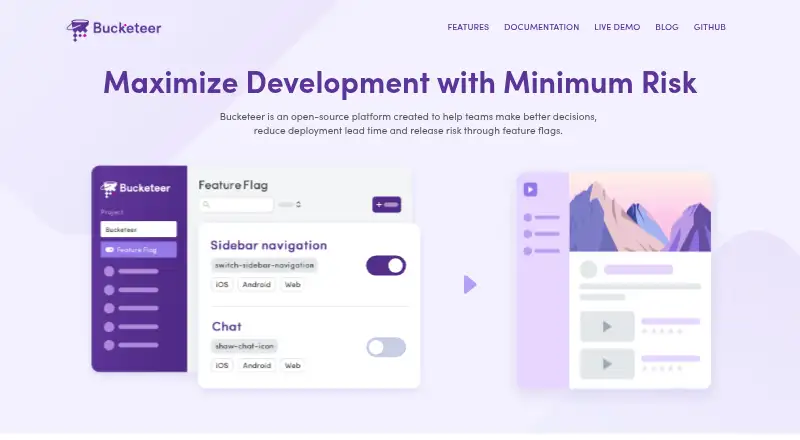
Bucketeer is an open-source feature-management and experimentation platform. It helps teams control releases and tests without deploying code for every change.
What it does
Feature flags can turn functions on or off in real time. Dark launches expose a function only to selected people, while progressive rollouts expand exposure hourly, daily, or weekly.
Rules can use user attributes, reusable segments, dates, other flag evaluations, and prerequisites. Nested audience splits support tests such as a 50/50 experiment within 5% of traffic.
Its experiments use Bayesian analysis, HMC-NUTS sampling, probability-of-being-best and expected-loss reports, and sample-ratio mismatch warnings. Automations can schedule changes, run event-rate kill switches, or react to webhooks.
How it connects
Bucketeer offers SDKs for Android, iOS, Flutter, JavaScript, React, React Native, Go, and Node.js. OpenFeature providers are listed for Android, iOS, JavaScript, React, React Native, Go, and Node.js.
A RESTful HTTP API handles flag, user, and evaluation operations with token authentication, but its documentation labels the API alpha. Separate keys are available for client SDKs, server SDKs, and read-only public access.
Integrations include Slack notifications, Firebase Cloud Messaging updates, webhooks, and CI/CD or monitoring connections such as Datadog, New Relic, and Dynatrace.
Good fit
Bucketeer suits teams that need feature flag software for safer releases, audience targeting, and controlled experiments.
It supports Android, iOS, Linux, web, API use, and self-hosting. Docker Compose is intended for development and lighter setups; Kubernetes with Helm is the production deployment option.
Environment-scoped Viewer, Editor, and Owner roles, audit logs, and environment isolation support teams that need release governance.
Watch for
The HTTP API is marked alpha, so check its maturity before making it central to an integration. Client SDKs use remote evaluation; server SDKs support local and remote evaluation.
Self-hosting requires your own infrastructure. Docker Compose starts Bucketeer with MySQL and Redis, while documented storage also includes PostgreSQL, Redis caching, and BigQuery, MySQL, or PostgreSQL warehouses.
The platform lists many controls and SDKs, but you should confirm that your target language, deployment model, and operational needs are covered.
Pricing
Bucketeer is free. The open-source self-hosted plan is free forever with no stated licensing or per-seat charges.
You run the infrastructure yourself, so hosting and operating costs remain yours. Deployment choices include Docker Compose or Kubernetes with Helm.
Verdict
Choose Bucketeer if you want open-source control over feature flags, staged releases, and Bayesian experiments, and you can operate the system yourself. Its targeting, automation, SDK coverage, and audit features address both release work and experimentation.
Look elsewhere if you need a mature public API, a vendor-managed service, or a setup that avoids infrastructure responsibility. The alpha API label and self-hosting requirement deserve particular attention before adoption.
Our take
Bucketeer fits engineering and product teams that want a free, open-source way to manage feature exposure and experiments across mobile, web, and server code. It offers detailed targeting, scheduled and event-driven rollouts, experiment diagnostics, and environment-level permissions. The trade-off is operational ownership: self-hosting, storage, and deployment are your responsibility, and the HTTP API is still labeled alpha. Teams seeking a managed service or a fully mature API should evaluate other options before committing.
- Free and open-source with self-hosted deployment options
- Real-time flags, dark launches, and scheduled progressive rollouts
- Bayesian experiments with sample-ratio mismatch warnings
- SDKs and OpenFeature providers for mobile, web, and server languages
- Audit logs and environment-scoped Viewer, Editor, and Owner roles
- HTTP API documentation labels the API alpha
- Self-hosting leaves infrastructure and operating costs to you
- Client SDKs use remote evaluation
- Production deployment uses Kubernetes with Helm
- Pick it ifTeams running controlled releases across mobile, web, and server apps; Organizations wanting open-source feature flags and experimentation; Teams able to operate Docker or Kubernetes infrastructure
- Skip it ifYou need a vendor-managed service instead of self-hosting; Your integration depends on a mature, non-alpha public API; You cannot take on infrastructure and storage responsibilities
Pricing
Bucketeer is free and open source. Self-hosted use has no stated licensing or per-seat charges, but you pay for the infrastructure you operate.
- Bucketeer (open-source self-hosted)Open source · self-hosted · free forever · free of per-seat pricingFree
- Open-source self-hostedfree forever; no licensing or per-seat charges stated · self-host your infrastructure · Docker Compose or Kubernetes/Helm deployment · infrastructure costs remainFree
As bucketeer.io lists them, checked 2 Oct 2026.
Questions
Is Bucketeer free?
Yes. Its open-source self-hosted plan is free forever, with no stated licensing or per-seat charges. Your infrastructure costs remain your responsibility.
Where can Bucketeer run?
It supports Android, iOS, Linux, web, API use, and self-hosting. Docker Compose is for development or lighter deployments; Kubernetes with Helm is the production option.
Does Bucketeer have a public API?
Yes. Its RESTful HTTP API supports flag, user, and evaluation operations with token authentication. The documentation labels the API alpha.
Which SDKs are available?
Official SDK documentation covers Android, iOS, Flutter, JavaScript, React, React Native, Go, and Node.js.
Can Bucketeer run A/B tests?
Yes. It uses Bayesian analysis with HMC-NUTS sampling and reports probability of being best, expected loss, and sample-ratio mismatch warnings.
What integrations does it list?
Bucketeer lists Slack notifications, Firebase Cloud Messaging updates, webhooks, OpenFeature compatibility, and CI/CD or monitoring integrations including Datadog, New Relic, and Dynatrace.
Near it
All alternatives →- F
 Flagsmith#2 on this board
- FFeaturevisor#3 on this board
- UUnleash#4 on this board
- G
 GrowthBook#5 on this board
- D
 DevCycle#6 on this board
- F
 feat#7 on this board
- S
 Statsig#8 on this board
- F
 FeatureProbe#9 on this board
- LE
 LaunchDarkly Experimentation#10 on this board
- HF
 Harness Feature Management & Experimentation#11 on this board