Customer Service Automation Software
Capacity: Contact Center AI and Automation
capacity.com · checked 21 Oct 2026
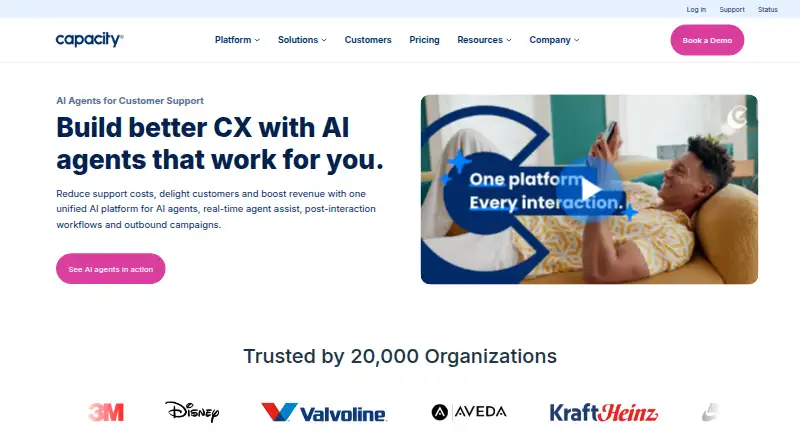
Capacity is a hosted CX automation platform offering contact centers AI agents, agent tools, workflows, and analytics.
How it plugs in
Signal on Customer Service Automation Software5.5#8 of 26
For contact centers, Capacity brings automated agents together with tools for human representatives. Customers can reach its AI agents through chat, SMS, voice, and email, with knowledge resources, workflows, analytics, and outbound campaigns supporting those interactions. The service offers web, iOS, Android, browser extension, and API access. It targets mid-market and enterprise teams, with annual subscriptions quoted on request and AI usage billed separately.
Review
In a line
Capacity automates customer experience operations in contact centers. Its platform connects knowledge, data, and business systems for use by AI agents and human representatives.
What it does
Customers can interact with Capacity’s AI agents over chat, SMS, voice, or email. During interactions, Agent Assist gives human representatives real-time answers and guidance.
Alongside a knowledge base and workflow automation, the platform offers conversation intelligence, Auto QA, AI CSAT, coaching, interaction summaries, and outbound campaigns. Teams can use SMS, voice, or WhatsApp campaigns to reach customers proactively.
How it connects
Capacity’s integrations directory includes 273 listed connections, such as Salesforce, Zendesk, Slack, and Microsoft Teams. It categorizes them as API, calendar, indexed-content, and interface integrations; API links can use REST, XML, or SOAP endpoints.
Custom connections can use the Capacity API, webhooks, authentication tools, databases, and open APIs. The developer platform lets admins manage API links and control application skills. Capacity sells proprietary software through a hosted platform; its public pages do not say whether customers can run it themselves.
Access is available through web, iOS, Android, a browser extension, and an API. Human handoff is available.
Good fit
Capacity targets mid-market and enterprise contact centers, often with 50 to 500 or more agents. It may suit teams seeking automated customer responses alongside live-agent support.
It may suit organizations looking to bring multiple support channels, shared knowledge, workflow actions, analytics, outbound engagement, and connections to existing helpdesk or business tools together.
Watch for
Capacity has no free plan, and subscription rates are provided on request. The annual platform subscription is separate from charges for AI agent usage and optional add-ons.
The software is proprietary, and public product and pricing pages describe it as hosted without saying whether customers can self-host it. Check which integrations, usage levels, storage limits, and security packages your team needs.
Capacity reports AES-256 encryption for data at rest and TLS 1.2 or higher for data in transit. Its listed standards are GDPR, HIPAA, and SOC 2 Type II; access controls include role-based permissions, audit logs, and single sign-on integrations such as Okta and Azure AD.
Pricing
There is no free plan. Core, Pro, and Enterprise are annual subscriptions with prices supplied on request, while AI agent usage and optional add-ons incur separate charges.
For small teams, Core includes five dashboards, 100 AI Assistant questions, and up to 100GB of storage. Pro is aimed at growing teams and combines helpdesk, live chat, and inbox with eight dashboards, 100 AI Assistant questions, and up to 1TB of storage.
Enterprise is sized for large teams and includes campaigns and CRM, 10 dashboards, 100 AI Assistant questions, up to 2TB of storage, and an optional HIPAA package. AI chat and email are billed per response, voice per minute, and SMS per message; Agent Assist and intelligence are billed by agent time per hour.
Verdict
Consider Capacity if your contact center wants a hosted system spanning automated conversations, live-agent guidance, knowledge, workflows, analytics, and outbound campaigns. Its channel coverage, API, and integrations directory may help it connect with an existing service stack.
It may not suit small teams looking for a free entry plan, published fixed prices, or open-source code. Public product and pricing pages do not say whether the platform can be self-hosted. Before signing, request a quote and confirm expected AI usage, add-on costs, storage needs, and the integrations your agents depend on.
Our take
Capacity may suit mid-market and enterprise contact centers looking to bring AI and human support into one hosted service. The platform spans chat, SMS, voice, email, knowledge management, workflows, analytics, and campaigns, with APIs and an integrations directory. Costs need consideration: there is no free tier, subscription prices are provided on request, and AI usage is charged by channel or agent time. Teams looking for open-source code or a published price may want to look elsewhere; public pages do not say whether self-hosting is available. Request a quote based on your channels, volume, storage, and add-ons.
- AI agents support chat, SMS, voice, and email
- Agent Assist gives human representatives real-time guidance
- 273 integrations are listed, including Salesforce and Zendesk
- API, webhooks, workflows, and outbound campaigns are available
- Capacity lists GDPR, HIPAA, and SOC 2 Type II compliance
- No free plan is available
- Plan prices are provided on request
- AI usage and optional add-ons are charged separately
- The software is proprietary; public pages do not say whether self-hosting is available
- Usage charges depend on channel or agent time
- Pick it ifMid-market and enterprise contact centers; Teams combining AI agents with live support; Organizations needing workflows, analytics, and outbound campaigns
- Skip it ifYou require open-source software; You require a free tier or public price list; Your team cannot manage usage-based AI charges
Pricing
Core, Pro, and Enterprise are annual subscriptions priced on request. AI agent usage and optional add-ons are charged separately. There is no free plan.
- CoreAnnual platform subscription; AI agent usage and optional add-ons are priced separately · Sized for small teams · 5 dashboards · 100 AI Assistant questions · Up to 100GB storageOn request
- EnterpriseAnnual platform subscription; AI agent usage and optional add-ons are priced separately · Sized for large teams · Campaigns and CRM included · 10 dashboards · 100 AI Assistant questions · HIPAA package available · Up to 2TB storageOn request
- ProAnnual platform subscription; AI agent usage and optional add-ons are priced separately · Sized for growing teams · Helpdesk, live chat and inbox · 8 dashboards · 100 AI Assistant questions · Up to 1TB storageOn request
As capacity.com lists them, checked 21 Oct 2026.
Questions
What is Capacity?
Capacity is a contact center CX automation platform that brings together AI agents, human agent assistance, knowledge tools, workflows, analytics, and outbound engagement.
Which channels does Capacity support?
AI agents support chat, SMS, voice, and email. The platform also supports web and lists outbound campaigns for SMS, voice, and WhatsApp.
Does Capacity have integrations and an API?
Yes. Its directory lists 273 integrations, including Salesforce, Zendesk, Slack, and Microsoft Teams. Capacity also documents an API, webhooks, authentication, databases, and custom integrations.
How much does Capacity cost?
Core, Pro, and Enterprise are annual subscriptions with prices available on request. AI agent usage and optional add-ons cost extra, and there is no free plan.
Can Capacity hand conversations to people?
Yes. Human handoff is available. Agent Assist provides support representatives with real-time answers and guidance during interactions.
Is Capacity open source or self-hosted?
Capacity is proprietary commercial software. Public product and pricing pages describe a hosted platform but do not say whether customers can self-host it.
What security controls does Capacity list?
Capacity reports AES-256 encryption at rest and TLS 1.2 or higher in transit. It lists GDPR, HIPAA, and SOC 2 Type II compliance, along with role-based permissions and audit logs.