DeepDoc: Code Repository Documentation Generator
deepdoc.tech · checked 7 Oct 2026
DeepDoc keeps a searchable documentation site in step with changes to your code repository.
How it plugs in
Signal on AI Documentation Generators6.7#3 of 28
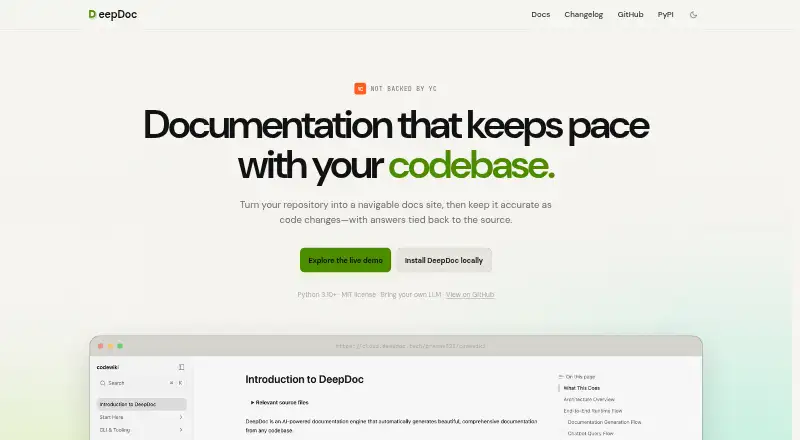
DeepDoc is a Python package that makes source code into a navigable documentation site. It examines supported files, organizes topic pages, adds API references when available, and can refresh pages touched by changes. The result is a static MkDocs Material site with search and an optional AI chatbot. You can run it locally or self-host it without an account or cloud service.
Review
In a line
DeepDoc makes a documentation website from a code repository. It is free, MIT licensed, and can run locally or on your own host.
What it does
DeepDoc examines source files, maps out the documentation, creates pages, adds OpenAPI references when present, and builds a site. Documentation is grouped into topics such as architecture, endpoints, integrations, and schemas.
Its answers can cite the source file paths and line ranges behind them. Running update refreshes only the pages touched by code changes rather than rebuilding everything.
How it connects
You install DeepDoc as a Python package with pip. Its listed support covers Python, JavaScript, TypeScript, Go, PHP, Vue, GraphQL, and OpenAPI or Swagger specifications.
The output can include Markdown, Mermaid diagrams, an interactive API reference, or a static Next.js/Fumadocs site. DeepDoc also builds a MkDocs Material site with navigation and search. It produces static files that can be deployed to any host.
DeepDoc runs in the terminal on Linux, macOS, Windows, the web, or a self-hosted setup. Python 3.10 or later is required, and you connect an LLM provider of your choice.
Good fit
DeepDoc suits teams that want repository-based documentation, source-linked answers, and API references without sending the project to a required hosted service.
It is also useful when code changes affect only part of the documentation, since the update command targets affected pages.
Watch for
DeepDoc does not provide its own language model. You must choose and connect a provider, and generation costs depend on that model and the number of documentation pages.
The listed commands init, serve, deploy, status, config, performance, and clean do not call an LLM; generate and update do. Check that your code uses one of the supported source types and that you can manage a self-hosted static site.
Pricing
DeepDoc has one free plan. There is no free trial because the software itself is free and no subscription plans are listed.
You still pay any usage charges from the LLM provider you select. The maker gives no dollar estimates; costs vary by model and by the documentation pages generated or updated.
Verdict
Choose DeepDoc if you want supported repository code turned into static, searchable documentation while keeping deployment under your control. Its source-path citations, API specification support, and targeted updates are useful for codebases that change regularly.
Look elsewhere if you need a bundled AI model, fixed documentation-generation costs, or a hosted service that handles setup for you. You will need Python 3.10 or newer, a model provider, and a place to host the generated files.
Our take
DeepDoc is a sensible choice for developers or teams that prefer local, self-hosted documentation generated from code. It covers several common languages, OpenAPI inputs, source-linked answers, and incremental page updates. The trade-off is operational: you supply the language model, manage its usage costs, and deploy the resulting static site yourself. Because the package is free and MIT licensed, it may fit projects that want control over hosting and source data rather than a subscription service.
- Free MIT-licensed package that needs neither an account nor cloud service
- Works with Python, JavaScript, TypeScript, Go, PHP, Vue, GraphQL, and OpenAPI
- AI answers include source file paths and line ranges
- Refreshes documentation pages touched by code changes
- Creates searchable static documentation with optional chatbot
- You must bring your own LLM provider
- Generation and update commands incur model-dependent usage costs
- Requires Python 3.10 or later
- You must deploy the generated static site yourself
- No automatic updates are listed
- Pick it ifTeams wanting local or self-hosted code documentation; Projects using supported languages or OpenAPI specifications; Codebases that need targeted documentation updates
- Skip it ifYou want a bundled AI model or predictable generation pricing; You need a hosted service to manage deployment and updates; Your code uses source types outside DeepDoc's listed support
Pricing
DeepDoc is free under an MIT license with no subscription plans or free trial. LLM charges are separate and vary by your chosen provider, model, and documentation pages generated.
- DeepDocMIT licensed · no account · no cloud · generation uses your chosen LLM and its costs depend on the model and documentation pagesFree
As deepdoc.tech lists them, checked 7 Oct 2026.
Questions
Is DeepDoc free?
Yes. DeepDoc has a free MIT-licensed plan. You still pay any usage charges from the LLM provider you choose.
Does DeepDoc require an account or cloud service?
No. The maker says it runs in the terminal without an account or cloud requirement, and it can be self-hosted.
Which languages and inputs does DeepDoc support?
The listed sources are Python, JavaScript, TypeScript, Go, PHP, Vue, GraphQL, and OpenAPI or Swagger specifications.
Can DeepDoc document APIs?
Yes. It supports API specifications and can stage OpenAPI references and build an interactive API reference.
What does DeepDoc output?
Outputs include Markdown, Mermaid diagrams, a static Next.js/Fumadocs site, and a MkDocs Material site with navigation and search.
Do all DeepDoc commands use an LLM?
No. Init, serve, deploy, status, config, performance, and clean do not call an LLM. Generate and update do.
What do I need to run DeepDoc?
Install the Python package with pip, use Python 3.10 or later, and provide your own LLM provider for generation tasks.