Diskover file catalog and storage management review
diskoverdata.com · checked 15 Oct 2026
Diskover catalogs file metadata across storage platforms so teams can search and manage unstructured data.
How it plugs in
Signal on Data Management Platforms7.7#1 of 30
Diskover creates one searchable catalog for files across cloud, on-premises, hybrid, NAS, SAN, object, tape, and archive storage. It indexes metadata without copying source data, adds business context through plugins, and supports search, analytics, tagging, cleanup, tiering, and workflow automation. A free Community Edition is available, while paid plans use annual fees quoted on request.
Review
In a line
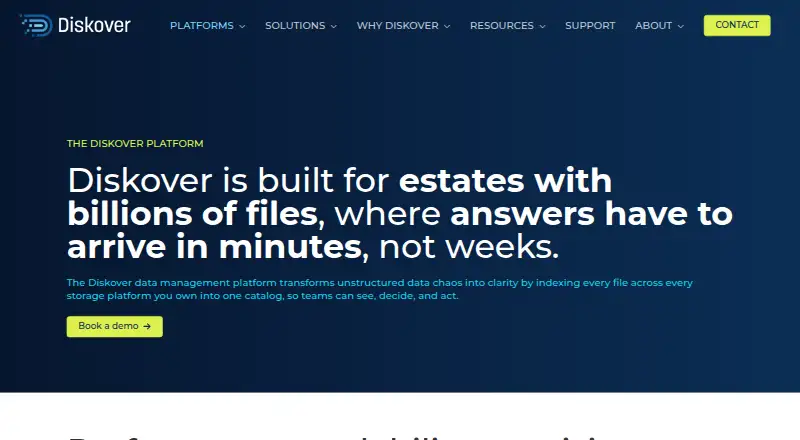
Diskover is a file-indexing platform for managing unstructured data. It builds a searchable catalog across many storage systems without moving the original files.
What it does
Diskover scans storage in parallel with a distributed indexing engine. Cached scan results can speed later indexing, and the catalog combines core file details with added business and technical attributes.
Search covers multiple indexes or clusters and offers filters, quick search, Elasticsearch query strings, file trees, treemaps, heatmaps, user analysis, cost analysis, dashboards, and custom reports.
Rules and plugins can automate cleanup, tagging, tiering, and repeated file tasks. Enterprise and Multistream plans add workflows that can delete, copy, move, rename, or run custom tasks.
How it connects
Diskover runs through a web browser, API, Linux, macOS, Windows, or a self-hosted setup. Its plugins connect with Azure Blob, OneDrive and SharePoint, Amazon S3-compatible storage, Grafana, Dell PowerScale, and Snowflake.
More than 50 plugins add metadata enrichment, workflow automation, data movement, and file actions without requiring code. Examples of added context include media properties, sequencing details, production status, storage costs, checksums, and permissions.
Diskover-Web has a REST API for creating, reading, updating, and deleting index and task data. The Community Edition is Apache-2.0 licensed and can run with Elasticsearch on Linux, macOS, and Windows 10.
Good fit
Diskover suits organizations with very large file estates, including media, life science, EDA, and energy teams. The platform is designed for billions of files and reports indexing 1.4 billion files in two hours.
It fits teams that need a single view of distributed storage, metadata-based search, cost or user analysis, and policy-driven movement between storage tiers or locations.
The Multistream tier adds a connector for data lakes and lakehouses plus curated datasets for AI and business-intelligence pipelines.
Watch for
Installation and configuration require a system administrator or someone with similar expertise. The documented stack includes Python 3.8 or newer, Elasticsearch 8.x, PHP 8.x with PHP-FPM, and NGINX or Apache for Diskover-Web.
Check deployment requirements and permissions before buying. Diskover says it uses the existing enterprise authentication system, and its catalog stores metadata rather than copying source files.
Paid plans do not publish dollar amounts.
Pricing
Community Edition is free for unlimited time and does not need a license key. It is downloadable source software.
Professional, Enterprise, and Multistream use annual platform fees with prices available by quote. Enterprise and Multistream include unlimited seats or users; Professional includes scanners, authentication options, analytics, tagging, and metadata and file-action plugins.
The AI connector and industry add-ons are optional annual fees priced on request. The AI connector works with Professional, Enterprise, or Multistream and supports a natural-language interface, desktop or mobile use, and a choice of large language model.
Verdict
Choose Diskover if your main problem is finding and organizing files spread across large or mixed storage environments. Its metadata-only catalog, broad plugin system, REST API, and self-hosted Community Edition give technical teams several deployment paths.
Consider a paid tier when you need scheduled data movement, lifecycle workflows, lakehouse connections, or AI and business-intelligence datasets. Budget for administration because setup is not aimed at beginners, and expect to request a quote rather than compare public prices.
It is a poor match for a small team seeking a simple file browser or a clearly priced hosted service.
Our take
Diskover is aimed at organizations managing very large, mixed storage estates rather than casual file sharing. The free Community Edition is a way to build a self-hosted catalog, while paid editions add analytics, plugins, data movement, lifecycle workflows, and lakehouse or AI features. Its REST API and open-source edition may suit teams with technical staff. Before committing, confirm that your administrators can support the documented software stack and request quotes for the capabilities you need, since published dollar prices are not available.
- Catalogs metadata without moving or copying source files
- Searches across cloud, on-premises, NAS, SAN, object, tape, and archive storage
- More than 50 plugins support enrichment, automation, and file actions
- Community Edition is free and Apache-2.0 licensed
- REST API supports index and task management
- Installation and configuration require administrator-level expertise
- Paid plan prices are available only by request
- Advanced data mobility and lifecycle workflows require higher tiers
- The documented stack has several server and software requirements
- Pick it ifLarge organizations with billions of files; Media, life science, EDA, and energy teams; Technical teams managing mixed storage environments
- Skip it ifYou need a simple file browser rather than a metadata management platform; You require publicly listed prices before contacting a vendor; You lack staff to install and maintain the documented stack
Pricing
A free Community Edition is available indefinitely. Professional, Enterprise, and Multistream have annual platform fees quoted on request. The AI connector and industry add-ons are optional annual fees priced on request.
- Community Editionfree for unlimited time · no license key requiredFree
- AI connectoroptional annual fee · works with Professional, Enterprise and Multistream · natural-language interface · desktop or mobile use · LLM choiceOn request
- Enterpriseannual platform fee · request a quote · unlimited seats/users · all Professional features · data-mobility plugins · orchestration pluginsOn request
- Industry add-onsoptional annual fee · Media · Life Science · EDA · EnergyOn request
- Multistreamannual platform fee · request a quote · unlimited seats/users · Enterprise features · data-lake/lakehouse super-connector · curated AI/BI datasetsOn request
- Professionalannual platform fee · request a quote · unlimited seats/users · scanners · authentication options · analytics · tagging · metadata-enrichment and file-action pluginsOn request
As github.com lists them, checked 15 Oct 2026.
Questions
Is Diskover free?
The Community Edition is free for unlimited time and does not require a license key. Other editions and add-ons are paid and use annual fees quoted on request.
Does Diskover move my files?
No. It creates a metadata catalog without moving or copying source files. Files move only when an approved workflow calls for it.
What storage can Diskover catalog?
It indexes cloud, on-premises, hybrid, NAS, SAN, object, tape, and archive storage. Listed integrations include Azure Blob, OneDrive, SharePoint, Amazon S3-compatible storage, Grafana, Dell PowerScale, and Snowflake.
Does Diskover have an API?
Yes. Diskover-Web exposes a REST API for creating, retrieving, updating, and deleting index and task data.
Can I run Diskover myself?
Yes. The Community Edition is downloadable source software. The repository says it runs on Linux, macOS, and Windows 10 with Elasticsearch.
What does the AI connector provide?
The optional connector offers natural-language interaction, desktop or mobile use, storage agnosticism, and a choice of large language model. It works with Professional, Enterprise, and Multistream.
Near it
All alternatives →- BBlueData#2 on this board
- LSLotame Spherical Data Collaboration Platform#3 on this board
- P
 Permutive#4 on this board
- PD
 Piano DMP#5 on this board
- IP
 Informatica Product 360#6 on this board
- SDSKP DMP#7 on this board
- AD
 Adform DMP#8 on this board
- AD
 Admixer DMP#9 on this board
- AA
 ArcSpan AMS#10 on this board
- A
 Audigent#11 on this board