Drupal: Free Open-Source Website and App CMS
drupal.org · checked 30 Sept 2026
Free, open-source content management software for building websites and applications.
How it plugs in
Signal on Content Management Systems7.6#4 of 165
Drupal provides no-cost, open-source tools for building websites and applications. It combines structured content and adaptable web service APIs with multilingual publishing, editorial workflows, custom roles and content types. Marketing teams, content creators and site builders can start with Drupal CMS, use temporary browser trials or deploy it themselves.
Review
In a line
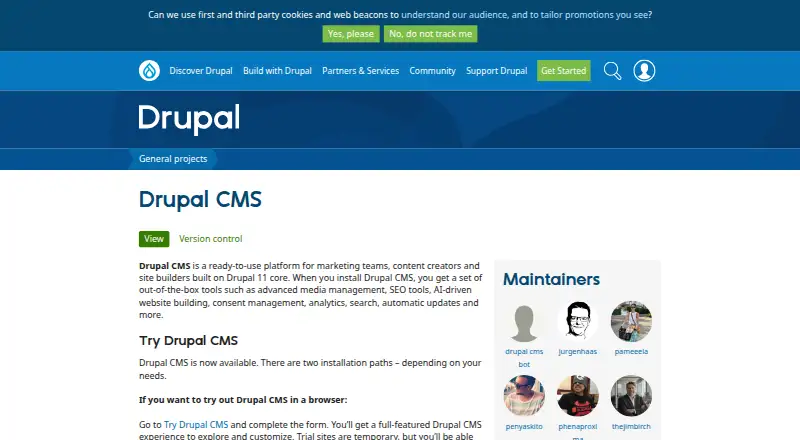
Drupal is software for managing content across websites and applications. Drupal CMS packages Drupal 11 core into a ready-to-use platform for marketing teams, content creators and site builders.
What it does
Drupal supports editorial workflows, custom user roles, multilingual content, SEO tools, media management and custom content types. Its built-in tools also cover consent management, analytics, search, AI-driven website building and automatic updates.
You can use structured content from one source across websites, mobile experiences and other channels. Drupal can be extended with thousands of modules, themes and distributions.
How it connects
Drupal is open-source GPL software with flexible web service APIs. Those APIs let other channels use the same structured content, and Drupal can connect with external services and applications in an organization’s infrastructure.
It runs through the web and can be self-hosted on Linux or similar systems. Hosting can use Apache, Nginx or other web servers, with MariaDB, MySQL, PostgreSQL or SQLite databases.
Good fit
Marketing teams, content creators and site builders may choose Drupal when they need a flexible base for websites or applications. It fits projects needing multilingual publishing, custom content structures, role-based access or several delivery channels.
Its accessibility, security process, editorial tools, APIs and scalability are useful when a site must grow or connect with other systems.
Watch for
Self-hosting and technical configuration are part of using Drupal. Windows can serve development environments, but production deployments should use Linux or a comparable operating system because Drupal does not run directly on Windows there.
Drupal CMS provides an initial site rather than ongoing self-updating after setup. Modules and themes installed on the site follow the normal Drupal update process. Support is available through its user guide, Drupal Slack’s #drupal-cms-support channel, the project issue queue and certified agency partners.
Self-hosted storage includes daily full-site backups, database backups and one-click restore.
Pricing
The Drupal plan is free GPL software, so it has no license charge; you still provide the hosting and technical setup.
A full-featured browser trial is available through temporary trial sites.
Verdict
Drupal is a fit for teams seeking free, open-source software with custom content models, multilingual publishing, editorial controls and APIs that deliver to several channels. It is also a fit if your organization can handle hosting and technical maintenance.
Look elsewhere if you need production hosting on Windows or do not want to manage setup, hosting, modules and themes.
Our take
Drupal makes sense for organizations that need a flexible publishing system rather than a simple hosted site builder. Its free license, structured content and APIs support websites, applications and multiple channels, while roles, workflows and language tools help larger publishing teams. The trade-off is operational: you must provide hosting, complete the technical setup and keep installed modules and themes updated. Windows cannot host Drupal directly in production. Try the temporary browser site before deciding whether its workflow and administration fit your team.
- GPL software is available without licensing fees
- Structured content and APIs serve multiple channels
- Multilingual content, workflows and custom roles
- Thousands of modules, themes and distributions
- Daily full-site backups with one-click restore
- You must supply hosting and technical setup
- Production hosting directly on Windows is unsupported
- Modules and themes require ongoing updates
- The Drupal CMS starting setup does not update itself
- Pick it ifTeams building multilingual or structured-content websites; Organizations that can manage self-hosted infrastructure; Projects needing APIs and custom publishing workflows
- Skip it ifYou need Drupal hosted directly on Windows in production; You want a hosted product with no technical setup; You do not want to maintain modules and themes
Pricing
Licensing is free under GPL, while the free plan still calls for self-hosting and technical setup. A full-featured temporary browser trial is available.
- Drupalopen-source GPL software · no licensing fees · self-hosting and technical setup requiredFree
As drupal.org lists them, checked 30 Sept 2026.
Questions
Is Drupal free?
Yes. Drupal uses the GPL and carries no licensing fee, but you remain responsible for self-hosting and technical setup.
Can Drupal run on Windows?
Windows is suitable for development environments only; direct production hosting on Windows is unsupported.
Does Drupal offer a trial?
Yes. Drupal CMS provides a full-featured browser experience through temporary trial sites.
What can Drupal publish?
Drupal provides structured content for websites, mobile experiences and other channels through flexible web service APIs.
Can Drupal handle multiple languages?
Yes. Multilingual content is a built-in capability.
How is Drupal extended?
You can extend Drupal with thousands of modules, themes and distributions, and connect it with external services and applications.
What hosting does Drupal recommend?
Drupal recommends Linux or a similar operating system. It works with Apache, Nginx and other web servers, plus MariaDB, MySQL, PostgreSQL and SQLite.