freenginx: Free Self-Hosted Proxy Software
freenginx.org · checked 4 Oct 2026
Open-source software for serving HTTP and proxying mail, TCP, and UDP traffic on self-hosted servers.
How it plugs in
Signal on Reverse Proxy Software6.6#7 of 33
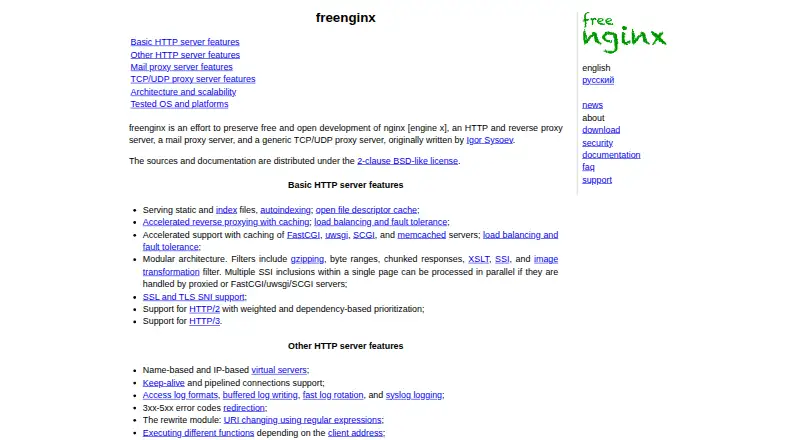
freenginx continues nginx's free and open development. It runs on Linux, macOS, Windows, or your own server. It serves web files and handles HTTP, mail, TCP, and UDP proxying, with caching, load balancing, TLS, HTTP/2, and HTTP/3 support. Configuration uses files, while upgrades and reloads can avoid interrupting clients.
Review
In a line
freenginx provides free, open-source software for web serving, mail proxying, and general TCP or UDP proxying. It is intended for self-hosted deployment on Linux, macOS, or Windows.
What it does
The HTTP server can deliver static files, forward requests to other servers, cache responses, balance traffic, and continue operating when a backend fails. SSL/TLS SNI, HTTP/2, HTTP/3, WebSocket connections, and rate limiting are supported.
Cached or accelerated connections are available for FastCGI, uwsgi, SCGI, and memcached servers. Mail proxy functions handle IMAP, POP3, and SMTP authentication, along with SSL and STARTTLS/STLS.
For other network services, freenginx handles TCP and UDP proxying with TLS SNI, load balancing, fault tolerance, and client-address controls. HTTP access rules can use an IP address, HTTP Basic password authentication, or a subrequest result.
How it connects
freenginx is self-hosted and configured with files. Its project code and documentation are released under a 2-clause BSD-like license, making it open source.
The download choices cover stable and mainline releases, Windows builds, and source from Mercurial repositories or a GitHub mirror. The project uses Mercurial for development and sends proposed changes to an nginx development mailing list.
A single master process manages several worker processes, which run as an unprivileged user. Operators can reload configuration or upgrade the executable without stopping client service.
Good fit
freenginx suits people who need one self-hosted tool for web serving and several kinds of proxy traffic. It can fit setups that need response caching, TLS termination, load balancing, or access controls.
The project says that 10,000 inactive HTTP keep-alive connections use about 2.5M of memory, and that it minimizes data copying.
Watch for
This is server software that you run and configure yourself, rather than a hosted service. Mailing lists provide support, and posting requires subscribing an email address first.
No separate free trial is offered. Check whether your team is comfortable with file-based configuration, self-hosting, and mailing-list support before choosing it. Security issues are reported by email, with patches signed by one of the project's PGP keys.
Pricing
A free plan is available. The project distributes its source and documentation under a 2-clause BSD-like license, and no separate trial period exists.
Verdict
Choose freenginx if you want open-source proxy and server software under your control on your own machines, covering HTTP, mail, TCP, and UDP traffic. Its caching, balancing, access rules, and interruption-free reloads cover demanding network setups.
Our take
freenginx is a practical choice for operators who want licensed source code and direct control over web, mail, and network proxying. It covers modern HTTP protocols, caching, balancing, access rules, and several backend server types in one package. Running it remains your responsibility, including configuration, upgrades, and support through subscribed mailing lists. Teams wanting a hosted experience should consider another option.
- Free availability with source under a 2-clause BSD-like license
- Runs on Linux, macOS, Windows, and self-hosted systems
- Handles HTTP, mail, TCP, and UDP proxy traffic
- Provides caching, load balancing, and fault tolerance
- Reloads and executable upgrades can avoid service interruption
- Self-hosted deployment requires your own server management
- Configuration is file-based
- Support is through mailing lists requiring subscription
- No separate free trial is offered
- Pick it ifSelf-hosted web and network proxy deployments; Teams that need several HTTP, mail, TCP, and UDP functions; Users who want open-source server software
- Skip it ifYou need a hosted service instead of software to run yourself; You require commercial or live support rather than mailing lists; Your team does not want file-based server configuration
Pricing
freenginx is available through a free plan, with source code and documentation under a 2-clause BSD-like license. There is no separate trial.
- freenginxSources and documentation distributed under a 2-clause BSD-like licenseFree
As freenginx.org lists them, checked 4 Oct 2026.
Questions
What is freenginx?
freenginx is free, open-source software for serving HTTP traffic and proxying web, mail, TCP, and UDP connections.
Which systems can run freenginx?
It supports Linux, macOS, Windows, and self-hosted deployment.
Does freenginx support HTTP/2 and HTTP/3?
Yes. SSL/TLS SNI, HTTP/2, and HTTP/3 are supported by its HTTP server.
Can freenginx proxy mail servers?
Yes. IMAP, POP3, and SMTP authentication are supported by the mail proxy, along with SSL and STARTTLS/STLS.
How is freenginx configured?
Configuration is handled through files.
How much does freenginx cost?
freenginx has a free plan. Its source code and documentation are released under a 2-clause BSD-like license, with no separate free trial.
How do I get support?
Mailing lists handle support, and an email address must be subscribed before posting.
Can it reload without interrupting users?
Yes. Configuration reloads and executable upgrades can occur while client servicing continues.