ngrok: What it does, connections, and pricing
ngrok.com · checked 20 Oct 2026
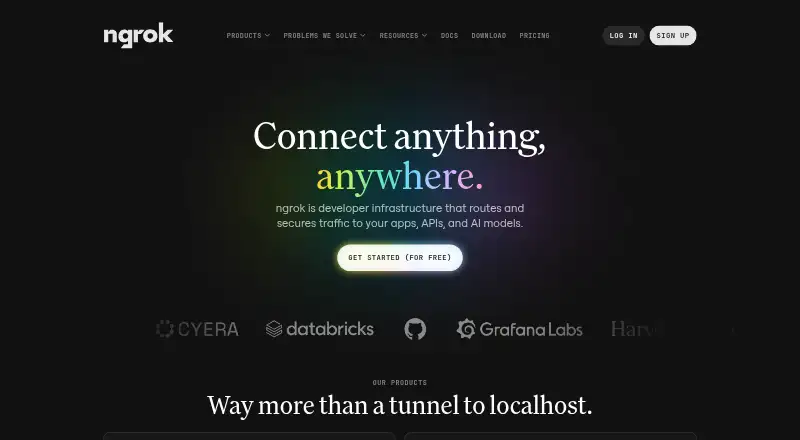
ngrok routes and secures traffic to local and remote applications, APIs, AI models, and devices.
How it plugs in
Signal on Reverse Proxy Software6.7#5 of 33
ngrok provides secure tunnels for reaching services without changing firewall settings, plus gateways and traffic controls for production use. Its traffic support spans HTTP, TLS, and TCP, with integrations, a public API, and Kubernetes ingress. A free plan is available; paid plans start at $10 a month, with usage limits and features varying by plan.
Review
In a line
ngrok provides cloud networking for routing and securing traffic to applications, APIs, AI models, and devices. It can connect to services running in different locations.
What it does
Developers can use ngrok's command-line tool to make a local application reachable at a public URL while they develop and test. Secure tunnels carry traffic to services without requiring firewall changes.
For production, Traffic Policy rules can direct requests, authenticate users, set rate limits, apply web application firewall controls, or reject traffic. Gateways are available for APIs, AI models, and devices, while site-to-site connections link applications and databases in customer networks.
HTTP, TLS, and TCP are supported, along with traffic such as WebSockets, gRPC, SSH, Postgres, MQTT, and Minecraft. Endpoint pooling balances traffic across agents and can fail over to healthy backends if needed.
How it connects
The Integrations Hub organizes guides for databases, Kubernetes, OAuth, webhooks, web servers, and other areas. Webhook signature verification covers over 70 providers, among them Stripe, GitHub, Slack, and Shopify.
The public API documents endpoints, domains, certificates, traffic rules, tunnels, and other platform settings. Applications can use agent SDKs to create and manage endpoints programmatically. Kubernetes ingress for clusters is provided by the ngrok Operator. The product is not open source.
It runs on Linux, macOS, and Windows, and offers web, API, and self-hosted options.
Good fit
ngrok suits developers who need to share a local app for testing, as well as teams routing production traffic to applications and APIs. Free and Hobbyist are positioned for developers, solo developers, home labs, and game servers; Pay-as-you-go is positioned for teams shipping production traffic.
Teams can also use it to connect databases and applications across customer networks, route AI-model traffic, or control IoT devices remotely.
Watch for
Check the plan limits against expected traffic. Free allows three online endpoints, 1GB of transfer, and 20k HTTP/S requests. Hobbyist includes three endpoints, 5GB of transfer, and 100k HTTP/S requests. Pay-as-you-go includes unlimited endpoints, 5GB of transfer, and 100k HTTP/S requests.
If Hobbyist usage credit is exhausted, endpoints stop working until the billing cycle ends and the credit resets. Pay-as-you-go charges extra for additional usage. Enterprise pricing is by request.
ngrok offers region pinning and lists locations across several regions, but confirm that its available locations meet your needs.
Pricing
Free has no price and comes with $5 in one-time usage credit. Hobbyist is $10 monthly, including $10 in usage. Pay-as-you-go is $20 monthly, with $20 of usage included and additional usage charged separately.
Enterprise has contract pricing available on request. A free trial is available.
Verdict
Choose ngrok if you need a public route to a local app, or want one platform for secure tunnels, production traffic rules, and connections to services in customer networks. Its API, integration guides, and Kubernetes support give teams several ways to connect it to existing systems.
The free plan is a practical starting point, but its endpoint, transfer, and request limits matter. If Hobbyist credit is depleted, its endpoints stay offline until the next billing cycle resets the credit, which can be a problem for services that need uninterrupted reachability. Teams with production traffic should compare included usage and confirm that the plan's controls and regional options fit their needs.
Our take
ngrok suits developers sharing a local service and teams applying traffic controls to production apps, APIs, AI models, or customer networks. Its free plan lets people start without a recurring charge, while paid tiers add usage and team capacity. Free and Hobbyist impose traffic limits, and Hobbyist endpoints pause when usage credit runs out. Teams with always-on production services should review usage costs and confirm plan details before relying on it.
- Public URLs let people reach local apps for development and testing.
- Traffic reaches services through secure tunnels without firewall changes.
- Supports HTTP, TLS, TCP, and several related traffic types.
- Webhook signatures are verified for more than 70 providers.
- A public API and Kubernetes Operator are available.
- Free plan has three endpoints, 1GB transfer, and 20k HTTP/S requests.
- Hobbyist endpoints stop when usage credit runs out.
- Pay-as-you-go adds charges for usage beyond included credit.
- ngrok is not open source.
- Pick it ifDevelopers sharing local apps for testing; Teams securing and routing production API traffic; Teams connecting apps and databases in customer networks
- Skip it ifYou need open-source software.; Your workload cannot tolerate Hobbyist endpoints pausing when credit runs out.; Your expected traffic does not fit the included plan limits.
Pricing
Free is $0 and includes $5 in one-time usage. Hobbyist is $10 a month with $10 in monthly usage. Pay-as-you-go is $20 a month plus additional usage, with $20 included. Enterprise pricing is on request. A free trial is available.
- Free$0 · $5 one-time usage · 3 online endpoints · 1GB transfer · 20k HTTP/S requests · interstitial page · 1 team memberFree
- Hobbyistmonthly · $10 monthly usage · 3 online endpoints · 5GB transfer · 100k HTTP/S requests · ngrok-branded domains · 1 team member$10/mo
- Pay-as-you-gomonthly plus additional usage · $20 included usage · unlimited online endpoints · 5GB transfer included · 100k HTTP/S requests included · custom domains · unlimited team members$20/mo
- Enterprisecontract pricing · SSO/SAML · SCIM · dedicated-support SLAs · HIPAA/SOC 2/BAAs · AWS Marketplace · per-device or per-customer pricingOn request
As ngrok.com lists them, checked 20 Oct 2026.
Questions
Can ngrok give a local app a public URL?
Yes. With ngrok's CLI, a local application can be exposed at a public URL for development and testing.
Does ngrok require firewall changes?
No firewall changes are needed for its secure tunnels to deliver traffic to services.
What traffic types does ngrok support?
Supported traffic includes HTTP, TLS, and TCP, as well as WebSockets, gRPC, SSH, Postgres, MQTT, and Minecraft.
Does ngrok work with Kubernetes?
Yes. Kubernetes clusters can use the ngrok Operator for ingress, and Kubernetes guides are available through the Integrations Hub.
What happens when Hobbyist usage credit runs out?
Endpoints go offline and remain so until the billing cycle ends and the usage credit resets.
Is ngrok open source?
No. ngrok is proprietary, though it provides a public API and agent SDKs.