Google Agent Development Kit
adk.dev · checked 15 Oct 2026
An Apache-licensed toolkit for creating, testing, and running AI agents and agent teams.
How it plugs in
Signal on AI agent platforms7.7#2 of 73
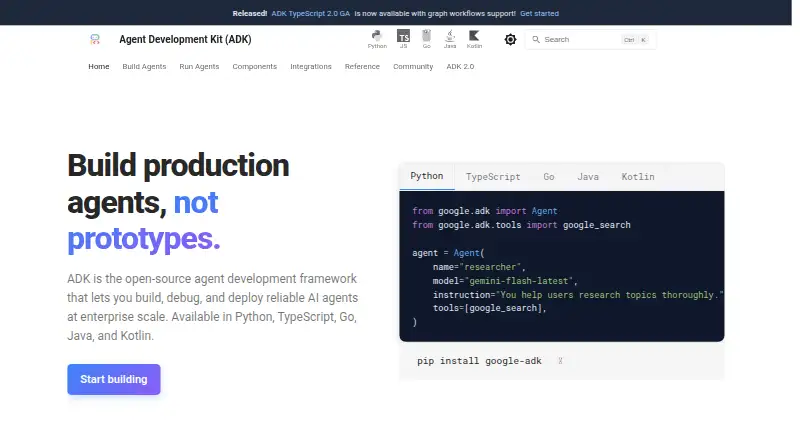
Google Agent Development Kit (ADK) offers a free, open-source way to create AI agents. Developers can use Python, TypeScript, Go, Java, or Kotlin, combine graph workflows with delegated agents, evaluate behavior, stream interactions, and select among deployment targets. Gemini is its primary focus, while adapters connect other hosted or local models.
Review
In a line
Google Agent Development Kit is an open-source framework for building, debugging, evaluating, and deploying AI agents. It also supports systems where several agents share work.
What it does
ADK lets you create agents that follow fixed steps, use model reasoning, or combine both in graph-based workflows. Workflow agents can run steps in sequence, concurrently, or repeatedly, and agents may pass work to specialized peers.
Agents can call built-in search and code execution, MCP and OpenAPI tools, custom functions, and third-party libraries. Through a local web UI, you can converse with agents and review events, state, and execution traces. The Agents CLI can generate project scaffolding and handle builds, tests, evaluations, and deployments.
ADK maintains session context, memory, events, tool outputs, and artifacts. It can also produce multi-turn evaluation sets, run evaluations locally from the CLI or development UI, and support live agents with two-way text, audio, and video streaming.
How it connects
ADK exposes APIs for Python, TypeScript, Go, Java, and Kotlin, plus references for its CLI, configuration system, and REST API. Its code is open source, and the Python repository uses the Apache License 2.0.
Gemini is the main model target, with adapters available for hosted alternatives and models running on your own systems. The integration catalog spans MCP, A2A agent communication, Google Cloud, databases, search, observability, communication and productivity tools, and other third-party services.
Deployment can use Google Cloud Agent Runtime, Cloud Run, GKE, local Docker or Podman, or other container-friendly infrastructure. The framework can be self-hosted without changing agent code.
Good fit
ADK suits teams building AI agents or multi-agent systems who want control over workflows, model connections, evaluation, and deployment. Its language coverage helps teams working in Python, TypeScript, Go, Java, or Kotlin.
It is a practical match for projects needing Gemini, local models, tool use, voice or video conversations, session memory, or deployment on infrastructure chosen by the team.
Watch for
Agent Config currently works only with Gemini models and requires Python. The framework is broad, so teams should check which language, model adapter, deployment target, and integrations their project needs.
Using models or cloud services can involve their own access requirements or charges, although the framework itself is free. Security guidance addresses identity, authorization, input and output guardrails, sandboxed code execution, and network controls; these still need to be planned for each deployment.
Pricing
The Apache 2.0 framework plan costs nothing and has no seat fee or usage ceiling. The separate Google ADK listing is also free, while model and cloud-service use may bring additional access requirements or billing.
Verdict
Choose ADK if you want an open framework for assembling agents, routing tasks among them, evaluating behavior, and deploying on Google Cloud, containers, or local infrastructure. It is especially relevant when Gemini support, several programming languages, or live media streaming matter.
Look elsewhere if you need Agent Config with a non-Gemini model or without Python. Also account for the separate costs and access rules that can apply to models and cloud services.
Our take
Google Agent Development Kit is a strong option for teams that need to build and operate AI agents rather than use a finished chatbot. Its free, open-source core covers workflows, delegation, evaluation, tools, streaming, and self-hosted deployment across five languages. The main checks are model compatibility, especially the Gemini-and-Python limit in Agent Config, plus any billing for models or cloud services. Pick it when you want detailed control over agent behavior and infrastructure; avoid it when a narrower, ready-made tool would be simpler.
- No charge, open codebase, and no seat or usage limit
- Available for Python, TypeScript, Go, Java, and Kotlin
- Graph-based orchestration with hierarchical agent delegation
- Web development UI and CLI cover construction, tracing, tests, and evaluation
- Supports Google Cloud, containers, and infrastructure you operate yourself
- Agent Config is limited to Gemini and Python
- Separate model or cloud-service charges may apply
- Its breadth means deployment and integration options require careful review
- Pick it ifTeams creating tailored AI agents and agent collectives; Projects that need Gemini, local models, or self-managed hosting; Developers using any of the five supported languages
- Skip it ifAgent Config must use a non-Gemini model; You need a finished application rather than an agent-building toolkit; Separate access fees for models or cloud services are unacceptable
Pricing
The framework has a free Apache 2.0 plan without seat charges or a usage cap. Models and cloud services can still have their own access or billing requirements.
- ADK frameworkApache 2.0 open source · no seat charge or usage capFree
- Google Agent Development Kit (ADK)Open-source framework; model and cloud service usage may require separate access or billingFree
As javisreview.com lists them, checked 15 Oct 2026.
Questions
Is Google Agent Development Kit free?
Yes. The framework has no seat fee or usage cap and is open source. Access to models or cloud services can still involve separate billing or permissions.
Which programming languages does ADK support?
Official APIs and guidance cover Python, TypeScript, Go, Java, and Kotlin.
Which models can ADK use?
Gemini is the primary target, and adapters allow connections to other hosted models or models running locally.
Can ADK run without Google Cloud?
Yes. You can operate agents in Docker or Podman locally, on other container-ready infrastructure, or in a self-hosted environment.
Does ADK support multiple agents?
Yes. Agents may form hierarchies, hand tasks to specialized agents, and route work among them.
What is the Agent Config limitation?
Agent Config currently supports only Gemini models and requires Python.
Does ADK include evaluation tools?
Yes. The tools support multi-turn evaluation datasets and local runs from the CLI or development UI.