Software Composition Analysis Software
Grype Software Review
github.com · checked 15 Oct 2026
Grype checks container images, filesystems, packages, and SBOMs for vulnerabilities as a free, open-source scanner.
How it plugs in
Signal on Software Composition Analysis Software7.6#1 of 65
This Apache-2.0 vulnerability scanner operates on the machine where it is installed. It checks container images, directories, archives, filesystems, individual packages, and SBOMs against a cached database. Output options include table, JSON, SARIF, and custom Go templates. Linux, macOS, Windows, and self-hosted deployments are supported.
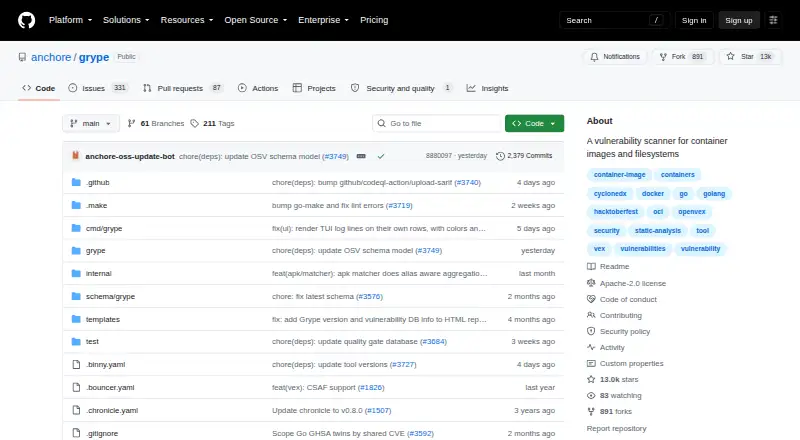
Review
In a line
Available under an open-source licence at no charge, Grype is a command-line utility that detects known vulnerabilities in software packages and related files.
The tool can be installed on Linux, macOS, Windows, or a self-hosted environment and run locally.
What it does
Grype accepts container images, source directories, filesystems, archives, SBOMs, and individual packages identified with PURL or CPE. Image support covers Docker, OCI, and Singularity formats.
Its package coverage includes operating-system ecosystems such as Alpine, Debian, Ubuntu, RHEL, SUSE, and Amazon Linux, along with PyPI, npm, Maven, Go modules, Composer, NuGet, Pub, RubyGems, Crates, Swift, GitHub Actions, Bitnami, Conda, and WordPress plugins. Supported language ecosystems include Ruby, Java, JavaScript, Python, .NET, Go, PHP, and Rust.
EPSS, KEV, and risk scores help order findings by priority. OpenVEX can filter findings or add context, and Grype can generate SBOMs.
How it connects
Grype can retrieve images from a local container daemon or a remote registry, including Docker and OCI workflows. It accepts Syft JSON, SPDX JSON, SPDX XML or tag-value, and CycloneDX JSON or XML as SBOM input.
Results can be emitted in table, JSON, SARIF, or custom Go-template form. It also runs in build pipelines, including via Anchore's Container Scan GitHub Action, where severity thresholds can make a pipeline fail.
Linux, macOS, and Windows have official binaries and source archives. Other installation paths include a Docker image, installer script, Homebrew, MacPorts, Winget, Scoop, and Snapcraft.
The public implementation is written in Go and exposes library packages, while the documentation does not describe a hosted REST API or official SDK. Once its database and inputs have been downloaded, scanning can continue offline.
Good fit
Grype suits teams and individuals seeking on-machine checks of container images, dependencies, filesystems, or SBOMs. The documentation describes individual package scans as useful for lightweight vulnerability and compliance checks.
It fits build pipelines that enforce vulnerability thresholds and self-hosted setups that prefer to keep scan work local. For related tools, browse container image scanning tools or container security software.
Watch for
Grype keeps a vulnerability database locally, combining data from multiple feeds. A scan normally fails if that database is older than five days, although age validation can be changed. Database commands cover checking, updating, deleting, importing, diffing, searching, and inspecting status.
Security fixes are limited to the latest release. Because the project remains below version 1.0, a minor upgrade can alter behavior; the independent review advises pinning versions in continuous-integration pipelines.
GitHub records a high-severity credential-disclosure issue involving Grype JSON output, published November 24, 2025. Review the current release and your JSON handling before depending on that output.
Pricing
Grype has no charge, paid plan, or free trial. The scanner is Apache-2.0 licensed open-source software, and its vulnerability database is published without charge.
Verdict
Choose Grype for a command-line vulnerability check that stays on your machines and fits image, dependency, or SBOM workflows. Its broad input coverage and multiple output choices work for one-off package reviews as well as automated pipelines.
A hosted service, documented REST API, or official SDK is not described, so those needs point elsewhere. Budget for database maintenance and version pinning because stale data blocks scans by default and security fixes target only the newest release.
Our take
Grype is a practical free option for local checks across containers, files, packages, and SBOMs. Operating-system and language ecosystem coverage, pipeline support, and machine-readable output broaden its use. You must maintain the local vulnerability database and installations, and pre-1.0 releases may change behavior. The documentation does not describe a hosted API or official SDK, while security updates apply only to the newest release. Teams seeking a managed service should evaluate other software.
- Apache-2.0 licensed open-source software at no charge
- Local execution with offline scanning after data is downloaded
- Coverage for containers, filesystems, packages, and SBOMs
- Results available as tables, JSON, SARIF, or Go templates
- CI support with configurable severity cutoffs
- Scans stop by default when the database is over five days old
- Security fixes apply only to the latest release
- Pre-1.0 updates may alter behavior
- No documented hosted REST API or official SDK
- A high-severity JSON-output vulnerability was disclosed in 2025
- Pick it ifOn-machine container, package, filesystem, and SBOM checks; CI pipelines enforcing vulnerability severity limits; Lightweight dependency and compliance reviews
- Skip it ifYou require a hosted scanning service or documented REST API; You cannot keep a local vulnerability database current; You need stable behavior without pinning pre-1.0 versions
Pricing
Grype has no charge, paid tier, or trial. Its open-source scanner and vulnerability database are available at no cost.
- GrypeApache-2.0 licensed open-source vulnerability scannerFree
- Grype open-source scannerNo cost · CLI tool · locally run · vulnerability database published at no costFree
As github.com lists them, checked 4 Oct 2026.
Questions
What inputs can Grype scan?
Grype supports container images, directories, filesystems, archives, SBOMs, and individual packages identified by PURL or CPE.
Which operating systems can run Grype?
Official binaries and source archives are available for Linux, macOS, and Windows, and the tool can also be self-hosted.
Can Grype work without an online service?
After its vulnerability database and scan inputs are downloaded, it can continue operating offline.
Which result formats are available?
Available output includes tables, JSON, SARIF, and custom Go-template results.
Does Grype provide an API or SDK?
It is documented as a command-line tool and Go project; no hosted REST API or official SDK is described.
When does the database become too old for a scan?
By default, scans fail when the local database is older than five days, though age validation can be changed.
Is Grype available at no cost?
Yes. Grype is Apache-2.0 licensed open-source software, and its vulnerability database is published without charge.