IndexTTS Voice Cloning and Text-to-Speech
github.com · checked 9 Oct 2026
Open-source TTS for cloning a voice from a single reference recording.
How it plugs in
Signal on Text-to-Speech Software7.8#17 of 223
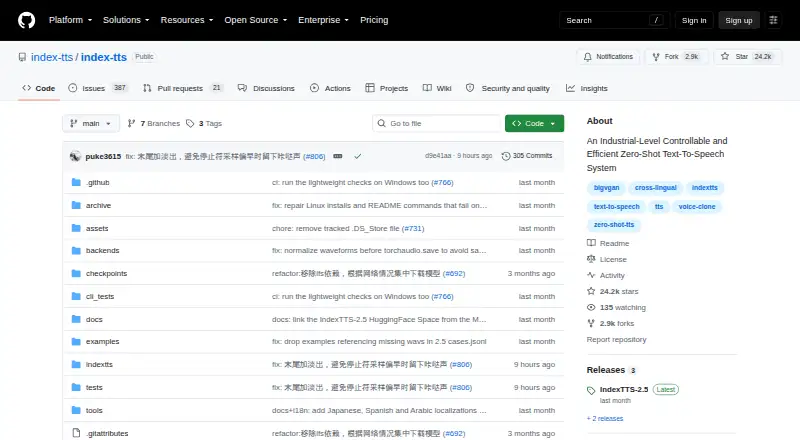
IndexTTS provides zero-shot speech synthesis as an open-source project. Using one reference audio clip, it renders speech in the corresponding cloned voice. In release 2.5, supported languages are Chinese, English, Japanese, Spanish, and Arabic, with controls for emotion, speed, and pronunciation. Linux and Windows users can access it through a local WebUI or Python API.
Review
In a line
With one reference audio clip, IndexTTS generates speech in a copied voice without model training. It is open source and intended for local or self-hosted use.
What it does
Give IndexTTS text and a reference recording, and it generates speech using that voice. IndexTTS-2.5 offers Chinese, English, Japanese, Spanish, and Arabic output.
You can steer delivery with an emotional recording, an emotion vector, or written emotion instructions. A duration factor between 0.5 and 2.0 adjusts speaking rate, with 1.0 representing normal speed. Pronunciation can be entered with Chinese Pinyin, English CMU phonemes, or Japanese Kana.
How it connects
For inference, the project documents a browser-based WebUI and Python API. A vLLM recipe is also documented for production serving, and generated files are WAV.
Local and self-hosted deployments support Linux and Windows through web and API interfaces. The repository contains the code and downloadable models. For other options, see text-to-speech software and voice cloning software.
Good fit
IndexTTS suits people who need voice cloning without training a model, and teams that want to run text-to-speech on their own Linux or Windows systems.
It can fit projects needing several supported languages, adjustable emotion, variable speaking speed, or pronunciation input.
Watch for
Installation requires Git and uv. For CUDA installation errors on Linux or Windows, the setup instructions point to NVIDIA CUDA Toolkit 12.8 or later. DeepSpeed is optional, may be challenging to install on Windows, and performance can vary with hardware, drivers, and the operating system.
For IndexTTS-2, Pinyin control applies only to the Chinese Pinyin cases listed in the project's vocabulary file. The project uses the bilibili Model Use License Agreement; read its disclaimer and contact [email protected] with commercial-use questions.
The maintainers say the GitHub repository is the core team's sole official channel and that they cannot assure the security, accuracy, or timeliness of other websites or services.
Pricing
IndexTTS has no charge and its code is open source. There is no listed hosted plan or paid price; model downloads and inference code are available.
Verdict
IndexTTS is worth considering if you want free, open-source voice cloning that runs locally or on servers you control. Its WebUI and Python API cover both browser and programmatic use, while emotion, speed, and pronunciation settings add control over generated speech.
Look elsewhere if you need a hosted subscription, a format other than WAV, or installation without local software and hardware requirements. Check the bilibili license and commercial-use contact before using it in a paid product.
Our take
IndexTTS is a practical choice for technically comfortable users who want open-source voice cloning on Linux or Windows. Its single-clip cloning, multilingual support, emotion settings, and Python API cover many self-hosted projects. The tradeoffs are setup work, possible CUDA and DeepSpeed hurdles, WAV-only export, and a license that requires attention for commercial use. It is not a fit for buyers seeking a ready-made hosted service with a published subscription plan.
- Open-source model and inference code at no cost
- Copies a voice using one reference audio clip
- Five languages are available in IndexTTS-2.5
- Emotion, speed, and pronunciation can be adjusted
- WebUI and Python API access
- CUDA Toolkit 12.8 or newer is recommended when a CUDA installation error occurs
- DeepSpeed can be difficult to install on Windows
- Exports speech as WAV files
- Commercial use requires checking the bilibili license
- Chinese Pinyin control has supported-case limits
- Pick it ifSelf-hosted voice cloning on Linux or Windows; Projects needing adjustable emotion and speaking speed; Developers using a Python API or local WebUI
- Skip it ifYou need a hosted plan with a listed price; You require audio formats other than WAV; You cannot manage local software, drivers, or hardware
Pricing
The open-source project is free and includes downloadable models and inference code. No hosted plan or paid price is listed.
- IndexTTSNo hosted plan or price listed; downloadable model and inference codeFree
As github.com lists them, checked 9 Oct 2026.
Questions
What is IndexTTS?
IndexTTS generates zero-shot speech that uses a single reference audio clip to reproduce a voice.
Which languages does IndexTTS-2.5 support?
IndexTTS-2.5 supports Chinese, English, Japanese, Spanish, and Arabic.
How can I run IndexTTS?
Documented options include a local browser WebUI, a Python API, and production serving through a vLLM recipe. Linux and Windows setups are supported.
Is IndexTTS free?
Yes. It is an open-source project with downloadable model files and inference code, and no hosted plan or paid price is listed.
Can IndexTTS control emotion and speed?
Emotion can come from a reference recording, vector, or text, and IndexTTS-2.5 changes speed through duration_factor values from 0.5 to 2.0.
What should commercial users check?
The release follows the bilibili Model Use License Agreement. Read its disclaimer and direct commercial-use questions to [email protected].
Near it
All alternatives →- AF
 Adobe Firefly#16 on this board
- RTReverie Text-to-Speech#18 on this board
- F
 Fliki#15 on this board
- PPaddleSpeech#19 on this board
- VVoiser#14 on this board
- VVoxCPM#20 on this board
- GCGoogle Cloud Text-to-Speech#13 on this board
- SSpeakatoo#21 on this board
- AAAnySpeak.ai#12 on this board
- SSpeaktor#22 on this board