VoxCPM Review
voxcpm.com · checked 8 Oct 2026
Multilingual, open-source speech synthesis with text-led voice creation, cloning, and self-hosting.
How it plugs in
Signal on Text-to-Speech Software7.8#20 of 223
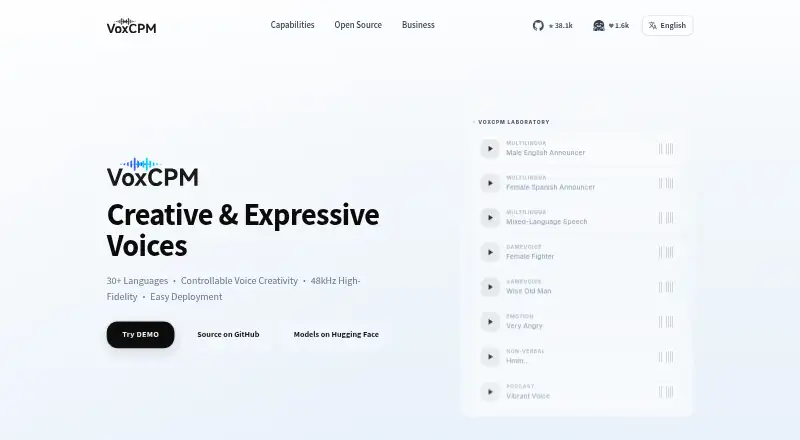
VoxCPM2 is an open-source system for expressive speech across 30 languages and nine named Chinese dialects. It offers text-guided voice creation, voice cloning, streaming generation, and WAV output. You can run it through an API, web demo, local installation, or self-hosted setup, with free commercial use under Apache-2.0.
Review
In a line
VoxCPM2 is a free, open-source text-to-speech system from VoxCPM in Beijing, China. It turns written text into expressive multilingual speech and can create or clone voices.
What it does
VoxCPM2 covers 30 languages and names nine Chinese dialects. It produces 48kHz audio, accepts 16kHz reference audio, and exports WAV files.
A plain-language prompt can specify a voice without reference audio. Voice cloning is also available, and streaming generation supports live audio workflows.
The model allows both full and LoRA adaptation using 5–10 minutes of audio. Its project materials describe a local web demo, Python and command-line workflows, production serving, and on-device inference.
How it connects
VoxCPM offers an API and self-hosted operation on Linux, macOS, and the web. Its vLLM-Omni option exposes an OpenAI-compatible /v1/audio/speech endpoint, while Nano-vLLM supports concurrent requests.
Apache-2.0 applies to the code and model weights, with commercial use allowed. Apple Silicon MPS is documented, along with C++ inference on CPU, Metal, CUDA, or Vulkan.
For related options, see Voice Cloning Software and Text-to-Speech Software.
Good fit
VoxCPM is aimed at users who need multilingual speech, voice creation from written prompts, or cloning through a self-hosted or API deployment. Its commercial-use license fits projects that need to run the model without a paid plan.
Watch for
Voice Design and controllable cloning may not return the same result every time. Languages not included in the supported list may require testing or fine-tuning.
The documented Python setup requires Python 3.10 or later but below 3.13, PyTorch 2.5.0 or later, and CUDA 12.0 or later. The project forbids impersonation, fraud, and disinformation, and recommends labeling AI-generated content.
Pricing
The Free & Open Source plan is available at no charge, and no paid tiers or usage limits are stated.
The Apache-2.0 license covers the code and model weights, including commercial use.
Verdict
Choose VoxCPM if you want open-source speech generation with multilingual coverage, voice creation from text, cloning, and several deployment choices. It is especially suited to buyers who can manage local hardware or an API server and who value commercial-use rights.
Consider another option if repeatability is essential for voice design or cloning and you cannot test outputs, or if your environment cannot satisfy the listed Python, PyTorch, and CUDA requirements.
Our take
VoxCPM is a practical choice for speech projects that need free commercial licensing, multilingual output, and control over deployment. Its API, web demo, local tools, and on-device paths give buyers several ways to run it. The main tradeoffs are technical setup requirements and variable results from voice design or cloning. Check language coverage and hardware before committing, especially for unsupported languages or systems without the documented software stack. Avoid it for impersonation, fraud, or disinformation, which the project explicitly forbids.
- Apache-2.0 open-source software with commercial-use rights at no cost
- Coverage spans 30 languages plus nine named Chinese dialects
- A written prompt can define a voice without reference audio
- API, streaming, self-hosted, web, and on-device paths are available
- 48kHz speech can be exported in WAV format
- Voice Design and cloning may differ from one run to the next
- Languages outside the listed set may call for testing or fine-tuning
- Installation depends on specified Python, PyTorch, and CUDA versions
- Impersonation, fraud, and disinformation are prohibited uses
- Pick it ifMultilingual speech projects needing open-source commercial use; Teams wanting self-hosted, API, or on-device deployment; Voice design or cloning with fine-tuning options
- Skip it ifYou require guaranteed repeatability for voice design or cloning; Your system cannot satisfy the documented Python, PyTorch, and CUDA requirements; Your intended use involves impersonation, fraud, or disinformation
Pricing
VoxCPM has a free open-source plan; no paid tiers or usage limits are stated. Apache-2.0 licensing permits commercial use of the code and model weights.
- Free & Open SourceNo paid tiers or usage limits statedFree
As voxcpm.com lists them, checked 8 Oct 2026.
Questions
Is VoxCPM free?
Yes. The Free & Open Source plan has no charge, and no paid tiers or usage limits are stated.
Can I use VoxCPM commercially?
Yes. Apache-2.0 covers the code and model weights, and the project permits commercial use.
What languages does VoxCPM support?
It covers 30 languages and names nine Chinese dialects. Other languages may need testing or fine-tuning.
Does VoxCPM clone voices?
Yes. Voice cloning is supported, and full or LoRA adaptation can use 5–10 minutes of audio.
What audio formats does it export?
VoxCPM generates 48kHz audio and can export WAV files; reference audio is accepted at 16kHz.
Where can I run VoxCPM?
The documented choices span Linux, macOS, web, API, self-hosted, local web, production serving, and on-device inference.
What hardware and software does installation need?
The documented Python installation calls for Python 3.10 or newer but earlier than 3.13, PyTorch 2.5.0 or newer, and CUDA 12.0 or newer.
Are there restrictions on use?
The project bars impersonation, fraud, and disinformation, and advises labeling content made by AI.