K8up: Kubernetes Backup Software
k8up.io · checked 9 Oct 2026
K8up is an open-source Kubernetes operator for backing up and restoring persistent volumes.
How it plugs in
Signal on Container Backup Software6.0#8 of 28
K8up manages scheduled and on-demand backups for Kubernetes persistent volumes, with restore operations available through its command-line tool. It uses Restic and supports storage targets including S3, SFTP, REST, and local storage. It is free and self-hosted, but it requires a Kubernetes cluster and is officially supported on Linux x64.
Review
In a line
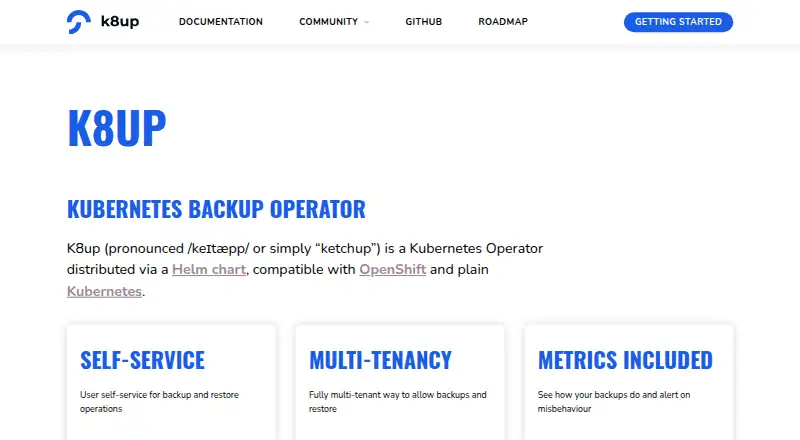
K8up is an open-source operator that manages backups and restores for Kubernetes. It is distributed through a Helm chart and works with OpenShift as well as standard Kubernetes.
What it does
K8up can back up persistent volumes either on a schedule or when requested. It supports volumes marked for shared or single-node access, and volumes selected by a label. It also supports multi-tenant backup and restore work and lets users handle those tasks themselves.
For application-aware backups, K8up can include output from tools that write to standard output. It can schedule longer-term archives, check backup repository integrity, and remove older backups. Restores use the K8up command-line tool.
How it connects
K8up is open source and uses Restic. Its storage targets include S3-compatible services such as Amazon S3 and Minio, plus SFTP, REST, and local storage.
You install it on a Kubernetes cluster with Helm. K8up provides Prometheus metrics for backup monitoring; operator and backup-job metrics are sent to a Prometheus Pushgateway.
Good fit
K8up may suit teams running Kubernetes or OpenShift that want scheduled or on-demand volume backups, self-service restores, and control over backup retention. Its metrics can help teams monitor backup activity and spot problems.
Watch for
K8up v2 and later officially supports recent stable Kubernetes releases with WebSocket support in the API server, starting with version 1.31. The project is built, tested, and supported on Linux x64. Arm64 images are available on a best-effort basis, without the same testing or support.
Restores require the K8up command-line tool. The project offers a CNCF Slack channel and GitHub Discussions, but does not currently hold community meetings.
Pricing
K8up is free and open source. There is no free trial because the software is already available at no cost.
Verdict
Consider K8up if you run Kubernetes or OpenShift and want an open-source way to schedule persistent-volume backups, manage archives, and restore data. Check that your Kubernetes version and Linux architecture fit its supported setup, and make sure your team is comfortable using its CLI for restores. It may not suit organizations looking for a hosted backup service or formal community meetings.
Our take
K8up is worth considering for teams that already run Kubernetes or OpenShift and want free, self-hosted backup management with scheduled jobs, retention controls, and CLI-based restores. Its storage options and monitoring metrics cover practical backup needs, but the project expects a Kubernetes environment and supports Linux x64 rather than offering a general desktop or hosted service. Check compatibility with your cluster version and architecture before adopting it.
- Free and open source.
- Supports scheduled and on-demand persistent-volume backups.
- Works with S3, SFTP, REST, local storage, and other targets.
- Provides Prometheus metrics for monitoring backup behavior.
- Requires a Kubernetes cluster for installation.
- Restores are performed with the K8up CLI.
- Linux x64 is the supported architecture; arm64 support is best effort.
- The project does not currently hold community meetings.
- Pick it ifKubernetes and OpenShift teams managing persistent-volume backups; Teams needing scheduled backups, retention, and CLI restores
- Skip it ifYou need a hosted backup service rather than software installed on Kubernetes.; You require tested and supported arm64 images.
Pricing
K8up is free and open source, so there is no paid plan or trial to compare.
Questions
Is K8up free?
Yes. K8up is open source and free, with no free trial needed.
What can K8up back up?
It backs up Kubernetes persistent volumes marked ReadWriteMany or ReadWriteOnce, or volumes selected by a label.
Which storage targets does K8up support?
It uses Restic and supports S3-compatible storage, SFTP, REST, local storage, and other targets.
Can K8up restore backups?
Yes. Restores are performed with the K8up command-line tool.
What Kubernetes versions does K8up support?
K8up v2 or later officially supports recent stable Kubernetes versions with WebSocket support in the API server, starting at version 1.31.
Does K8up support arm64?
Arm64 images are provided on a best-effort basis, without further testing or support. Linux x64 is the supported architecture.
Near it
All alternatives →- C
 CloudCasa#7 on this board
- AK
 Afi Kubernetes Backup#9 on this board
- BE
 Bacula Enterprise#6 on this board
- RRancher#10 on this board
- VK
 Veeam Kasten for Kubernetes#5 on this board
- B
 Bnkr#11 on this board
- VVelero#4 on this board
- KBKubeSphere Backup#12 on this board
- VBVinchin Backup & Recovery#3 on this board
- SStash#13 on this board