Velero Review: Kubernetes Backup and Restore
velero.io · checked 5 Oct 2026
Open-source Kubernetes backup, restore, disaster recovery, and migration tool.
How it plugs in
Signal on Kubernetes Backup Software6.6#4 of 31
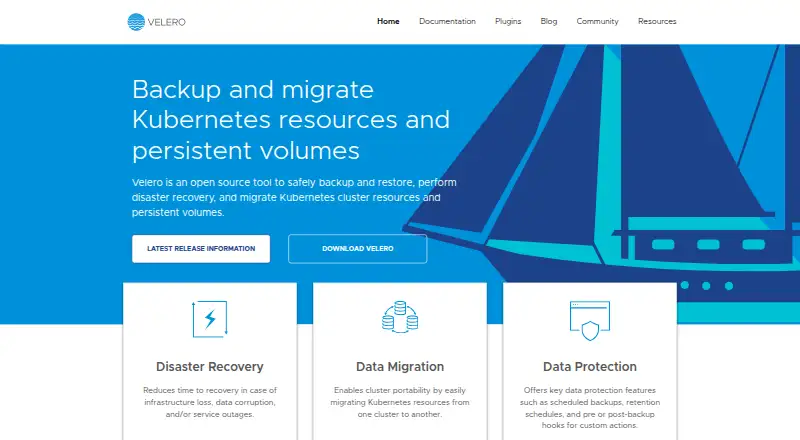
Kubernetes resources and persistent volumes can be captured with Velero and later recovered after data loss or transferred across clusters. It runs a server in Kubernetes and a local command-line client. The free, open-source project supports cloud and on-premises setups through provider plugins, with scheduled backups, custom retention, and backup hooks.
Review
In a line
Velero is open-source software for protecting Kubernetes clusters. Its capabilities include backup, recovery, disaster response, and cross-cluster resource moves.
What it does
A backup may include the entire cluster, or only namespaces and resources selected by labels. Persistent volumes can be included, and recurring schedules determine when jobs run.
After data loss, Velero can recover a cluster or copy resources to another cluster, including production copies for development or testing. Pre- and post-backup hooks allow extra operations around a backup. CSI-backed volumes can be handled through Kubernetes CSI Snapshot APIs when the cluster and driver meet their requirements.
How it connects
A Velero server runs inside Kubernetes while its command-line client runs on your computer. Setup requires a Kubernetes cluster, kubectl, an object-storage provider, and at least one plugin.
Provider plugins maintained by the project support AWS, Google Cloud, Microsoft Azure, and VMware vSphere; additional plugins are maintained by the community. Its plugin design also allows custom storage, backup, and restore functions without changing the main program.
Cloud and on-premises deployments are possible with object storage and, where supported, block storage. The client has releases for macOS and Windows, but Windows workload backups still need at least one Linux node for the server. Help is available through GitHub issues and Kubernetes Slack's #velero-users channel.
Good fit
Velero suits teams that operate Kubernetes clusters and need scheduled protection, recovery after data loss, cluster migration, or copies for development and testing. It supports custom retention and both application-consistency approaches.
Watch for
Kubernetes, kubectl, object storage, and plugins are prerequisites, while file-system backup is not included by default. CSI volume support depends on the cluster and its CSI driver.
Backups are not marked immutable. Certain object-storage immutability configurations may behave unexpectedly because Velero must update backup metadata. Check provider, storage, and certificate requirements before deployment.
Pricing
Velero is free and open source. The software itself has no paid plan; you supply the Kubernetes environment, storage, and any provider services it uses.
Verdict
Choose Velero when your team already runs Kubernetes and wants one open-source workflow for scheduled backups, volume protection, restores, or cross-cluster moves. Its cloud and on-premises options, provider plugins, and hooks cover varied setups.
It is a poor match if you need a turnkey service without Kubernetes administration, plugins, or separate storage. Review immutability behavior, CSI prerequisites, and the Linux-node requirement for Windows workloads before committing.
Our take
Velero makes sense for organizations responsible for Kubernetes data and cluster continuity. It can protect selected workloads or an entire cluster, run backups on a schedule, and enable recovery or migration across clusters. The trade-off is operational work: Kubernetes access, kubectl, storage, and plugins are required, and some storage immutability modes can interfere with metadata updates. Teams seeking a managed, no-setup backup product should look elsewhere. Those comfortable managing their own infrastructure get a free tool with cloud and on-premises deployment choices.
- Free, open-source software
- Protection for Kubernetes resources and persistent volumes
- Scheduled backups with custom retention
- Recovery and migration between clusters
- Plugins support major cloud and VMware storage
- Requires a Kubernetes cluster, kubectl, storage, and plugins
- File-system backup is not installed by default
- Certain object-storage immutability settings may cause issues
- Windows workloads need a Linux node for the server
- CSI volume support depends on cluster and driver prerequisites
- Pick it ifTeams operating Kubernetes clusters; Disaster recovery and cross-cluster migration; Production copies for development or testing
- Skip it ifYou need a managed backup service without Kubernetes setup; Your storage depends on immutability settings that may not work with Velero's metadata updates; You cannot provide a Linux node for Windows workload backups
Pricing
Velero itself is free and open source. Budget separately for Kubernetes, object storage, provider plugins, and any cloud or on-premises infrastructure.
- VeleroOpen source tool; cloud or on-premises; requires Kubernetes and storage provider pluginsFree
As velero.io lists them, checked 5 Oct 2026.
Questions
Is Velero free?
Yes. Velero is a free, open-source tool.
What does Velero back up?
It can capture Kubernetes resources and persistent volumes, covering a whole cluster or selections based on namespaces or labels.
Can Velero move workloads between clusters?
Yes. Resources can be restored in another cluster, including production copies intended for development or test environments.
Which storage providers does Velero support?
Plugins maintained by the project cover AWS, Google Cloud, Microsoft Azure, and VMware vSphere. Community-maintained plugins provide additional options.
What must be installed first?
Access to Kubernetes, kubectl, a compatible object-storage provider, and at least one Velero plugin is required. File-system backup is not installed by default.
Does Velero run on Windows?
The command-line client has Windows releases, but backing up Windows workloads still requires at least one Linux node running the Velero server.
Can Velero use immutable object storage?
Some immutability settings may not work as expected because Velero needs to update backup metadata.
Near it
All alternatives →- VBVinchin Backup & Recovery#3 on this board
- VK
 Veeam Kasten for Kubernetes#5 on this board
- SB
 Storware Backup & Recovery#2 on this board
- BE
 Bacula Enterprise#6 on this board
- P
 Plakar#1 on this board
- C
 CloudCasa#7 on this board
- HRHYCU R-Cloud#8 on this board
- KK8up#9 on this board
- AK
 Afi Kubernetes Backup#10 on this board
- B
 Bnkr#11 on this board