LangWatch: Agent Testing, Evaluation, and Monitoring
langwatch.ai · checked 21 Oct 2026
From agent simulations to production traces, LangWatch gives AI teams tools for engineering agents throughout their lifecycle.
How it plugs in
Signal on AI Agent Observability Tools7.6#4 of 31
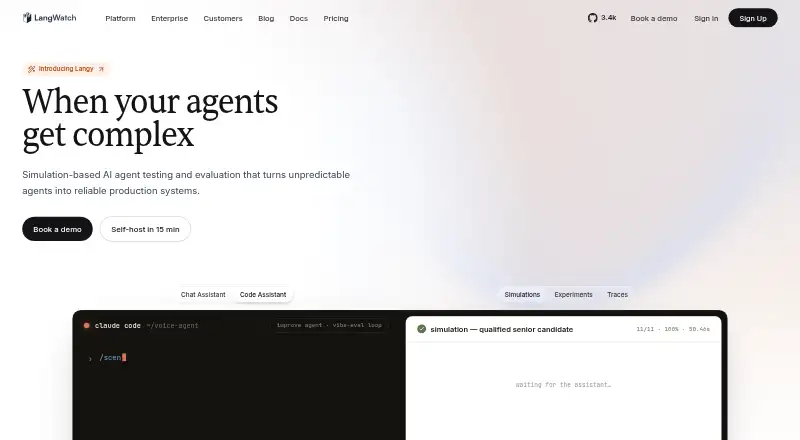
LangWatch combines agent simulations, evaluation, observability, prompt management, and AI governance. Teams can exercise agent conversations and tool use before release, assess performance on datasets or live traffic, and track costs, tokens, errors, and other activity. Deployment is available through managed cloud, self-hosting, or a hybrid setup; plans include a free tier and paid service from €29 per core seat monthly.
Review
In a line
LangWatch is an engineering platform for AI agents, with tools to build, test, and observe them. It is aimed at teams taking agents into production and working to keep them reliable.
What it does
Before launch, teams can run simulations of multi-turn conversations, tool interactions, recovery, and business outcomes. Evaluations may be performed offline using datasets, continuously against production traffic, or in CI/CD to gate merges.
For production use, LangWatch traces agent steps and reports cost, token use, duration, errors, evaluations, and annotations. Teams can version prompts using code, the interface, or API; compare them in experiments; and use an AI gateway to route requests, set budgets, and fall back between providers.
How it connects
Python and TypeScript SDKs, OpenTelemetry ingestion, and a direct REST API are available. Integrations include model providers and frameworks such as LangGraph, LangChain, CrewAI, DSPy, OpenAI Agents, and Google ADK. Voice-agent testing covers OpenAI Realtime, Gemini, ElevenLabs, Pipecat, and Twilio, among other tools.
The project also provides a CLI and an MCP server for coding assistants and other MCP clients. Its core platform uses the Apache 2.0 license; enterprise modules require a commercial production license. SDKs are MIT licensed.
Deployment can be managed in the cloud, self-hosted, or hybrid. Self-hosting is available through Docker Compose with the customer's ClickHouse, as well as Docker, Kubernetes/Helm, or VPC options. The self-host command requires Node.js 24 or newer on macOS or glibc-based Linux.
Good fit
AI teams shipping agents may find LangWatch useful for pre-launch testing and post-release monitoring. Its evaluation workflows address developers, product owners, QA staff, and domain experts.
It may also suit teams looking to version prompts, track costs, or apply organization-wide controls, including audit exports and an inventory of AI tools.
Watch for
Check the event allowance, retention period, and team limits for the plan you are considering. Developer caps monthly events, data access, users, scenarios, simulations, and custom evaluations. Growth charges for events over its included amount and storage beyond the retention allowance.
Self-hosting uses your own ClickHouse database, and the self-host command has a Node.js requirement. Enterprise modules also require a separate commercial production license.
Pricing
Developer costs nothing, with no expiration, and allows 50k events monthly, 14-day data access, two users, three scenarios, three simulations, and three custom evaluations, plus community support.
Growth is €29 monthly per core seat. It comes with 200k events, 30-day retention, unlimited lite users, simulations, evaluations, and prompts, and private Slack or Teams support. Extra events are €5 per 100k; storage beyond retention is €3 per GB.
Enterprise pricing is custom. Available terms include hybrid, self-hosted, or on-prem deployment; custom retention; SSO and role-based access; audit logs and SLAs; and dedicated engineering support.
Verdict
LangWatch is an option for teams seeking agent simulations and production monitoring alongside evaluations, prompt management, and governance. The free plan provides a starting point; Growth raises the event allowance and adds team support for a monthly per-seat fee.
It may be more than you need if your work is limited to a basic prompt tool or simple monitoring. Self-hosting also means operating ClickHouse. Teams with particular retention, access-control, or deployment requirements should check the plan against those needs before committing.
Our take
LangWatch is suited to teams that want to exercise agent behavior before release and examine costs, errors, and evaluation results in production. Developer supports an initial setup with capped usage, while Growth increases the event allowance and lifts several limits on users and experiments. Consider alternatives for a single narrow task or if providing ClickHouse for self-hosting is unsuitable. Larger organizations should verify that Enterprise terms and deployment options meet their needs.
- Simulates multi-turn conversations, tool interactions, recovery, and business outcomes.
- Supports evaluations on datasets, production traffic, or in CI/CD.
- Reports agent steps, costs, tokens, duration, errors, evaluations, and annotations.
- Deployment choices include managed cloud, self-hosted, and hybrid.
- The core platform is open source under Apache 2.0.
- Developer allows 50k events monthly and 14-day data access.
- Growth charges for events above its included allowance.
- Self-hosting relies on the customer's ClickHouse.
- Enterprise modules require a commercial production license.
- Pick it ifAI teams engineering, testing, and observing agents from development into production.; Teams needing agent evaluations, prompt management, and cost tracking.
- Skip it ifYou need more than 14 days of data access on a free plan.; You want to self-host but cannot provide ClickHouse.
Pricing
Developer is free indefinitely with usage limits. Growth costs €29 per core seat monthly; events and storage beyond included allowances incur additional charges. Enterprise pricing is custom.
- Developerfree forever · 50k events/month · 14-day data access · 2 users · 3 scenarios · 3 simulations · 3 custom evals · community supportFree
- Growthper core-seat/month · 200k events included · €5/100k additional events · 30-day retention · €3/GB beyond retention · unlimited lite users · unlimited simulations, evals and prompts · private Slack/Teams support€29/mo
- Enterprisecustom pricing · hybrid/self-hosted/on-prem · custom retention · SSO/RBAC · audit logs and SLAs · ISO 27001 reports · DPA/custom terms · dedicated engineering support · cloud marketplace billingOn request
As langwatch.ai lists them, checked 21 Oct 2026.
Questions
Is there a free LangWatch plan?
Yes. Developer has no charge and includes 50k events monthly, 14-day data access, two users, three scenarios, three simulations, and three custom evaluations.
What does Growth cost?
Growth is €29 per month per core seat. It includes 200k events; additional events are €5 per 100k.
Can LangWatch be self-hosted?
Yes. Deployment options include Docker, Kubernetes/Helm, and VPC. Self-hosting uses the customer's ClickHouse. The self-host command requires Node.js 24 or newer on macOS or glibc-based Linux.
Which frameworks integrate with LangWatch?
Listed frameworks include LangGraph, LangChain, CrewAI, DSPy, OpenAI Agents, Pydantic AI, Agno, Mastra, Vercel AI SDK, Google ADK, LangFlow, and Flowise.
Does LangWatch support voice-agent testing?
Yes. Support is listed for OpenAI Realtime, Gemini, ElevenLabs, Google Live API, Pipecat, WebSocket bots, and Twilio.
Is LangWatch open source?
The core platform is licensed under Apache 2.0, and its SDKs under MIT. Enterprise modules require a commercial production license.