OpenLIT: LLM and Agent Monitoring
openlit.io · checked 14 Oct 2026
OpenLIT is an open-source platform for monitoring and managing LLM and AI agent work.
How it plugs in
Signal on AI Agent Observability Tools7.7#2 of 31
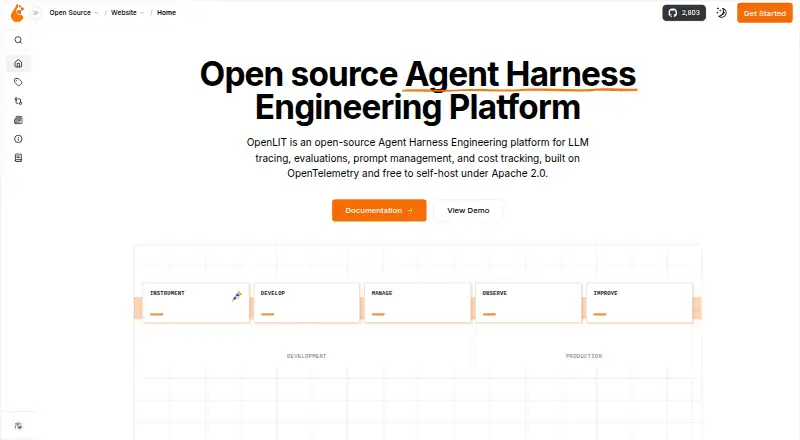
OpenLIT brings LLM tracing, evaluations, prompt management and cost tracking into one platform. It can record model and tool calls, compare models, and monitor coding-agent activity. The open-source OSS plan is free and can be self-hosted; a hosted Cloud plan is listed as price on request and waitlist only. It connects with many model and agent tools and can send telemetry to compatible monitoring services.
Review
In a line
OpenLIT is an open-source platform for tracing and managing LLM and AI agent activity. It also covers evaluations, prompts and costs.
What it does
OpenLIT records model calls, tool calls, retrievals and agent steps so teams can examine production activity. Filters include user, session, cost, response time and other details. Evaluations can use another LLM as a judge, set rules, or involve human review, on live traffic or experiments.
Prompt Hub keeps prompt versions and supports variables that change at runtime, retrieval through an API, and AI-assisted edits. OpenGround compares models by response time, token use and cost, using your own model keys. The platform also tracks coding-agent sessions, repository activity, tokens and costs, and includes GPU dashboards for usage, memory, temperature and power.
How it connects
OpenLIT is Apache 2.0 open source. It lists 56+ integrations across models, agent frameworks, databases for vector search and GPUs. Examples include OpenAI, Anthropic, LangChain, Pinecone and NVIDIA NIM. Official software kits are available for Python, TypeScript and Go, and a public API is documented.
It accepts OpenTelemetry data, a standard format for sending monitoring information, through OTLP. That data can be routed to Grafana, Datadog, New Relic, SigNoz, Jaeger or another compatible service. OpenLIT can run on Linux, macOS and Windows, in a browser, or on your own servers. Self-hosting is documented for Docker Compose and Kubernetes Helm.
Good fit
OpenLIT may suit teams that need to review LLM or agent activity, compare model costs, manage prompts, or evaluate responses. It also covers coding-agent monitoring and GPU metrics.
The free self-hosted plan lists unlimited users, projects, environments and usage. Its site says self-hosting keeps prompts, traces and secrets in the user's environment.
Watch for
Self-hosting requires Docker and Docker Compose for the local sandbox, or Kubernetes for the Helm deployment. The OSS plan's Fleet Hub lists monitoring collectors in a single cluster, so check whether that limit fits your setup.
OpenLIT spans several jobs, but its Cloud plan is waitlist only and its price is on request. The OSS plan includes community support through GitHub.
Pricing
The OSS plan is free and self-hosted, with unlimited usage, users, projects and environments, plus community support on GitHub. The project uses the Apache 2.0 license.
Cloud is a hosted service with managed infrastructure and upgrades. Its price is on request, and access is listed as waitlist only.
Verdict
Consider OpenLIT if you want an open-source place to trace LLM and agent activity, track costs and manage prompts, and are prepared to host it yourself. Its broad integrations and support for standard OpenTelemetry routing may help it fit alongside existing monitoring tools.
It is a less straightforward choice if you need a hosted service now: Cloud is waitlist-only with pricing on request. Also check the single-cluster collector monitoring noted for Fleet Hub and whether community GitHub support is enough for your team.
Our take
OpenLIT is worth considering for teams that want to inspect model and agent activity, compare costs, manage prompts and run evaluations in an open-source platform. It offers a free self-hosted plan and connects to many model tools and standard monitoring services. Before choosing it, confirm that you can operate Docker Compose or Kubernetes and that its single-cluster Fleet Hub collector monitoring fits your needs. If you require hosted access today, Cloud is currently listed as waitlist only, with pricing on request.
- Free OSS plan lists unlimited usage, users, projects and environments.
- Records LLM calls, tool calls, retrievals and agent steps.
- Supports prompt versions, runtime variables and API retrieval.
- Routes OpenTelemetry data to compatible monitoring services.
- Includes official Python, TypeScript and Go SDKs.
- Self-hosting requires Docker Compose or Kubernetes.
- Fleet Hub lists single-cluster collector monitoring.
- Cloud is waitlist-only and its price is on request.
- OSS plan support is through the GitHub community.
- Pick it ifTeams monitoring LLM and agent activity, costs and evaluations; Teams wanting an open-source, self-hosted platform; Teams comparing models or tracking coding-agent work
- Skip it ifYou need hosted Cloud access immediately.; Your setup needs multi-cluster Fleet Hub collector monitoring.; You cannot run Docker Compose or Kubernetes for self-hosting.
Pricing
The OSS plan is free and self-hosted, with unlimited usage, users, projects and environments. Cloud is hosted with managed infrastructure and upgrades, but is waitlist-only and priced on request.
- OSSUnlimited self-hosted usage · unlimited users · unlimited projects/environments · community GitHub support · Apache 2.0Free
- CloudFully hosted service · managed infrastructure and upgrades · pricing shared at launch · waitlist onlyOn request
As openlit.io lists them, checked 14 Oct 2026.
Questions
Is OpenLIT free?
Yes. Its OSS plan is free and self-hosted, with unlimited usage, users, projects and environments.
Can I host OpenLIT myself?
Yes. It documents Docker Compose and Kubernetes Helm deployments. The local sandbox requires Docker and Docker Compose.
What can OpenLIT monitor?
It records LLM calls, tool calls, retrievals and agent steps. It can also track coding-agent sessions, repository activity, tokens and costs.
Which tools does OpenLIT connect to?
Its site lists 56+ integrations, with examples such as OpenAI, Anthropic, LangChain, Pinecone and NVIDIA NIM. It can route OTLP telemetry to compatible services such as Grafana and Datadog.
Does OpenLIT have a public API?
Yes. Its sandbox exposes an OpenAPI description and documents API-key scopes for areas including telemetry, prompts, evaluations and vault.
How much does OpenLIT Cloud cost?
Cloud is listed as price on request and waitlist only. It is hosted, with managed infrastructure and upgrades.