Network Packet Analyzer Software
Malcolm Network Traffic Analysis Overview
idaholab.github.io · checked 1 Oct 2026
Free, self-hosted tooling for monitoring and analyzing network traffic.
How it plugs in
Signal on Network Packet Analyzer Software6.4#11 of 32
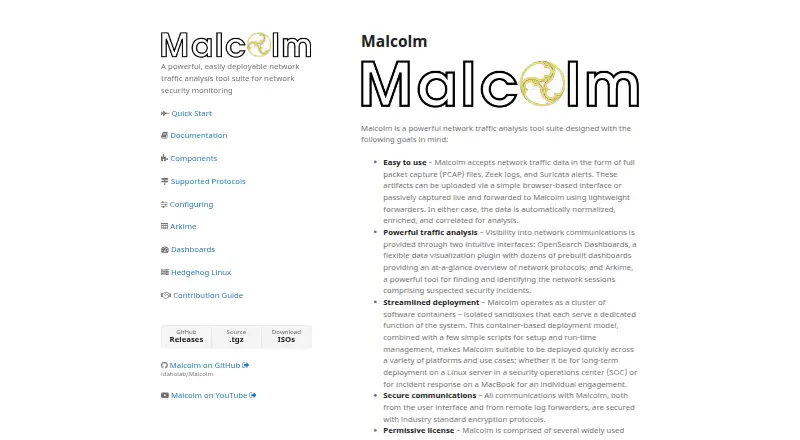
Malcolm is a free suite for analyzing network traffic in security-monitoring work. PCAP files, Zeek logs, and Suricata alerts arrive through browser uploads or lightweight forwarders, which can also send live captures. Analysts use OpenSearch Dashboards and Arkime to examine sessions enriched with GeoIP, hardware, asset, and JA4 details. Deployment is available through containers or a Debian-based installer.
Review
In a line
Malcolm is a deployable suite for examining network traffic during security monitoring. It is free and can run on your own systems.
What it does
Users can upload PCAP files, Zeek logs, and Suricata alerts in a browser; lightweight forwarders also relay captured traffic for live analysis.
Prebuilt views come from OpenSearch Dashboards, and Arkime supports finding and identifying network sessions. Session records also receive GeoIP, hardware-manufacturer, asset-inventory, and JA4 fingerprinting enrichments.
How it connects
Docker, Podman, and Kubernetes can run Malcolm's container cluster, including on AWS Kubernetes deployments. It can also be installed from a standalone Debian-based ISO. Analysts open its interfaces in a web browser.
It includes a REST API, which can pass requests to Logstash, OpenSearch, NetBox, and Arkime APIs. Its wider component set includes Zeek, Suricata, Strelka, YARA, Capa, ClamAV, MISP, TAXII, PostgreSQL, Valkey, and Keycloak.
Malcolm's source is available under Apache License 2.0. Host-configuration guidance is provided for Linux, macOS, and Windows, and a command-line tool is available.
Good fit
The project targets security operations centers, smaller networks, home environments, and field incident-response work. It can support long-term monitoring as well as short investigations.
It supports live capture and PCAP files, and its dashboards and session search are designed for analyst workstations or SOC displays.
Watch for
Direct capture on a local network interface is unavailable when Malcolm uses rootless Podman. Metadata from a network sensor appliance can still be accepted.
Using the ISO causes every non-removable storage medium to be partitioned and formatted without a warning or partitioning confirmation. Check the storage setup before using the ISO.
Authentication can use local accounts, LDAP, TLS certificates, or Keycloak roles. Industry-standard encryption protects interface and remote-forwarder communications.
Pricing
Malcolm uses a free pricing model and lists a free plan.
Verdict
Malcolm fits teams seeking self-hosted, no-cost collection and investigation of network evidence through several established security tools. Its browser dashboards, session search, enrichment lookups, REST API, and container deployment give teams several ways to operate it.
Consider another option if you must capture directly from local interfaces while using rootless Podman, or if an installer must protect existing disks with confirmation steps. Teams should also plan authentication, storage, and deployment before putting it into regular monitoring.
Our take
Malcolm is a sensible choice for teams that want free network monitoring they can host themselves. It accepts common capture and alert data, supports live forwarding, and brings dashboard views, session search, enrichment, and API access together. The Apache-licensed code and container options suit organizations that manage their own infrastructure. Be careful with the ISO installer's disk behavior, and avoid rootless Podman for direct local-interface capture. Its broad authentication and integration options may fit a SOC, a small network, a home lab, or an incident-response assignment.
- Free pricing model with a listed free plan
- Accepts PCAP files, Zeek logs, and Suricata alerts
- OpenSearch dashboards plus Arkime session search
- REST API and many security-tool integrations
- Docker, Podman, or Kubernetes deployment
- Rootless Podman lacks direct capture from local network interfaces
- The ISO formats non-removable storage without warning
- Self-hosted deployment requires managing containers or an ISO
- Pick it ifSecurity operations centers and long-term monitoring; Smaller networks, home environments, and incident response; Teams wanting self-hosted network analysis
- Skip it ifYou need direct local-interface capture with rootless Podman; You require installer partitioning confirmations before disk changes
Pricing
Malcolm is free and lists a free plan.
Questions
Is Malcolm free?
Yes. Malcolm uses a free pricing model and lists a free plan.
Which inputs can Malcolm analyze?
The browser accepts PCAP files, Zeek logs, and Suricata alerts, while lightweight forwarders can send those data types during live capture.
How do analysts view Malcolm data?
OpenSearch Dashboards provides prebuilt dashboards, and Arkime provides search and identification for network sessions. Access is through a web browser.
Does Malcolm have an API?
Yes. Malcolm provides a REST API and forwards requests to Logstash, OpenSearch, NetBox, and Arkime APIs.
Which operating systems can host Malcolm?
Host-configuration documentation covers Linux, macOS, and Windows. Malcolm can run in containers or from a Debian-based installer ISO.
What is the Podman limitation?
Malcolm cannot capture on local network interfaces under rootless Podman, but it can take in metadata forwarded by a network sensor appliance.
What should I know about the installer?
The ISO provides no partitioning confirmations and formats every non-removable storage medium without warning.