
Radioso: Open-Source Agents for Customer Work
radioso.ai · checked 21 Oct 2026
Customer-facing agents from Radioso handle support work, lead qualification, and handoffs while keeping the code open source.
How it plugs in
Signal on Chatbot builders7.7#4 of 257
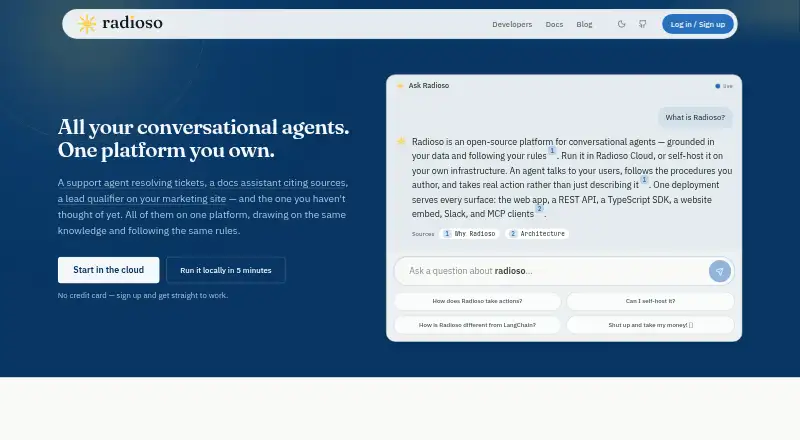
Radioso gives organizations AI agents that draw on documents and shared knowledge, perform multi-step routines, call tools, fire webhooks, qualify leads, and transfer harder cases to people. Access is available through Slack, web interfaces, an API, a TypeScript SDK, or an MCP server, with deployment in Radioso Cloud or on infrastructure the customer operates.
Review
In a line
An open-source Radioso workspace lets teams assemble agents for support and lead work. Those agents use organizational knowledge and can route a conversation to staff when automation reaches its limit.
What it does
Help-center material and policy content give agents a basis for routine jobs such as returns and escalations. Responses may include citations drawn from uploaded files and knowledge connected across channels.
Stateful routines cover several steps, including booking flows. Registered tools, webhooks, and asynchronous actions are available, and a person can receive the transcript plus completed actions when the agent stops.
In Slack, users can mention @Radioso or send it a direct message to ask questions, run routines, or hand a case to a teammate.
How it connects
Assistants are reachable through public chat, a site embed, Slack, plain HTTP REST endpoints, a typed TypeScript client, and an MCP server. REST focuses on conversations and product workflows, while @radioso/mcp-server makes conversations and workspace documents available to MCP clients with retrieval and citations.
OpenAI and Anthropic are among the configurable providers. Teams may enter their own model credentials instead of paying inference markup. Documents and connected sources are chunked, embedded, and tagged with metadata for retrieval.
The complete system may be deployed on customer infrastructure with customer-managed Postgres and model keys, or used through Radioso Cloud. Code outside ee/ is Apache License 2.0, whereas ee/ contains proprietary Enterprise Edition software. See other conversational AI platforms if you need to compare approaches.
Good fit
The product is presented for high-volume customer-experience operations, product builders adding service agents, and teams responsible for knowledge bases.
It suits organizations needing document-based answers, lead qualification, multi-step support routines, tool calls, and contextual transfer to a live person. Operating the platform and supplying model keys yourself is an option for self-hosting teams.
Watch for
Generated answers can be wrong or incomplete, and the terms make no uninterrupted-service promise. Review responses and escalation routes before using automation for consequential cases.
Radioso Cloud uses Google Cloud Platform in an EU region and PostHog EU Cloud for analytics. Configured AI providers may handle prompts and retrieved context primarily in the United States. Cloud content remains while the workspace retains it; backups are removed within 35 days, operational logs remain up to 90 days, and audit and security events up to 12 months.
A June 2026 repository review identified credentials in HTTP logs, proxy-related rate-limit weaknesses, and an SSRF gap involving crawler redirects as fixes or backlog items. Check the current code against your security needs before deployment. Cloud fees are not published; the documented bootstrap calls for Node 24 and Docker Desktop and starts the web app on port 3000 with the API on 8080.
Pricing
The Open source and Open-source edition offerings have no charge and include the product capabilities for self-hosting. Open-source edition code is the Apache-2.0 repository portion.
Enterprise Edition uses a negotiated price, a written commercial agreement, and covers scaled multi-tenant deployments plus the proprietary ee/ directory. Radioso Cloud also uses negotiated pricing, with billing and limits specified in each customer agreement.
Verdict
Radioso is a candidate for teams wanting open-source agents grounded in documents, lead qualification, and workflows that can move from automation to a teammate. It is particularly relevant when self-hosting, customer-supplied model credentials, or API and SDK access are priorities.
Consider alternatives if you require posted cloud rates, dependable accuracy guarantees, or no responsibility for infrastructure. Organizations with sensitive data should review provider transfers, retention terms, and the reported security items before choosing Cloud or self-hosting.
Our take
Radioso fits teams building support or lead workflows around their own documents and policies. Free open-source offerings provide a self-hosted route, while the API, SDK, Slack app, widget, and MCP server provide multiple access paths. Cloud charges are negotiated, responses can be inaccurate or incomplete, and configured providers may process data in the United States. Customer-operated deployments also require attention to infrastructure, storage, security, and model credentials. Choose it when control and workflow flexibility justify that work.
- No-cost open-source offerings for self-hosting
- Available in customer-operated environments or Radioso Cloud
- Slack, web embed, REST, SDK, and MCP access
- Routines can invoke tools and webhooks
- Transfers include conversation context and completed actions
- Cloud fees and limits are negotiated privately
- Generated responses can be inaccurate or incomplete
- Configured providers may process prompts mainly in the United States
- The documented bootstrap uses Node 24 and Docker Desktop
- A 2026 review identified security fixes and backlog items
- Pick it ifSupport operations with many routine tickets; Product teams adding service agents; Knowledge-base groups working on lead qualification
- Skip it ifYou require publicly listed cloud rates; You cannot review agent answers or run customer infrastructure; Your policy prohibits provider processing in the United States
Pricing
Open-source offerings are free for self-hosting. Enterprise Edition and Radioso Cloud use negotiated commercial arrangements.
- Open sourceAll product features included · self-host on your own infrastructureFree
- Open-source editionApache-2.0 repository code · self-hosted · all product featuresFree
- Enterprise EditionWritten commercial agreement required · Multi-tenant deployments at scale · commercial ee/ directoryOn request
- Radioso CloudIndividually arranged; no public pricing page · Subscription limits set in customer agreementOn request
As radioso.ai lists them, checked 9 Oct 2026.
Questions
Is there a free Radioso option?
Yes. The Open source and Open-source edition offerings are free for self-hosting and include all product features.
Can we deploy the platform ourselves?
Yes. Radioso can run on customer infrastructure with customer-managed Postgres and model keys.
How can users reach Radioso assistants?
Channels include Slack, public chat, an embedded website widget, a REST API, a TypeScript SDK, and an MCP server.
Can an agent pass a case to a person?
Yes. If automation cannot complete the case, the conversation goes to a person with its transcript and actions attached.
May we provide our own model keys?
Yes. Customers can supply model credentials, and configurable providers include OpenAI and Anthropic.
How is Radioso Cloud billed?
Cloud pricing is available on request; billing is arranged individually and limits appear in the customer agreement.
Are customer prompts used to train Radioso's models?
Radioso says ingested content, conversations, and prompts are not used to train its own general-purpose models.