Segments.ai: Multi-Sensor Data Labeling Platform
segments.ai · checked 15 Oct 2026
Cloud labeling for robotics data across 2D, 3D, video and multiple sensors.
How it plugs in
Signal on Image Annotation Software6.3#6 of 28
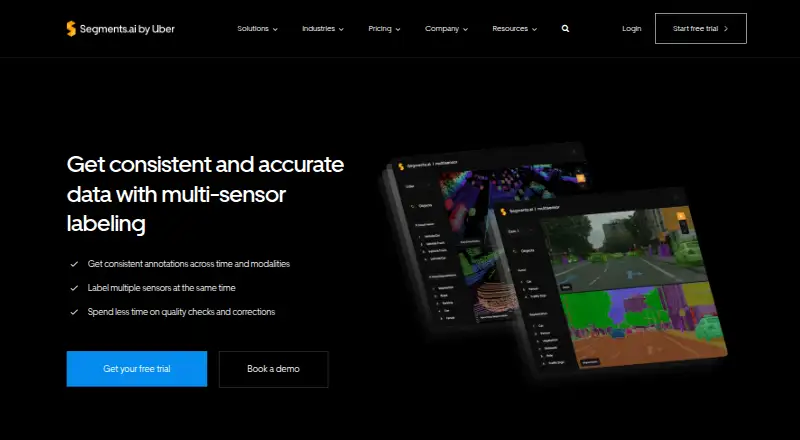
For robotics and autonomous-vehicle teams, Segments.ai provides web-based labeling of images, videos, point clouds and synchronized sensor views. Its tools cover 2D and 3D annotation, machine-assisted review, APIs and a Python SDK. Qualifying academics can request no-cost non-commercial access, while commercial plans are quoted.
Review
In a line
Segments.ai is a web service for preparing computer-vision data in robotics and autonomous driving. Images, video, 3D point clouds and several sensor feeds can be handled together.
What it does
Images and point clouds can receive segmentation, boxes, cuboids, polygons, polylines and keypoints. For images, the toolkit also offers semantic, instance and panoptic segmentation, superpixels, Autosegment and hover-and-click methods.
Batch Mode, merged point clouds, interpolation and automatic tracking help extend annotations through video and 3D sequences. Uploaded model outputs can serve as pre-labels for checking and correction.
How it connects
A REST API and Python SDK support dataset creation, uploads, labels, releases and downloads. The SDK is installed with pip, and its public repository uses the MIT license. API access uses an API key.
Output options cover JSON, PyTorch, TensorFlow and Hugging Face. The documentation also lists TensorFlow and PyTorch integrations, AWS S3 cross-account access, Azure Blob Link Service and customer-managed cloud buckets. Data labeling software
Segments.ai runs as a cloud service on the web and through its API. Its own upload storage limits files to 100 MB; production guidance recommends keeping assets in your own bucket. No self-hosted package is provided in the documented options.
Good fit
Segments.ai is intended for computer-vision engineers and data scientists working on autonomous robots and vehicles. It is useful when 2D and 3D labels must coexist, labels need projection between sensors, and datasets are managed in code.
Unlimited seats and projects are included in the paid plans. Team collaboration, quality checks and organization tools are available on Core, while Fusion adds sensor-fusion interfaces, webhooks, metrics and access to a labeling workforce.
Watch for
Each Core point cloud may contain up to 500,000 points. Fusion allows point clouds and images without the stated size or resolution caps. Individual reviews describe slow or stalled loading for computationally heavy or very large 3D sequences.
New users may face a steep learning curve, complex features and limited training material. Check export needs, storage arrangements and the level of support your team requires before choosing a plan.
Pricing
Non-commercial academic researchers can seek a free Academic license, subject to a request. Segments.ai also advertises a 14-day trial.
Core is price on request, starting at 3,600 hours a year (equivalent to $2.67 an hour). Enterprise is price on request and includes 150,000+ hours a year. Fusion is price on request, starting at 5,000 hours a year.
Verdict
Segments.ai makes sense for projects combining camera and point-cloud data, requiring consistent labeling across sequences, or depending on API and SDK workflows. Its academic license may suit non-commercial research.
Look elsewhere if you need a self-hosted product, simple onboarding for occasional annotators, or guaranteed performance on very large 3D sequences.
Our take
Segments.ai suits organizations creating robotics or autonomous-driving datasets that require synchronized 2D/3D annotation, machine-assisted checking and automated data workflows. Qualifying research users can access it free, while commercial buyers should expect a sales quote and confirm storage, export and support details. Teams with very large point clouds, little training time or a need to run the software on their own servers may prefer another labeling tool.
- 2D and 3D labels can be viewed and projected across sensors.
- REST API and MIT-licensed Python SDK support data workflows.
- Output formats include JSON, PyTorch, TensorFlow and Hugging Face.
- Qualifying academic research can use a free license.
- Fusion permits point clouds and images of unlimited size and resolution.
- Core point clouds are limited to 500,000 points each.
- Commercial prices require a custom quote.
- Documentation notes no self-hosted deployment package.
- New users may face a steep learning curve.
- Heavy 3D sequences can be slow or get stuck.
- Pick it ifRobotics and autonomous-vehicle computer-vision teams; Teams labeling images, video and point clouds together; Researchers needing a free non-commercial academic license
- Skip it ifYou require self-hosting or a published fixed price.; Your work depends on consistently fast, very large 3D sequences.; Your annotators need extensive beginner training materials.
Pricing
Academic use can be free with approval. Commercial Core, Enterprise and Fusion plans use custom quotes; Core and Fusion list annual hour starting points. A 14-day trial is available.
- Academic license100% free for non-commercial academic research · For students and researchers with non-commercial academic use · License request requiredFree
- CoreCustom quote; starting at 3,600 hours/year (equivalent to $2.67/hour) · Unlimited seats · Unlimited projects · Unlimited images and point clouds · Unlimited API and SDK access · Point clouds up to 500,000 points each · ML labeling tools · Cloud bucket integrations · QA and organization managementOn request
- EnterpriseCustom quote; includes 150,000+ hours/year · Unlimited seats · Unlimited projects · Unlimited images and point clouds · Unlimited API and SDK access · Custom interfaces · Custom pipelines and workflows · Technical-roadmap influence · Custom security solutionsOn request
- FusionCustom quote; starting at 5,000 hours/year · Unlimited seats · Unlimited projects · Unlimited images and point clouds · Unlimited API and SDK access · Unlimited-size point clouds and images · Sensor fusion interfaces · Webhooks · Priority support · Metrics dashboard · Labeling workforce access · Mail, Slack and Discord supportOn request
As segments.ai lists them, checked 8 Oct 2026.
Questions
Does Segments.ai have a free plan?
Yes. Non-commercial academic researchers can request its free Academic license. A 14-day trial is also advertised.
What data can Segments.ai label?
Images, videos, 3D point clouds and multi-sensor data are supported, along with segmentation, boxes, cuboids, polygons, polylines and keypoints.
Does Segments.ai offer an API?
Yes. Its REST API authenticates with an API key, while the Python SDK handles dataset creation, uploads, labeling and release exports.
Can I keep files in my own cloud storage?
Yes. Documentation describes AWS S3 cross-account access, Azure Blob Link Service and customer-managed buckets. The built-in uploader limits files to 100 MB.
What are the Core plan limits?
Core provides unlimited images and point clouds, with a maximum of 500,000 points in each point cloud. Pricing is by custom quote.
Is Segments.ai open source or self-hosted?
The product is not open source and is presented as a cloud service. The public Python SDK repository is MIT licensed, but no self-hosted product package is documented.