
Sentry WMS: Open-Source Warehouse Management
hightower-systems.github.io · checked 14 Oct 2026
Open-source warehouse tools for e-commerce fulfillment.
How it plugs in
Signal on Warehouse Management Software7.4#3 of 44
Built for e-commerce fulfillment, Sentry WMS manages receiving, storage, picking, packing, shipping, counting, and transfers at no charge. An existing ERP or database remains the authoritative record. Web and Android clients, a REST API, Docker-based self-hosting, barcode operations, and support for multiple warehouses are included, while several named commerce and accounting platforms lack built-in connectors.
Review
In a line
For e-commerce fulfillment, Sentry WMS provides warehouse management software that is free and open source. It runs as a self-hosted service with web and Android apps.
What it does
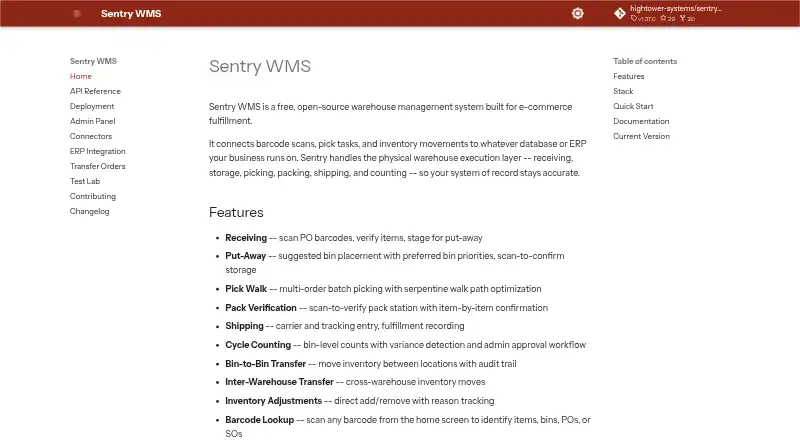
The system coordinates barcode-based receiving, put-away, picking, packing, shipping, counting, and inventory transfers. Workers can scan purchase orders, items, bins, and sales orders from the mobile app.
Pick Walk groups several orders into one batch and suggests a serpentine route through the warehouse. At packing, each item is verified by barcode; shipping entries include carrier, tracking, and fulfillment details.
Bin-level cycle counts flag differences for administrator approval. Transfers between bins and warehouses keep audit records. Sentry expects another system to manage orders, products, and customers; it is not an ERP.
How it connects
Sentry provides a documented REST API for authentication, warehouse tasks, inventory, transfers, lookups, and administration. Machine-readable options include webhooks, outbound event polling, inbound writes for five resource types, shipping endpoints, and point-of-sale endpoints. Programmatic callers use bearer tokens; the browser panel uses HttpOnly cookies with CSRF protection.
Its connector framework provides scaffolding for ERP, commerce, and other HTTP API links. Direct, first-party integrations for NetSuite, QuickBooks, Shopify, and BigCommerce are not shipped. There is no separate vendor SDK package listed.
The project is open source. Installation uses Docker Compose after cloning the public repository and setting secrets. The documented stack includes React, React Native with Expo, Flask, PostgreSQL 16, and Vite. Production HTTPS needs a reverse proxy because the API is HTTP-only.
Good fit
For e-commerce operations with an ERP or database already in place, Sentry supplies a warehouse execution layer. It supports barcode work, batch picking, cycle counts, transfers, and more than one warehouse.
It may also fit teams able to run their own Docker-based service and connect systems through the API or connector framework. See Warehouse Management Software for the wider category.
Watch for
You must supply the existing system of record for orders, products, and customers. Connecting it to other software may require your own connector work because named systems such as Shopify and NetSuite have no first-party connectors yet.
Self-hosting requires Docker Compose, configured production secrets, and deployment work. Bulk CSV or JSON imports allow up to 5,000 records per import. Check the repository license for your release: versions before v1.7.0 are MIT-licensed, while v1.7.0 and later use Apache License 2.0.
Pricing
Sentry WMS has a free, self-hosted, open-source offering. No paid tiers are stated, and there is no free trial.
Verdict
Choose Sentry WMS when your warehouse needs barcode-led execution and your business already relies on another platform for core records. Its API, mobile app, batch picking, counting controls, and multi-warehouse support cover the listed warehouse workflows.
Look elsewhere if you need a ready-made ERP, managed hosting, or turnkey links to the named commerce and accounting products. Order Fulfillment Software can help compare adjacent options.
Our take
Sentry WMS makes sense for an e-commerce warehouse that can run software itself and keep an ERP or database in charge of business records. The free Apache/MIT-licensed code, Android and web clients, barcode flows, and documented API give technical teams room to adapt it. The trade-off is responsibility: deployment, HTTPS setup, secrets, and missing first-party connectors remain yours. Businesses wanting a hosted service or a complete order and product system should consider another tool.
- Free, open-source software with self-hosted deployment
- Barcode workflows cover receiving, storage, picking, packing, and shipping
- Batch picking uses an optimized serpentine route
- Cycle counts include variance checks and approval
- Supports Android, web, API, and multiple warehouses
- Not an ERP; it relies on an existing order and product system
- Named systems including NetSuite, QuickBooks, Shopify, and BigCommerce lack first-party connectors
- Running it yourself calls for Docker Compose and production secrets
- CSV or JSON imports top out at 5,000 records
- A reverse proxy must sit before the API for HTTPS
- Pick it ifE-commerce warehouses with an existing ERP or database; Teams that can self-host and build API connectors; Operations needing barcode and multi-warehouse workflows
- Skip it ifYou need managed hosting or a complete ERP; You require ready-made Shopify, NetSuite, QuickBooks, or BigCommerce links; Your imports regularly exceed 5,000 records
Pricing
Sentry WMS is offered as a free, open-source, self-hosted plan. No paid tiers are stated, and there is no separate free trial because the product is already free.
- Free, open-sourceFree forever · Self-hosted deployment · no paid tiers statedFree
- Sentry WMSFree and open source · self-hosted deploymentFree
As hightower-systems.github.io lists them, checked 14 Oct 2026.
Questions
Is Sentry WMS free?
Yes. The Sentry WMS offering is free forever, runs on your own infrastructure, and has no paid tiers stated.
Does Sentry WMS replace an ERP?
No. It performs warehouse operations while an existing ERP or database handles orders, products, and customers.
Which systems connect directly to Sentry WMS?
A connector framework and API are available, but first-party integrations for NetSuite, QuickBooks, Shopify, and BigCommerce are not included.
Can Sentry WMS run on Android?
Yes. Its deployment instructions cover sideloading an APK and pointing it at the operator's API server.
What warehouse tasks does it support?
Receiving, put-away, batch picking, packing, shipping, cycle counting, bin and warehouse transfers, and barcode lookups are covered.
How large can an import be?
The Admin Panel accepts up to 5,000 records in a bulk CSV or JSON import.
Is Sentry WMS open source?
Yes. Releases earlier than v1.7.0 remain under MIT, while v1.7.0 and newer releases use Apache License 2.0.