
Sentry WMS: Open Warehouse Software for E-commerce
github.com · checked 21 Oct 2026
Self-managed warehouse execution for e-commerce teams, with open code.
How it plugs in
Signal on Warehouse Management Software7.6#2 of 44
Sentry WMS handles warehouse tasks from inbound receiving through outbound fulfillment for e-commerce operations. It is deployed by the customer and combines Android and web interfaces with a Flask API and PostgreSQL. The software costs nothing, while connecting it to platforms such as NetSuite, QuickBooks, Shopify, or BigCommerce requires work through its connector framework.
Review
In a line
Sentry WMS is open-source software focused on warehouse execution for online fulfillment. It performs physical warehouse activities while an ERP or another system of record retains business information.
What it does
Warehouse functions include receiving, storage, picking, packing, shipping, and stock counts. Receiving can scan purchase-order barcodes, check items, and stage goods for put-away. Put-away suggests bins by priority and confirms storage with a scan.
Orders can be picked in multi-order batches using serpentine route optimization. At the pack station, each item is barcode-checked; shipping captures carrier and tracking information before marking the order fulfilled.
Bin-level cycle counts identify quantity variances and may require administrator approval. Staff can record reasoned inventory additions or removals, move stock between bins or warehouses, and scan the mobile home screen to identify items, bins, purchase orders, or sales orders.
How it connects
An HTTP API exposes authentication plus endpoints for receiving, put-away, picking, packing, shipping, inventory, transfers, lookups, and administration. Through the inbound API, outside systems can submit sales orders, items, customers, vendors, and purchase orders using source-specific YAML mappings and scoped WMS tokens.
The connector framework targets ERP products such as NetSuite and QuickBooks, along with commerce services including Shopify and BigCommerce; first-party links to those services are not included yet. Operators or developers are expected to write connectors against the interface.
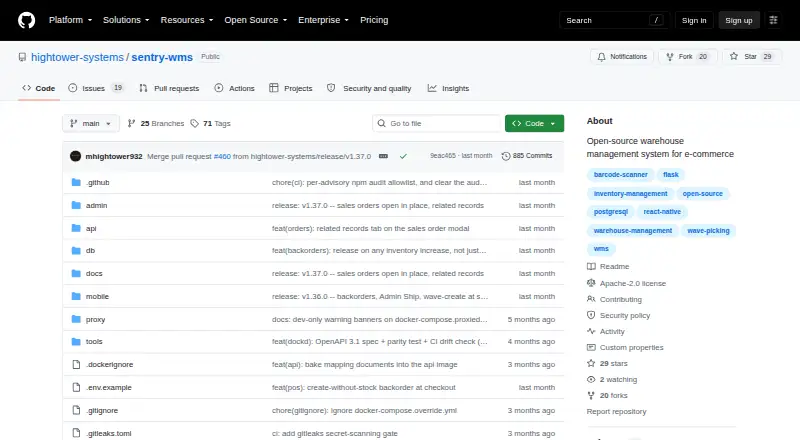
Docker Compose is used in the documented setup, which includes a Flask API, PostgreSQL 16, a React administration panel, Redis, a Celery worker, and a React Native Expo mobile app. The public repository is under the Apache-2.0 license; releases before v1.7.0 remain MIT-licensed.
Good fit
Sentry is aimed at e-commerce businesses that already use an ERP or other system of record and want a distinct warehouse-execution layer. It supports multiple warehouses, Android mobile work, barcode scanning, batch picking, and self-managed deployment.
It can fit teams that want to inspect or contribute to open-source code and connect warehouse activity to their own systems through the API or custom connectors.
Watch for
This is not an ERP for maintaining orders, products, or customers. Its maker describes first-party ERP and commerce connections as planned for version 2.0.0, leaving integration work potentially with your team.
Running the software yourself means using Docker and Docker Compose. A project issue also notes that mobile builds still permit cleartext HTTP as an accepted risk, so assess the deployment and security configuration before adoption.
Pricing
Sentry WMS is available at no software charge and uses an open-source license. Its self-hosted offering lists no monthly payment or per-user price. A trial is not provided because the available plan is free.
Running it yourself still means providing and maintaining the required server environment and deployment components.
Verdict
Sentry makes sense for an e-commerce operation that needs warehouse workflows, already has a system of record, and can manage self-hosting or connector development. Its coverage includes the main warehouse steps, mobile barcode workflows, multi-warehouse transfers, and a documented API.
Teams needing turnkey connections to NetSuite, QuickBooks, Shopify, or BigCommerce, or an ERP that owns customer, product, and order records, should look elsewhere.
Our take
For e-commerce teams, Sentry WMS offers a no-cost warehouse layer that can be operated locally and linked to an existing ERP. It covers receiving through shipping, barcode work, batch picking, cycle counts, transfers, and audit records. The compromise is integration effort: ready-made connectors are absent, and the product is not an ERP replacement. Docker-based deployment and the documented mobile HTTP risk also require attention. It suits teams that value control and source access over turnkey operation.
- No-cost warehouse execution software with open code
- Handles receiving, put-away, picking, packing, and shipping
- Android app supports barcode lookup and scanning
- Multiple warehouses and bin-level stock controls
- HTTP API plus a framework for custom connectors
- First-party ERP and commerce links are not included
- Docker and Docker Compose are required for self-hosting
- ERP duties such as product and customer management are outside its scope
- Mobile builds permit cleartext HTTP as an accepted risk
- Pick it ifE-commerce operations that already have an ERP or system of record; Teams prepared to self-host and develop connectors; Warehouses needing mobile barcode and batch-picking workflows
- Skip it ifYou require ready-made NetSuite, QuickBooks, Shopify, or BigCommerce links; You want a hosted warehouse service or complete ERP; Your team cannot maintain Docker-based infrastructure
Pricing
Sentry WMS has a free plan and open-source code. Self-hosted use lists no monthly or stated per-user charges, but infrastructure and integration work remain your responsibility.
- Free, open-sourceSelf-hosted deployment · No first-party ERP or commerce connectors yetFree
- Self-hosted Sentry WMSSelf-hosted · no monthly fees · no per-user pricing statedFree
As hightower-systems.github.io lists them, checked 7 Oct 2026.
Questions
Is Sentry WMS available without a software fee?
Yes. The self-hosted software is free and open source, with no monthly or stated per-user charge.
Are Shopify or NetSuite links included?
Not as first-party connectors. Shopify, BigCommerce, NetSuite, and QuickBooks are framework targets, but operators or developers must build the connections.
Can it serve as the ERP?
No. Sentry performs warehouse execution and depends on another system of record for orders, products, customers, and related business data.
Which warehouse operations are covered?
Its workflows include receiving, put-away, batch picking, barcode checks during packing, shipping records, cycle counts, inventory adjustments, and transfers between bins or warehouses.
Is an API available?
Yes. The HTTP reference covers authentication, warehouse activities, inventory, transfers, lookups, and administrative endpoints, with inbound updates for several business-data objects.
What deployment environments are documented?
Documentation lists Android, web, Linux, API access, and self-managed installations. Docker Compose runs the API, database, admin panel, Redis, and worker.
What merits review before deployment?
Allow for Docker and Docker Compose, custom connector development, and a security review. Mobile builds are documented as allowing cleartext HTTP under an accepted-risk classification.