Supavisor: PostgreSQL Connection Pooler Review
github.com · checked 21 Oct 2026
Open-source Postgres connection pooler for multi-tenant or single-tenant deployments.
How it plugs in
Signal on Database Proxy Software7.3#4 of 31
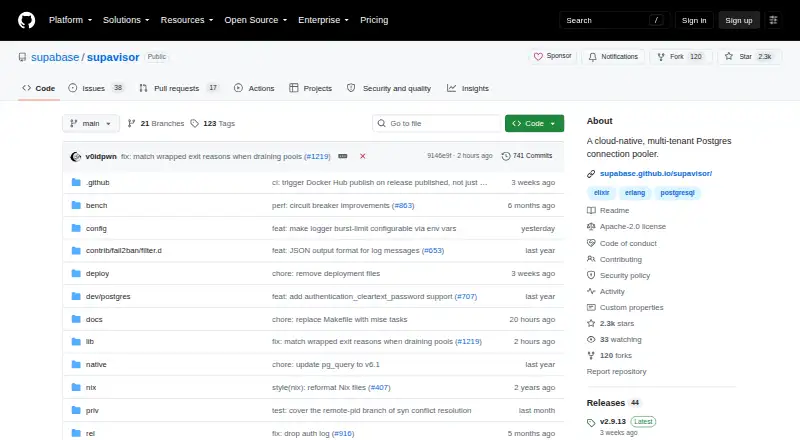
Supavisor manages large numbers of PostgreSQL client connections by placing pooled database connections behind a proxy. It supports transaction, session, and native modes, multiple tenants, metrics, an OpenAPI management interface, and high-availability cluster behavior. It runs on Linux or as a self-hosted API service, with free open-source use and hosted Supabase plans.
Review
In a line
Supavisor is an open-source, cloud-native proxy that pools PostgreSQL connections. A cluster can send very large numbers of client connections through a smaller pool of native database connections.
What it does
It supports transaction, session, and native pool modes. Transaction mode returns a database connection after each transaction; session mode keeps it for the client connection; native mode acts like a direct PostgreSQL connection and is generally used for migrations.
A cluster can serve several PostgreSQL instances or clusters as separate tenants, or run as a single-tenant replacement for PgBouncer. Client credentials can be checked against tenant users or an authentication query.
The project reports a load test with 1,003,200 concurrent clients and more than 20,000 queries per second on two nodes. A published local test recorded 189.23 transactions per second for Supavisor versus 195.96 for PgBouncer under that test.
How it connects
Supavisor is available as open-source Apache-2.0 software for Linux, an API service, or self-hosting. Its management interface has an OpenAPI description at `/api/openapi` and a Swagger UI at `/swaggerui`.
It includes a Prometheus metrics endpoint and tenant-level throughput visibility. Pulumi and Terraform can configure clusters and tenant databases. Guidance covers Prisma, while Prisma, Drizzle, and Psycopg are listed as client ORMs.
Installation starts with a PostgreSQL database for tenant data, and the guide provides a Docker Compose command for PostgreSQL 14. A public container image lists linux/amd64 and linux/arm64 images for version 2.9.13.
Good fit
Supavisor suits teams that need PostgreSQL connection pooling across multiple tenants or a single-tenant PgBouncer replacement. It fits clustered deployments using rolling or blue-green updates.
It can monitor tenant traffic, handle replacement pools after a node failure when clients reconnect, and work with Prisma using the same connection-string pattern as PgBouncer.
Watch for
Supavisor is not intended for serverless environments and does not require Kubernetes. Setup includes a PostgreSQL database for its tenant data, and an independent comparison described the operator setup as difficult to understand.
Pooling can add latency, make authentication more complex, and create more troubleshooting paths. Transaction mode does not support ordinary prepared statements unless named-prepared-statements support is enabled; session mode supports them.
Clients above the configured limit receive a PostgreSQL “Max client connections reached” error. The project documents issues involving unavailable databases, DNS, authentication, node RPC timeouts, and pool limits. It does not provide automatic failover.
Pricing
The open-source Supavisor project is free under the Apache-2.0 license and can be self-hosted. Supabase also offers hosted plans that include its shared, multi-tenant Supavisor pooler.
The Free plan costs $0 a month. Pro costs $25 a month, Team costs $599 a month, and Enterprise pricing is on request. The plans add wider Supabase service limits and support features; the listed Supavisor self-hosting option remains free.
Verdict
Choose Supavisor when PostgreSQL connection pooling, tenant separation, or PgBouncer-style modes are central requirements and you can operate a persistent cluster. Its open code, metrics, management API, and infrastructure-as-code support help with controlled deployments.
Avoid committing without checking serverless compatibility, prepared-statement needs, client limits, and operational skills. If you only need a simple database connection, the extra proxy layer may add work and troubleshooting.
Our take
Supavisor is a practical choice for PostgreSQL systems that must absorb many client connections or separate several database tenants. It offers three pooling behaviors, an open-source license, management endpoints, metrics, and documented clustered deployments. The trade-off is operational: it needs persistent infrastructure and a PostgreSQL database for tenant data, is not aimed at serverless use, and can complicate authentication and troubleshooting. Check prepared-statement behavior and configured limits before migration. Its hosted Supabase plans cover buyers who prefer a managed service, while self-hosting is available at no software cost.
- Open-source Apache-2.0 project with self-hosted deployment
- Transaction, session, and native PostgreSQL pool modes
- Multi-tenant and single-tenant PgBouncer replacement options
- Prometheus metrics and OpenAPI management endpoints
- Rolling and blue-green deployment support
- Not intended for serverless environments
- Setup can be difficult to understand for operators
- Pooling may add latency and troubleshooting paths
- Transaction mode limits ordinary prepared statements
- No automatic failover
- Pick it ifPostgreSQL teams pooling connections across tenants; Single-tenant PgBouncer replacement deployments; Operators needing self-hosted, open-source infrastructure
- Skip it ifYou need a serverless-only deployment; Your application relies on ordinary prepared statements in transaction mode; You want a simple setup with no extra proxy operations
Pricing
Self-hosted Supavisor is free under Apache-2.0. Hosted Supabase options include Free at $0 a month, Pro at $25 a month, Team at $599 a month, and Enterprise at price on request.
- Free$0 / month · Unlimited API requests · 50,000 monthly active users · 500 MB database · 5 GB egress · 1 GB file storage · 2 active projects · projects pause after 1 week inactivityFree
- Open-source SupavisorApache-2.0 licensed; self-hosted deploymentFree
- ProFrom $25 / month · 100,000 monthly active users · 8 GB disk per project · 250 GB egress · 100 GB file storage · daily backups stored 7 days · 7-day log retention$25/mo
- TeamFrom $599 / month · SOC 2 and ISO 27001 · project-scoped and read-only access · HIPAA available as paid add-on · SSO · priority email support and SLAs · 14-day backups · 28-day logs$599/mo
- EnterpriseCustom · Technical account management · uptime SLAs · AWS PrivateLink · 24×7×365 premium support · private Slack channel · custom security questionnairesOn request
As supabase.com lists them, checked 21 Oct 2026.
Questions
Is Supavisor free?
Yes. The open-source Supavisor project is free to self-host under the Apache-2.0 license. Supabase also has a Free hosted plan at $0 a month.
Which database does Supavisor support?
Supavisor supports PostgreSQL connections and PostgreSQL instances or clusters.
Can Supavisor replace PgBouncer?
Yes. It supports single-tenant deployments as a drop-in PgBouncer replacement, and its pool modes can use the same connection-string pattern with Prisma.
Does Supavisor run in serverless environments?
No. The project says it is not intended to run in a serverless environment.
What happens when a client limit is reached?
Clients above the configured limit receive the PostgreSQL “Max client connections reached” error.
Does Supavisor support prepared statements?
Session mode supports prepared statements. Transaction mode needs named-prepared-statements support enabled for ordinary prepared statements.
How is Supavisor managed?
It lists an OpenAPI specification at `/api/openapi` and a Swagger UI at `/swaggerui`, plus a Prometheus metrics endpoint.