
UniTime Review
unitime.org · checked 15 Oct 2026
Open-source scheduling for university courses, exams, rooms, events and student class assignments.
How it plugs in
Signal on School Scheduling Software7.7#1 of 29
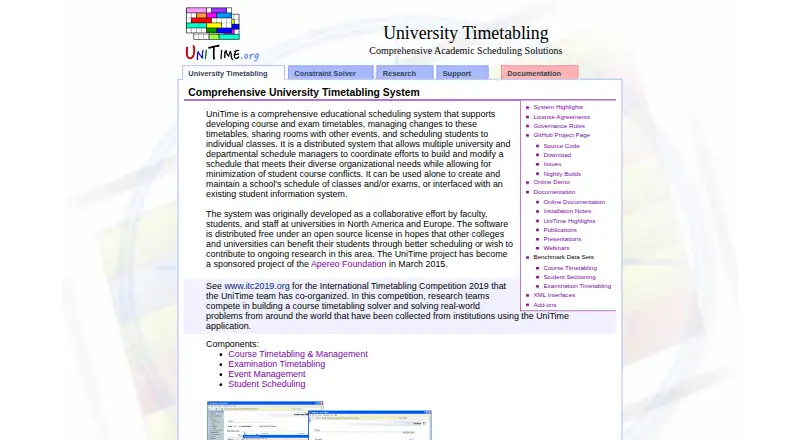
UniTime is a free, open-source system for schools, colleges and universities. It builds course and exam timetables, assigns students to classes, manages room sharing and handles events. It runs as a self-hosted web application on Linux, Windows or macOS, can connect with a student information system, and exchanges data through XML and REST interfaces.
Review
In a line
UniTime is a distributed higher-education scheduling system for courses, exams, students and events. Schools can run it themselves through a web interface.
What it does
Course scheduling can consider student demand, curricula, past patterns, faculty availability, rooms and related class requirements. After publication, an interactive solver can suggest limited-impact room or time changes while showing new conflicts and broken preferences.
The exam module creates midterm and final schedules while reducing direct, back-to-back and excessive-daily conflicts. Student scheduling places students into available class spaces using course requirements, past requests and timetable data, but it cannot guarantee that every conflict is removed.
Staff and students can request events or search for open times and locations in the web Events interface. Organizers receive notices about event requests. Room constraints, teacher constraints, conflict detection and automatic timetable work are supported.
How it connects
UniTime can operate alone or connect to an existing student information system. XML import and export cover academic, student, course and timetable data, and documented REST interfaces provide additional exchange options.
Its HTTP API supports basic login and optional API tokens. Documented permissions include roles, instructor schedules, classes, enrollments, events, rooms, student scheduling and data exchange. The project is open source under the Apache License 2.0, with public Java documentation, examples and extension repositories.
The application is self-hosted as a platform-independent archive deployed on Apache Tomcat with MySQL or Oracle. A Docker setup can expose it at localhost:8888. Installation material covers Linux, Windows and Mac, plus LDAP, CAS, OAuth2 and SSL settings.
Good fit
UniTime suits schools, colleges and universities where several departments or schedule managers coordinate academic calendars. It covers course timetabling, exam planning, student placement, room sharing and event requests in one system.
It may also fit teams looking for [School Scheduling Software]school scheduling software or dedicated [Exam Scheduling Software]exam scheduling software, especially when self-hosting and data exchange matter.
Watch for
Student scheduling is not guaranteed to solve every conflict. MariaDB may work, but the project explicitly does not support it; documented development and testing use MySQL 8.0 and Oracle 19c.
Check the server stack before deployment. UniTime 4.8 and 4.9 require Java 17 or newer. Version 4.9 requires Tomcat 10.1 or later, while 4.8 uses Tomcat 9, with a special Tomcat 10 build.
Version guidance needs attention: installation notes recommend 4.8 for production while the nightly-build page lists 4.9 as production. The project offers free email support for educational institutions, with extra services available for a fee.
Pricing
UniTime is free. The listed UniTime plan includes course timetabling, examination timetabling, student scheduling and event management at no charge.
The software is open source, but self-hosting still means arranging the server, database and administration needed for deployment.
Verdict
Choose UniTime if your institution needs one self-hosted place for academic timetables, exams, student assignments and events, with XML or REST data exchange and an open-source license.
It is a poor fit if you need guaranteed conflict-free student schedules, a hosted service with no server work, or MariaDB as a supported database. Confirm the UniTime and Tomcat version path, authentication setup and integration responsibilities before rollout.
Our take
UniTime is a practical option for higher-education organizations that want broad scheduling coverage without a software fee. Its open-source code, self-hosted deployment, APIs and XML exchange give administrators control over connections and data. The tradeoff is operational work: Java, Tomcat and a supported database must be maintained, and student assignment results can still contain conflicts. Institutions should also resolve the differing 4.8 and 4.9 production guidance before choosing a release. Smaller schools may find the setup heavier than their scheduling needs justify.
- Free plan covers courses, exams, students and events
- Open-source Apache 2.0 application
- XML exchange and REST interfaces are documented
- Runs on Linux, Windows and macOS through self-hosting
- Supports room, teacher and conflict constraints
- Student scheduling cannot guarantee every conflict is resolved
- MariaDB is explicitly unsupported
- Requires Java 17 or later for versions 4.8 and 4.9
- Self-hosting requires Tomcat and MySQL or Oracle
- Production guidance differs between 4.8 and 4.9
- Pick it ifUniversities coordinating courses, exams, rooms and events; Institutions needing open-source, self-hosted scheduling; Teams integrating schedules with student information systems
- Skip it ifYou need guaranteed conflict-free student assignments; You require a hosted service with no server administration; Your supported database must be MariaDB
Pricing
The UniTime plan is free and includes course timetabling, examination timetabling, student scheduling and event management. Self-hosting and administration remain your responsibility.
- UniTimecourse timetabling · examination timetabling · student scheduling · event managementFree
As apereo.org lists them, checked 15 Oct 2026.
Questions
Is UniTime free?
Yes. UniTime has a free plan covering course timetabling, examination timetabling, student scheduling and event management.
Who is UniTime for?
It is designed for schools, colleges and universities with multiple schedule managers coordinating courses, exams, rooms, students and events.
Can UniTime connect to other systems?
Yes. It can interface with an existing student information system and supports XML imports and exports plus documented REST interfaces.
Where can UniTime run?
It is self-hosted as a web application on Linux, Windows or macOS. Deployments use Apache Tomcat with MySQL or Oracle, and Docker is supported.
Does UniTime guarantee conflict-free student schedules?
No. The documentation says stochastic student scheduling cannot guarantee that every conflict will be resolved.
What database versions are supported?
MySQL 8.0 and Oracle 19c are used in development and testing. MariaDB may work but is explicitly unsupported.
Which Java and Tomcat versions are needed?
UniTime 4.8 and 4.9 require Java 17 or later. Version 4.9 requires Tomcat 10.1 or later; 4.8 uses Tomcat 9.
Is UniTime open source?
Yes. UniTime 4.x is distributed under the Apache License, Version 2.0, with public documentation and extension repositories.
Near it
All alternatives →- PTPrime Timetable#2 on this board
- PAPeñalara GHC#3 on this board
- ATaSc Timetables#4 on this board
- FFET#5 on this board
- T
 TimetableMaster#6 on this board
- MAMasterSchedule.app#7 on this board
- GEGC Education Analytics K–12 Master Scheduler#8 on this board
- S
 SchoolGrid#9 on this board
- OMOrchestra Master Scheduler#10 on this board
- AS
 Academic Scheduler#11 on this board