Event Volunteer Management Software
WhenToHelp Volunteer Scheduling Software Overview
whentohelp.com · checked 15 Oct 2026
Volunteer scheduling with shift automation, self-signup, reminders, and calendar connections.
How it plugs in
Signal on Event Volunteer Management Software6.6#5 of 29
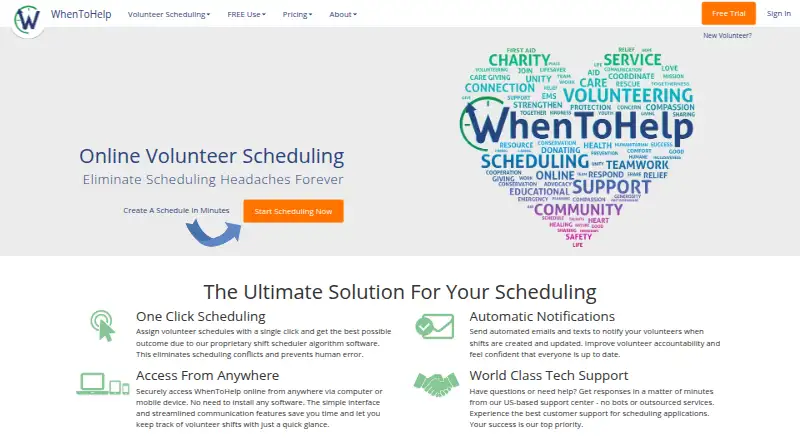
WhenToHelp is an online scheduling service for organizations coordinating volunteers. Coordinators build repeating schedules, assign shifts with AutoFill, and send email or text updates. Volunteers can manage their availability, submit time-off requests, take open shifts, and exchange assignments. The service works through web and mobile browsers, links with Google Calendar and Outlook, and has both free and paid options.
Review
In a line
WhenToHelp is cloud software for creating, publishing, changing, and tracking volunteer shifts. It is designed for organizations that coordinate unpaid or community-service volunteers.
What it does
Recurring schedules for one or more locations can be created from templates, with shifts repositioned through drag-and-drop editing. AutoFill places coverage according to volunteer availability, preferences, and scheduling constraints.
Volunteers can enter preferred times, ask for time off, claim open shifts, and swap assignments through the Tradeboard. The service sends schedule and change notices by email and text message.
Accounts can have unlimited coordinators with permissions that control what each person can view or change. Twelve configurable schedule layouts cover hourly through monthly views, and schedules can be printed or exported.
How it connects
Google Calendar and Outlook can show the schedules, and automatic export to each service is supported. Volunteer and schedule information can also be exported, while schedules can be printed to PDF or exported as text.
Access is listed for web, Android, and iOS. On phones and tablets, the mobile version is reached through a browser at m.whentohelp.com, without an app download.
The service is an online subscription with no documented self-hosting option, open-source license, public API, or SDK.
Good fit
WhenToHelp suits groups that need recurring volunteer coverage across one or more locations. It is useful when volunteers should manage availability, time off, open shifts, and trades themselves.
It also fits teams that want automated assignment, configurable coordinator permissions, calendar connections, and email or text reminders without running their own scheduling software.
Watch for
WhenToHelp Lite supports up to 250 volunteers, 100 shifts per week, and 18 months of past schedule information. Charities with a US 501(c)(3) designation or Canadian registered charity status that schedule unpaid volunteers can apply for extended free use.
The advertised trial lasts 30 days and needs no credit card, although the current trial page reports that new trials are closed and advises checking back in 2024. Confirm availability before relying on it.
Check whether browser-based mobile access meets your needs, since the mobile version does not require an app download.
Pricing
Qualifying charities may receive WhenToHelp Lite at no cost through extended free use. Full-version monthly prices begin at $16 for 1–10 helpers and increase by range: $33 for 11–30, $54 for 31–60, $78 for 61–100, $97 for 101–150, and $117 for 151–200.
Annual full-version pricing is $110 a year for 1–10 helpers, $220 a year for 11–30, $360 a year for 31–60, $520 a year for 61–100, $650 a year for 101–150, and $780 a year for 151–200. Monthly, 3-month, 6-month, and 1-year terms are listed, with no setup, add-on, multi-location, or department charges stated.
Verdict
Choose WhenToHelp if your organization needs volunteer scheduling with self-service signups, automated assignment, and calendar links. The free Lite option may work for eligible charities within its limits.
Look elsewhere if you require a documented public API, open-source code, self-hosting, or a downloadable mobile app. Also verify trial availability and confirm that the volunteer and shift caps match your operation before paying.
Our take
WhenToHelp is a practical match for organizations managing repeating volunteer coverage and frequent shift changes. Its strongest points are AutoFill assignment, volunteer self-service, coordinator permissions, and exports to Google Calendar and Outlook. The main tradeoffs are the lack of a documented public API or self-hosting option, browser-based mobile access, and limits on the free Lite tier. Pricing scales by helper count, with annual plans available. Charities should check eligibility for extended free use, while all buyers should confirm whether the advertised trial is currently open.
- AutoFill assigns shifts according to availability, preferences, and scheduling rules.
- Volunteers can submit time-off requests, take open shifts, and exchange assignments.
- Google Calendar and Outlook connections are supported.
- Coordinator accounts can be unlimited and permissions can be configured.
- Qualifying charities may use the free Lite plan.
- No public API or SDK is documented.
- No self-hosting deployment option is documented.
- The mobile experience is browser-based instead of requiring an app download.
- Lite limits volunteers, weekly shifts, and schedule history.
- The current trial page reports that new trials are closed.
- Pick it ifOrganizations coordinating recurring volunteer shifts; Charities seeking an eligible free Lite plan; Teams needing calendar exports and volunteer self-service
- Skip it ifYou need open-source code, self-hosting, or a documented public API.; You require a downloadable mobile app instead of browser access.; Lite's volunteer or shift limits are below your needs.
Pricing
Free Lite is limited and reserved for approved charities seeking extended free use. No setup or add-on charges are listed.
- WhenToHelp LiteExtended free use by application for qualifying charities · Up to 250 volunteers · 100 shifts per week · 18 months of past schedule information · approved charities onlyFree
- 1-10 helpers monthlymonthly · 1–10 helpers · full version$16/mo
- WhenToHelp Full VersionPay Monthly · 1–10 helpers · $33 for 11–30 · $54 for 31–60 · $78 for 61–100 · $97 for 101–150 · $117 for 151–200$16/mo
- 11-30 helpers monthlymonthly · 11–30 helpers · full version$33/mo
- 31-60 helpers monthlymonthly · 31–60 helpers · full version$54/mo
- WhenToHelp Full VersionTotal price 6 months · 1–10 helpers · 11–30: $132 · 31–60: $216 · 61–100: $312 · 101–150: $390 · 151–200: $468$66 one-time
- 61-100 helpers monthlymonthly · 61–100 helpers · full version$78/mo
- 101-150 helpers monthlymonthly · 101–150 helpers · full version$97/mo
As whentohelp.com lists them, checked 4 Oct 2026.
Questions
What does WhenToHelp do?
WhenToHelp is cloud software for creating, publishing, changing, and tracking volunteer shifts.
Is a no-cost WhenToHelp option available?
Qualifying charities may obtain WhenToHelp Lite through extended free use; the plan covers up to 250 volunteers, 100 shifts per week, and 18 months of past schedule information.
What are WhenToHelp's prices?
The full version starts at $16 per month for 1–10 helpers, or $110 for a year. Larger helper ranges cost more.
Can volunteers manage their own shifts?
Volunteers can set preferences, submit time-off requests, take open shifts, and exchange assignments through the Tradeboard.
Does it connect to Google Calendar and Outlook?
Yes. The schedules can appear in Google Calendar and Outlook, with automatic export to each service.
Is a WhenToHelp trial available?
The advertised trial runs for 30 days and requires no credit card. The current trial page reports that new trials are closed, so check availability first.
Does WhenToHelp offer a public API?
Official pages document exports and calendar connections but do not describe a public API or SDK.
Where can WhenToHelp run?
WhenToHelp lists web, Android, and iOS access. Mobile use takes place in a phone or tablet browser at m.whentohelp.com.