Zero Friction Cloud Meter-to-Cash Billing Review
zerofriction.co · checked 21 Oct 2026
Cloud software that takes heating and cooling meter data through billing and cash collection.
How it plugs in
Signal on Utility Billing Software5.6#6 of 26
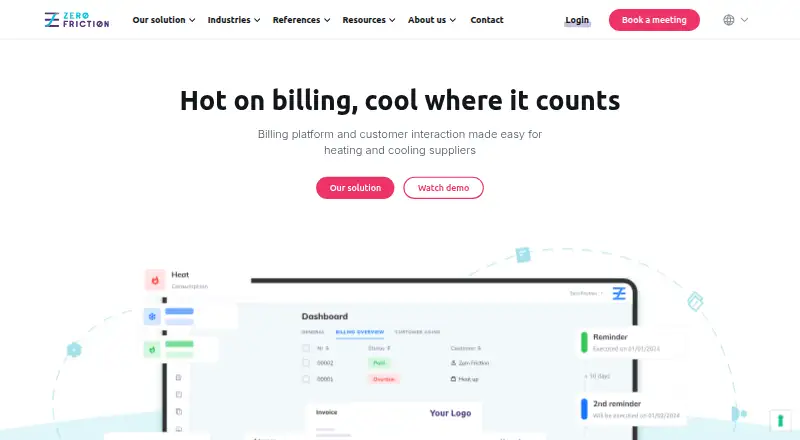
Zero Friction provides web-based billing for district-heating, communal-heating and cooling operations. It brings together meter imports, tariff setup, cost allocation, invoicing, payments, customer records and reporting. Data can arrive by API, file transfer or email. The platform is available on the web and via API; prices are quoted on request, and a free trial is offered.
Review
In a line
Heating and cooling suppliers, building managers and related service providers can use Zero Friction as a cloud meter-to-cash and billing platform. It automates work from meter readings to invoice creation.
What it does
The platform imports meter readings, applies fixed or usage-based rates, and creates invoices. It supports credit billing, cost allocations and pay-as-you-go arrangements across monthly, quarterly, half-yearly or yearly periods.
It calculates building heat losses and distributes the related costs among individual accounts. Payment options include direct debit, manual bank transfers, QR codes, payment links, reminders and payment plans.
An optional portal lets end customers see energy usage and invoices and complete relocations online. Users can configure products and tariff structures themselves.
How it connects
Meter data can enter through an API, secure file transfer, or email. Standard hourly readings are supported, with no stated maximum number of connections. Connections are available for meter-data management, CRM, ERP and banking systems, with Stripe, Zendesk, Freshdesk and Power BI named among the integrations.
Zero Friction publishes a developer portal containing API documentation, reference material, quick starts and interactive tools. API access uses subscription keys and OAuth 2.0 sign-in. The documented limits are 60 calls per minute on Standard and 600 on Enterprise; the Enterprise API is an additional paid product quoted on request.
Reports can be exported to Excel, viewed in embedded Power BI reports or sent to a data warehouse. Other named connections include Elvaco files and PEPPOL/UBL invoice exports. Standard APIs can also be used to integrate the customer portal.
Good fit
District-heating, communal-heating and cooling suppliers, along with building managers handling many accounts, are among Zero Friction's stated users. The company says the platform has no maximum connection limit and supports mixed billing, rate management, autopay and customer portals.
It can also fit teams that need payment collection, cost distribution, reporting and links to existing business systems. Included support offers self-service access around the clock plus chat, phone or email contact during Central European office hours.
Watch for
Beyond custom integrations, the company does not provide custom product development. Every customer uses the same SaaS product, while feature requests can be submitted or voted on.
Check that standard hourly metering meets your needs and review data-retention rules. The service stores data in European Union data centers on Microsoft Azure and states that it is GDPR compliant and ISO 27001 certified.
API capacity differs by plan, and Enterprise API use carries an additional charge. A personalized trial environment requires a trial agreement; a generic demo requires accepting the terms and conditions.
Pricing
There is no free plan. Prices are provided on request, and a free trial is available. SaaS pricing includes Azure data storage and processing, with support included in the monthly price.
SaaS billing combines per-connection and per-user fees with a one-time implementation charge and optional add-ons. BPO Standard and BPO Enterprise are billed monthly per connection; both include operational services, while Enterprise also covers cash collection, customer interaction, reporting and governance.
Verdict
Choose Zero Friction if you run heating or cooling services and want one system for metering, billing, payments, accounts and reporting. Its API, file imports and named business-system links can help it fit an existing setup.
Ask for a detailed quote and confirm integration, data-retention and customization needs before committing. Smaller teams wanting a simple, fixed-price billing app may prefer another utility billing software option.
Our take
Zero Friction serves heating and cooling suppliers, building managers and service providers. It covers the flow from meter data to collections, with customer self-service, reporting and several ways to connect other systems. The lack of a public price, no free plan and limited customization make a sales discussion necessary. It is a sensible shortlist choice for district or communal heating and cooling operations that need scalable connections and structured billing, but less suitable for buyers seeking a simple off-the-shelf app with transparent monthly pricing.
- Handles meter data, tariffs, invoices, payments and cost allocation
- Supports API, file-transfer and email meter imports
- Optional portal for energy usage, invoices and online relocations
- No stated maximum connection limit
- EU data centers and stated GDPR compliance
- Pricing is available only on request
- No free plan
- Custom development is limited to custom integrations
- Enterprise API access costs extra
- Standard hourly metering is the stated frequency
- Pick it ifDistrict and communal heating suppliers; Cooling providers and building managers; Teams connecting billing with existing business systems
- Skip it ifYou need transparent public pricing before speaking with sales; You require custom product development beyond integrations
Pricing
Paid service with pricing on request and no free plan. A free trial is available. SaaS uses per-connection and per-user charges plus a one-time implementation cost; BPO plans use a monthly rate per connection. Optional add-ons and Enterprise API access cost extra.
- BPO Enterprisemonthly rate per connection · meter reading · master data management · contracting · billing · cash collection · customer interaction · reporting and governanceOn request
- BPO Standardmonthly rate per connection · meter reading · master data management · contracting · billing · reporting and governanceOn request
- SaaSprice per connection and price per user · one-time implementation cost · optional add-onsOn request
As zerofriction.co lists them, checked 21 Oct 2026.
Questions
Is a free plan available?
No. Pricing is on request, and the company offers a free trial instead.
Which utility operations does it support?
The platform serves district-heating, communal-heating and cooling suppliers, as well as building managers and service providers.
How can meter data be sent?
Meter readings can arrive through the API, secure file transfer or email. Standard hourly data is supported.
Does it include an end-customer portal?
Yes. The optional portal displays usage and invoices, supports online relocations and can connect through standard APIs.
Is a public API provided?
Yes. Its developer portal contains documentation, references, quick starts and interactive tools. Limits are 60 calls per minute on Standard and 600 on Enterprise.
Where is customer data stored?
The service says data is stored in European Union data centers on Microsoft Azure and that it complies with GDPR.
What customization is available?
Custom development is not offered except for custom integrations. Customers can submit or vote on feature requests.
Near it
All alternatives →- CU
 CUSI Utility Billing#5 on this board
- CUCivicPlus Utility Billing#7 on this board
- UG
 Utilities Group#4 on this board
- CUCUBIC Utility Billing#8 on this board
- VU
 Vitality Utility Billing#3 on this board
- CCadebill#9 on this board
- CC
 Cogsdale CSM Utility Billing#2 on this board
- U
 Utilmate#10 on this board
- SU
 SkyBill Utility Billing#1 on this board
- QQuikWater#11 on this board