LabelU Data Annotation Platform Review
opendatalab.github.io · checked 9 Oct 2026
Multimodal, open-source annotation for images, video, and audio.
How it plugs in
Signal on Data Labeling Software6.3#8 of 24
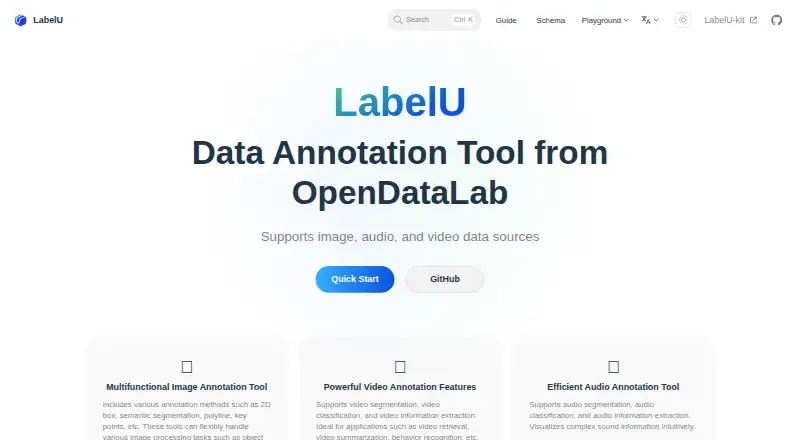
LabelU provides a multimodal workspace for annotating image, video, and audio data. It supports common image marking tools, video and audio labeling tasks, AI-assisted image annotation, and pre-annotated data review. You can run it in a browser, on Windows or macOS, or host it yourself. S3-compatible storage can supply files, and supported outputs include JSON, COCO, and MASK.
Review
In a line
LabelU is a free workspace for annotating images, video, and audio, with its code available as open source. The OpenDataLab GitHub organization publishes it, and you can use it online or run it on your own computer.
What it does
Image projects can use 2D bounding boxes, semantic segmentation, polylines, and keypoints. These tools mark objects, shapes, or points in pictures.
Video and audio projects can use segmentation, classification, and information extraction. You can also load existing pre-annotations and adjust them.
For image batches, automatic annotation can find and segment objects while reporting progress. Reference servers are available for Florence-2, GroundingDINO with SAM ViT-B, and SAM 3.
How it connects
Files may be brought in from S3-compatible services, including AWS S3 and MinIO. The available output options include JSON, COCO, and MASK.
A local setup uses Python 3.11 and pip, after which the service is available at localhost:8000. SQLite is the default database, and MySQL is documented as an option.
Deployment is supported on macOS, Windows, the web, or a self-hosted server. The project uses the Apache 2.0 license. Its online instance and browser toolkit provide web access.
Good fit
LabelU suits teams creating training data from images, video, or audio. It covers object marking, segmentation, classification, keypoints, and information extraction in one platform.
It can also fit workflows needing model-assisted labeling, batched image annotation, or self-hosting.
Watch for
Running the reference AI services needs local computing resources. Florence-2 and GroundingDINO with SAM ViT-B list minimum memory of about 4 GB; SAM 3 lists about 8 GB and requires CUDA 12.6 or later.
Self-hosting requires Python 3.11, pip, and local server setup. Windows instructions use Anaconda Prompt, and the README includes a note for Intel-based Macs. Check these requirements before choosing an AI-assisted workflow.
Pricing
LabelU is free and released as open-source software.
Verdict
Choose LabelU if you need one open-source tool for image, video, and audio annotation, especially when S3-compatible storage, common export formats, or self-hosting matter.
It may not suit teams that cannot provide the required Python setup or memory and CUDA resources for the reference AI models.
Our take
LabelU is a sensible choice for people who need multimodal labeling without a software fee. Its image tools, audio and video task types, storage imports, and standard exports cover a broad annotation workflow. Self-hosting gives control over where projects run, while the browser option lowers the setup barrier. The main decision point is technical capacity: local installation uses Python 3.11, and AI-assisted labeling can require substantial memory plus CUDA 12.6 or later for SAM 3. If those requirements fit, LabelU offers a flexible open-source route.
- Free, open-source software under the Apache 2.0 license
- Image, video, and audio annotation support
- Imports from AWS S3 and MinIO
- JSON, COCO, and MASK output options
- AI-assisted image annotation
- AI reference models need significant memory
- SAM 3 requires CUDA 12.6 or later
- Self-hosting requires Python 3.11 and local setup
- Pick it ifMultimodal image, video, and audio labeling; Teams wanting open-source or self-hosted annotation; Projects using S3-compatible storage
- Skip it ifYou cannot provide Python 3.11 or the listed AI hardware requirements
Pricing
LabelU is free, with open-source code and a free plan.
Questions
Is LabelU free?
Yes. LabelU is free, open-source software, and a free plan is listed.
What data can LabelU annotate?
It handles image, video, and audio tasks, including segmentation, classification, and information extraction.
Can LabelU run locally?
Yes. The project documents installation with Python 3.11 and pip, then running a local server at localhost:8000.
Which storage systems can it import from?
LabelU can import files from S3-compatible storage, including AWS S3 and MinIO.
Which output types does it support?
The listed output options are JSON, COCO, and MASK.
Does LabelU provide AI labeling?
Yes. Automatic image annotation can find and segment objects in batches while showing progress. Reference servers are available for Florence-2, GroundingDINO with SAM ViT-B, and SAM 3.
What hardware does the AI annotation need?
The reference models list about 4 GB minimum memory for Florence-2 and GroundingDINO with SAM ViT-B, and about 8 GB for SAM 3. SAM 3 requires CUDA 12.6 or later.