
PagerDuty: Incident Management, Integrations, and Pricing
pagerduty.com · checked 16 Nov 2026
Coordinate incidents with routed alerts, on-call planning, automation, and team response.
How it plugs in
Signal on On-Call Management Software6.7#1 of 30
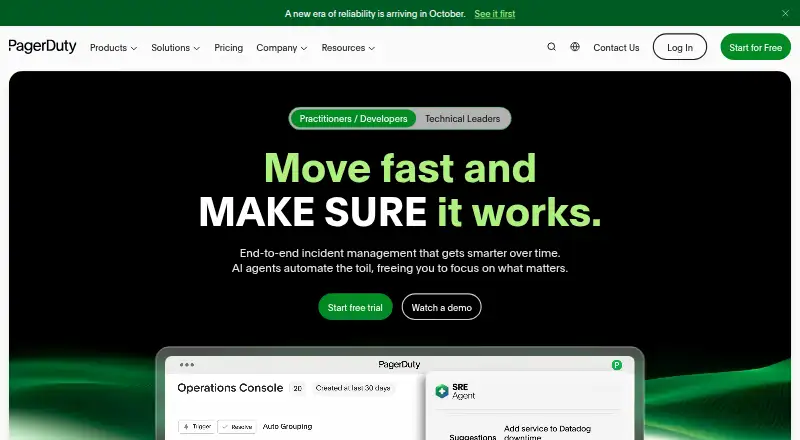
PagerDuty handles incidents from initial detection through resolution using automation and live collaboration. Notifications can arrive by phone, SMS, email, push, or chat, alongside schedules, escalation policies, automation, AIOps, and post-incident reviews. Connections span 750+ integrations, APIs, webhooks, and mobile apps. The entry level supports five users, while annual paid subscriptions start at $21 per user monthly.
Review
In a line
Founded in 2009, PagerDuty provides incident-management software. It helps teams identify, coordinate, and resolve incidents through automated notifications and real-time collaboration.
What it does
PagerDuty covers the incident process from detection and responder mobilization to guided remediation, stakeholder communication, resolution, and post-incident learning. Teams can configure on-call schedules, rotations, overrides, and escalation policies to reach the appropriate responder.
Phone, SMS, email, push, and chat are available for notifications, with the service applying prioritization and escalation automatically. Machine-learning features in AIOps reduce alert noise, orchestrate events, correlate related activity, and accelerate triage. PagerDuty AI can summarize incidents and provide task-focused AI agents.
PagerDuty Automation applies repeatable workflows across business and technical teams, tools, and systems to reduce manual effort. Its mobile apps support incident response, schedules, overrides, incident context, and automated response tasks.
How it connects
PagerDuty advertises 750+ platform integrations. Connections may use email, an API, or MCP. Examples it highlights include AWS, Slack, Anthropic Claude Connector, Microsoft Teams, Cursor, and Datadog.
Its REST API is a JSON interface for reading and changing account configuration through standard CRUD operations. An Events API receives monitoring events, while webhooks deliver PagerDuty activity notifications. Official developer resources include Go, Python, Ruby, and Node client libraries, Terraform, OAuth, and MCP server support.
Jira, ServiceNow, and BMC Helix can exchange incident and ticket data with PagerDuty, including status changes and audit history. PagerDuty's software is proprietary rather than open source, and its downloadable Runbook Automation Self-hosted product needs a license key. See incident-management software and on-call scheduling software for related categories.
Good fit
PagerDuty says developers, reliability engineers, customer success, security, and C-suite teams use its platform. It is useful for alert routing, on-call coordination, workflow automation, stakeholder communication, and post-incident reviews.
The service runs on web, Windows, macOS, Linux, iOS, Android, API, and self-hosted offerings. The web application requires a modern JavaScript-enabled browser.
Watch for
The Incident Management Free plan allows up to five users, one on-call schedule, and one escalation policy. Standard Email & Chat Support is unavailable on the no-cost tier and appears on Professional and higher plans.
The mobile app costs nothing to download, but use requires a PagerDuty account. As of April 2025 it supports iOS 17 or newer and Android 12 or newer; new versions from November 16, 2026 require iOS 18 or Android 13.
PagerDuty's service and documentation are proprietary. Check the required plan, notification allowances, support level, and license needs before choosing it.
Pricing
PagerDuty has a free tier alongside a 14-day trial. Free is billed at $0 per year for five users, one on-call schedule, one escalation policy, and 100 SMS or phone notifications monthly. Incident Management Free also has no charge and provides basic chat with limited email, push, SMS, and phone notifications.
Professional costs $21 per user monthly with annual billing or $25 per user monthly on a monthly term. Business is $41 per user monthly when billed annually. The Incident Management Professional listing shows $2521 a month, while its billing details specify $25 per user monthly or $21 annually, a 16% annual discount.
Reliability Platform Starter is $2,800 per year, Essential is $12,000 per year, and Ultimate is priced by request. These platform options differ in included seats, Signal Intelligence Events, and AI actions. Some plans offer add-ons that may be charged separately.
Verdict
Choose PagerDuty if your organization needs formal incident handling, scheduled responders, multiple alert channels, and connections to monitoring, chat, ticketing, or infrastructure tools. Its APIs, webhooks, SDKs, and self-hosted Runbook Automation option support varied technical setups.
The free plans can suit a small team with modest notification needs. Larger teams should compare user limits, support, notification allowances, add-ons, and platform fees. Avoid committing before confirming mobile operating-system requirements and whether proprietary licensing fits your policies. For alternatives, compare AlertOps or PagerTree.
Our take
PagerDuty fits teams that need a defined incident process rather than simple alerts. It combines on-call scheduling, escalation, many notification channels, workflow automation, AIOps, AI assistance, and incident records in one service. The free tier gives small groups a starting point, while paid and platform plans add support, reviews, workflows, integrations, seats, and AI allowances. Check the five-user free limit, notification caps, support differences, mobile requirements, proprietary license, and possible add-on charges. Smaller teams wanting only basic alerts may find the broader plan structure unnecessary.
- The no-cost plan supports five users, one schedule, and one escalation policy.
- 750+ integrations are available alongside email, API, and MCP connections.
- Responders can receive alerts by phone, SMS, email, push, or chat.
- AIOps helps cut alert noise and correlate related events.
- Mobile apps support response, schedules, context, and automated tasks.
- Free access limits users, schedules, policies, and notification volume.
- Free does not include standard email and chat support.
- Using the mobile app requires an account, and later versions need newer operating systems.
- The service and documentation are proprietary, not open source.
- Some plans and add-ons require larger fees or custom pricing.
- Pick it ifTeams coordinating incidents across on-call responders and tools; Organizations needing alert automation, AIOps, and incident reviews; Companies integrating monitoring, chat, and ticketing systems
- Skip it ifYou require open-source software.; You need more than five free users or one free schedule.; You cannot meet the account, browser, mobile, or licensing requirements.
Pricing
A free tier and 14-day trial lower the entry cost. Business is $41 per user monthly on an annual term.
- Freeper year · 5 users; 1 on-call schedule; 1 escalation policy; Runbook Automation not includedFree
- Incident Management Freeper year · 5 users · 1 on-call schedule · 1 escalation policy · basic chat · limited email, push, SMS and phone notificationsFree
- Professional annual$21 per user per month, billed annually · Free features plus enhanced chat · post-incident reviews · add-ons available$21/mo
- Professionalper user/month (annual billing; $25 monthly) · Runbook Automation available as add-on$21/mo
- Professional monthly$25 per user per month · Free features plus enhanced chat · post-incident reviews · add-ons available$25/mo
- Business annual$41 per user per month, billed annually · Custom fields · advanced incident workflows · advanced ITSM integrations · historical data · status pages$41/mo
- PD Reliability Platform Starter$2,800 platform fee per year · 10 seats · 5,000 Signal Intelligence Events · 1,000 AI actions$2,800/yr
- Starterplatform fee per year · Runbook Automation available as add-on$2,800/yr
As pagerduty.com lists them, checked 16 Nov 2026.
Questions
Does PagerDuty have a free plan?
Yes. Free costs $0 per year and covers five users, one on-call schedule, one escalation policy, and 100 SMS or phone notifications per month.
How much does PagerDuty cost?
Professional is $21 per user monthly with annual billing or $25 per user monthly. Business is $41 per user monthly annually. Other platform plans use annual or custom pricing.
What integrations does PagerDuty support?
PagerDuty lists 750+ integrations. Connections can use email, API, or MCP, including AWS, Slack, Microsoft Teams, Cursor, Datadog, and Anthropic Claude Connector.
Does PagerDuty offer an API?
Yes. Its REST API reads and changes account configuration, while an Events API accepts monitoring events and webhooks send activity notifications.
Is PagerDuty open source?
No. PagerDuty characterizes its service and documentation as proprietary technology. Its self-hosted Runbook Automation software requires a license key.
Can I use PagerDuty on a phone?
Yes. The free iOS and Android apps handle incident response, schedules, overrides, context, and automated response tasks, but an account is required.