Refact.ai: Features, Integrations, and Pricing
refact.ai · checked 11 Oct 2026
An open-source coding tool that pairs an autonomous agent with editor chat and code suggestions.
How it plugs in
Signal on AI Coding Assistants6.9#17 of 103
Refact.ai helps with coding through an autonomous agent, in-editor chat, and real-time code suggestions. It analyzes a code repository to tailor its help to a project. It supports several editors and can use configured AI providers or local model runtimes. Refact has announced the retirement of hosted accounts and paid cloud features; check current setup and plan availability before choosing it.
Review
In a line
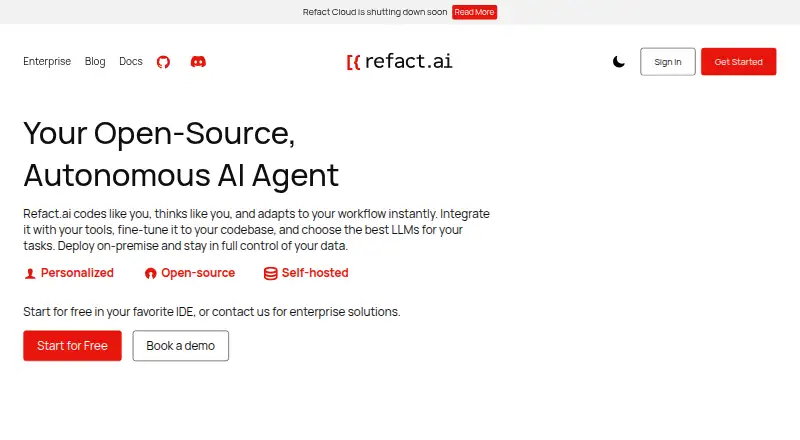
Refact.ai is an open-source, autonomous AI agent for software development. It includes an agent, chat, and code completion.
What it does
The agent can plan and carry out coding tasks, then deploy them. You can preview its steps and control the process. In-editor chat can answer questions about code, make edits, help debug, and generate code.
Refact analyzes a project repository to give suggestions that account for the code around them. It provides real-time completions and supports over 25 programming languages.
How it connects
The download page lists extensions for VS Code and JetBrains IDEs; Visual Studio, Neovim, and Sublime Text are marked beta. Refact also lists GitHub, GitLab, Docker, PostgreSQL, MySQL, databases, CI/CD pipelines, and MCP among its integrations and tools.
For its local product, Refact lists configurable connections to OpenAI, Anthropic, Gemini, DeepSeek, OpenRouter, Groq, xAI, and custom OpenAI-compatible endpoints. It can also connect to Ollama, LM Studio, or vLLM, and users can supply their own API key.
Refact is available for Linux, macOS, and Windows, as well as through an API and self-hosted setup. The maker says the current local-first product sends requests only to the providers, local runtimes, and integrations users configure.
Good fit
Refact may suit individual developers who want code help inside an editor, or teams that want an agent they can monitor and direct. The Free plan is aimed at personal and hobby projects, while Enterprise is for engineering teams.
The enterprise offering describes on-premise, SaaS, and AWS deployment, company-code fine-tuning, and dedicated support. On-premise deployment is described as keeping code on the customer's servers.
Watch for
Refact has announced the retirement of hosted accounts, managed inference, credits, subscriptions, cloud billing, and team cloud features. It says paid hosted service will not continue after the transition. Confirm which plans and features are currently available before relying on a hosted setup.
Visual Studio, Neovim, and Sublime Text plugins are still in beta. The privacy policy says Refact does not collect data on the server side; configured providers, local runtimes, and integrations remain distinct parts of the data flow.
Pricing
The Free plan is available at no cost for personal and hobby projects. It includes limited daily agent use, in-editor chat with 32k context, unlimited Qwen2.5-Coder completions, and a code-aware vector database.
Pro is priced at $10 per month for professional use. It includes 40 agent requests per day, unlimited in-editor chat with 64k context, and additional completion models. Enterprise pricing is available on request.
Refact says it will not offer paid hosted service after the transition, so the listed Pro and Enterprise offerings may not describe subscriptions currently available through its hosted service.
Verdict
Consider Refact.ai if you want an open-source coding tool that can work in an editor, use project context, and provide an agent whose process you can oversee. It has options for local model runtimes and self-hosting, and its enterprise page describes on-premise deployment.
Before choosing it, verify that your preferred editor plugin is ready for your needs and that the plan or deployment you want is still offered. The announced end of paid hosted service makes it a less straightforward choice for anyone who depends on managed cloud accounts or team cloud features.
Our take
Refact.ai is worth considering for developers who want code completion and chat alongside an agent they can inspect and control. Its open-source code, self-hosting options, and support for local runtimes may appeal to people who want to configure where requests go. Its transition away from hosted accounts and paid cloud features is the key consideration. Check current plan availability, deployment choices, and the beta status of some editor plugins before making it part of a team's workflow.
- Combines code completion and in-editor chat with an autonomous coding agent.
- Analyzes repositories to make suggestions that account for project code.
- Can connect to local runtimes such as Ollama, LM Studio, and vLLM.
- Offers self-hosted use and an open-source project.
- VS Code and JetBrains IDE extensions are listed.
- Hosted accounts and paid cloud features are being retired.
- Visual Studio, Neovim, and Sublime Text plugins are beta.
- The free plan limits daily autonomous agent use.
- Enterprise pricing is available on request.
- Pick it ifDevelopers seeking editor-based chat, completions, and agent help; People who want to configure local model runtimes or self-host; Engineering teams considering on-premise deployment
- Skip it ifYou need a paid hosted subscription or team cloud features to continue; You require a non-beta plugin for Visual Studio, Neovim, or Sublime Text
Pricing
The plans listed are Free, Pro at $10 a month, and Enterprise at a price on request. Because paid hosted features are being retired, confirm which plans remain available and whether your intended deployment is covered.
- FreeFor personal and hobby projects · Autonomous AI Agent limited daily usage · In-IDE chat with 32k context · Unlimited Qwen2.5-Coder completions · Code-aware vector database (RAG)Free
- ProFrom $10/month · For professional use · 40 Autonomous AI Agent requests/day · Unlimited in-IDE chat with 64k context · Additional code completion models$10/mo
- EnterpriseOn-premise, SaaS, or AWS deployment · LLM fine-tuning on company codebase · Multi-GPU optimization · Code privacy · Priority support and onboardingOn request
As refact.ai lists them, checked 11 Oct 2026.
Questions
Is Refact.ai free?
Yes. Its Free plan is for personal and hobby projects, with limited daily agent use, in-editor chat, unlimited Qwen2.5-Coder completions, and a code-aware vector database.
How much does Refact Pro cost?
Pro is listed at $10 a month. Refact says paid hosted service will not continue after the transition, so check whether this plan is currently available.
Which editors does Refact.ai support?
The download page lists extensions for VS Code and JetBrains IDEs. Visual Studio, Neovim, and Sublime Text are marked beta.
Can Refact.ai use local AI models?
It can connect to local runtimes including Ollama, LM Studio, and vLLM. Users can also configure providers and custom OpenAI-compatible endpoints.
Does Refact.ai send code to its servers?
The maker says the local-first product sends requests only to the providers, local runtimes, and integrations users configure. Its privacy policy says it does not collect data on the server side.
Is Refact.ai open source?
Yes. Refact describes itself as an open-source AI coding agent. Support and bug reports are moving to the project's GitHub issues and discussions.