Telesign Communications Platform
About
Telesign Communications Platform provides APIs for customer communications, verification, and identity insights. Its Messaging API covers SMS, MMS, email, RCS, WhatsApp, and Viber through one API, with intelligent routing that can redirect failed messages through another carrier route or channel. Telesign says its SMS API reaches more than 230 countries and territories and supports over 80 languages. Customers can purchase or lease phone numbers with geographically accurate area and country codes. Developer resources include code samples and SDKs for C#, PHP, curl, Node.js, Python, Java, and Ruby. A free trial account requires no credit card and includes $5 in credit that does not expire. The REST API uses TLS 1.2/1.3 and signed requests. Telesign states that it is ISO 27001 certified and HIPAA compliant, and that support is available 24/7 to current customers. Pricing is available on request. The Messaging API is not available for purchase or use in mainland China.
Who it is for
The platform suits teams building customer messaging, verification, or identity workflows through APIs. Its listed SDKs and messaging channels may suit developers working across several languages and communication channels.
What is good
- One Messaging API supports six listed channels.
- SMS API reach spans 230+ countries and territories.
- Trial includes $5 credit without a credit card.
- REST calls use TLS 1.2/1.3 and signed requests.
- SDKs and samples cover multiple programming languages.
What to know first
- Messaging API is unavailable in mainland China.
- Pricing is available on request.
- 24/7 support is for current customers.
Inferse review
Telesign Communications Platform: the full review
Telesign offers a broad set of messaging channels and developer resources through APIs, alongside verification and identity insights. Teams should account for on-request pricing and the mainland China availability restriction for Messaging API.
Overview
Telesign is an API platform for customer messaging, voice, verification, and identity insights. It suits teams building communications into products across multiple channels; custom pricing and the mainland China restriction are important trade-offs.
Founded in 2005 and based in Los Angeles, Telesign says its SMS API reaches more than 230 countries and territories in over 80 languages. The Messaging API cannot be purchased or used in mainland China, which rules it out as a single solution for teams that need messaging there.
It belongs among Communications Platforms as a Service, and is also relevant to teams comparing RCS Business Messaging Software or Phone Number Validation Software.
Key features
Messaging across channels
One Messaging API supports SMS, MMS, email, RCS, WhatsApp, and Viber, while the platform also offers programmable voice. This breadth can help teams consolidate customer communications behind one integration rather than build around a single channel. Two-way messaging, rich media, suggested actions, carousel messages, and delivery and read receipts support more interactive exchanges than basic one-way text.
Routing, numbers, and verification
Intelligent routing can redirect a failed message through another carrier route or channel, giving teams a fallback path when delivery fails. Customers can purchase or lease numbers with geographically accurate area and country codes. Verification capabilities include push verification, SMS OTP, and email OTP; line-type, carrier, and reachability data add identity and phone context for workflows that need it.
Developer and security provisions
The Developer Center provides code samples and SDKs for C#, PHP, curl, Node.js, Python, Java, and Ruby. REST API calls use TLS 1.2/1.3 and signed-request authentication. Telesign says it is ISO 27001 certified and HIPAA compliant, and offers 24/7 support to current customers. These provisions suit teams with integration and security requirements, though the API-first access model is not a substitute for a standalone mobile app.
Pricing
The Telesign Communications Platform uses custom pricing; contact sales for a quote. A free plan and free trial are available, but the trial account is the clearest stated entry point: it requires no credit card and includes $5 in credit that never expires. That gives developers room to begin an integration without a short trial countdown, but it does not establish the ongoing cost of production messaging.
The platform plan covers programmable messaging and voice, supported channels, phone numbers, verification, webhooks, and messaging features such as rich media and delivery receipts. No seat or production quota is stated. Teams should confirm channel-specific rates and expected usage with sales before committing, particularly if message volume drives their budget.
Platforms
Telesign is accessed by API and lists web as a platform. SDK support spans C#, Java, Node.js, PHP, Python, and Ruby, with Android and iOS SDK language support also indicated. This favors product teams integrating communications into existing services over users seeking a native end-user application.
Who it's for
Telesign is a strong fit for teams that need a single API surface across messaging channels, voice, verification, and phone-number data, especially when fallback routing and two-way or rich-media messaging matter. It is less suitable when public pricing is a prerequisite for vendor selection, or when Messaging API access in mainland China is essential.
Pros and cons
- Pros: One API supports six named messaging channels, with programmable voice also available, reducing the need to select a channel-specific platform at the outset.
- Pros: Failed-message rerouting, two-way exchanges, rich media, carousels, and receipts support more resilient and interactive communications.
- Pros: The no-card trial includes $5 credit with no expiry, giving developers a low-friction way to start.
- Cons: Custom pricing makes it harder to estimate production costs before engaging sales.
- Cons: Messaging API use is unavailable in mainland China, requiring another option for that market.
Alternatives
Choose Gupshup if a free plan with a stated $0.001 USD per-message Gupshup fee better suits your cost comparison; WhatsApp fees are billed at actuals. SimplyRCS is worth considering for a freemium RCS option with a $0 platform pay-as-you-go plan and messaging charged at published rates. For usage-based RCS pricing, compare BuzZync RCS Messaging, whose pay-as-you-go total varies with monthly messaging volume.
Bandwidth Messaging API may suit teams comparing per-message U.S. SMS rates, including a listed $0.01 USD per-message U.S. short-code outbound plan; it has no free plan but does offer a free trial. Google RCS for Business is an RCS-specific alternative with carrier-rate-card billing based on destination region and conversational category. Helo.ai is another paid API option with a custom enterprise plan. LINK Mobility RCS is an RCS alternative whose pricing varies by message type, with distinct limits for basic and conversation messages. Yup Chat RCS API is another paid API and web option.
Verdict
Choose Telesign when your product needs messaging across several channels alongside voice, verification, and phone-number intelligence through APIs. Its breadth, routing fallback, and non-expiring trial credit are persuasive for builders; custom pricing and the mainland China restriction are the clearest reasons to compare alternatives.
Compared on RCS business messaging software
- Free plan
- Notelesign.com
- Channels supported
- SMS, MMS, email, RCS, WhatsApp, Viber, voicetelesign.com
- Pricing model
- paygtelesign.com
- Programmable voice
- Yestelesign.com
- Programmable messaging
- Yestelesign.com
- SDK platforms
- C#, Java, Node.js, PHP, Python, Rubytelesign.com
- Phone number support
- Yestelesign.com
Facts
- What it does
- Telesign provides APIs for customer communications, verification, and identity insights.telesign.com · 30 Sept 2026
- Messaging channels
- Its Messaging API supports SMS, MMS, email, RCS, WhatsApp, and Viber through one API.telesign.com · 30 Sept 2026
- Message delivery
- The Messaging API uses intelligent routing and can redirect failed messages through another carrier route or channel.telesign.com · 30 Sept 2026
- Global SMS reach
- Telesign says its SMS API reaches more than 230 countries and territories and 80+ languages.telesign.com · 30 Sept 2026
- Phone numbers
- Customers can purchase or lease phone numbers with geographically accurate area and country codes.telesign.com · 30 Sept 2026
- Developer tools
- The Developer Center lists code samples and SDKs for C#, PHP, curl, Node.js, Python, Java, and Ruby.telesign.com · 30 Sept 2026
- Trial account
- The Developer Center says a trial account is free, requires no credit card, includes $5 in credit, and the credit never expires.telesign.com · 30 Sept 2026
- Support
- Telesign says its support team is available 24/7 to current customers.telesign.com · 30 Sept 2026
- Security
- Telesign's security page says its REST API uses TLS 1.2/1.3 and authenticates each call with signed requests.telesign.com · 30 Sept 2026
- Compliance
- Telesign's security page says the company is ISO 27001 certified and HIPAA compliant.telesign.com · 30 Sept 2026
- Integrations
- Telesign describes integration partners as organizations that integrate its data and communications capabilities into their offerings.telesign.com · 30 Sept 2026
- Availability limit
- The Messaging API page says the feature is not available for purchase or use in mainland China.telesign.com · 30 Sept 2026
Company
- Founded
- 2005telesign.com · 28 Sept 2026
- Headquarters
- Los Angeles, California, United Statestelesign.com · 28 Sept 2026
Best Telesign Communications Platform alternatives
See all 12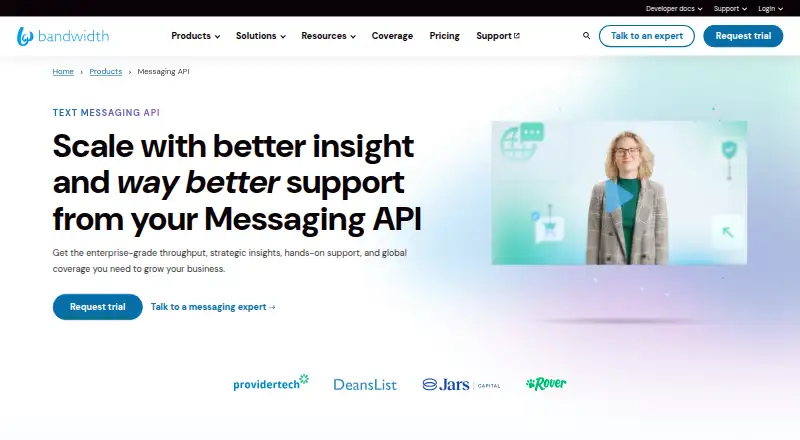 7.4 Bandwidth Messaging API See plans price on the maker's page Free trial
 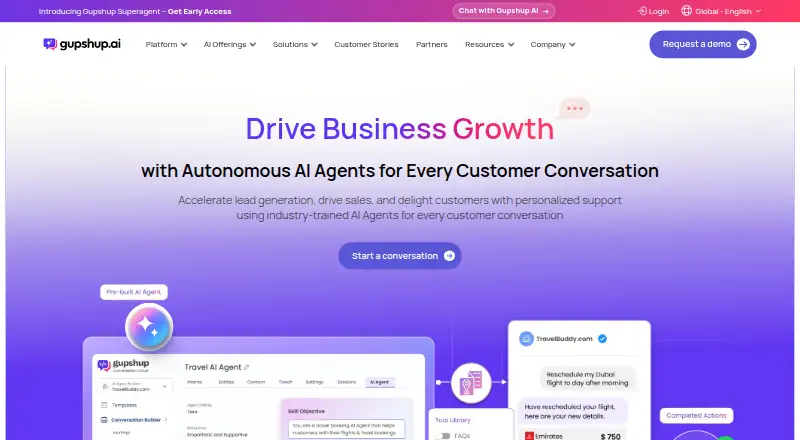 7.2 Gupshup Free free plan, no paid price published Free plan
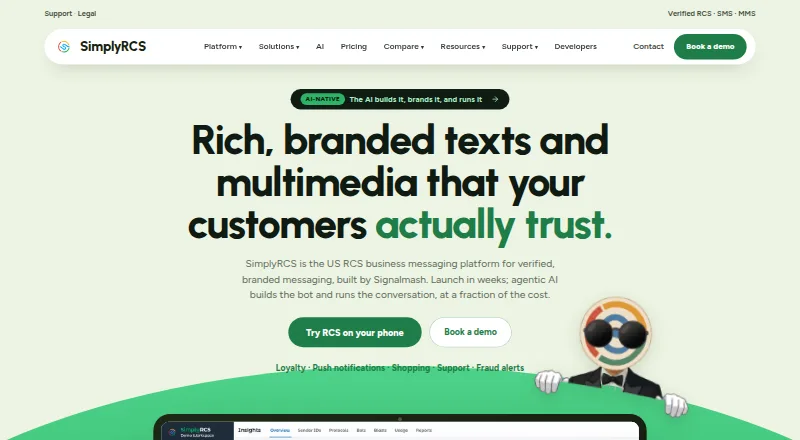 7.2 SimplyRCS $20/mo first paid tier Free plan
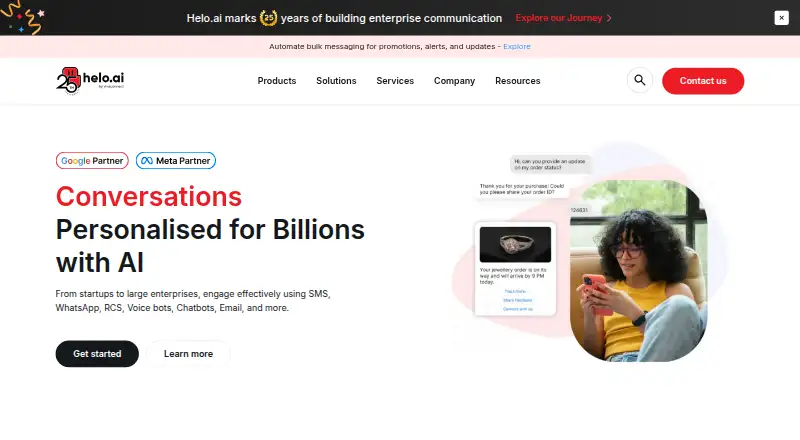 7.0 Helo.ai See plans price on the maker's page Free trial
 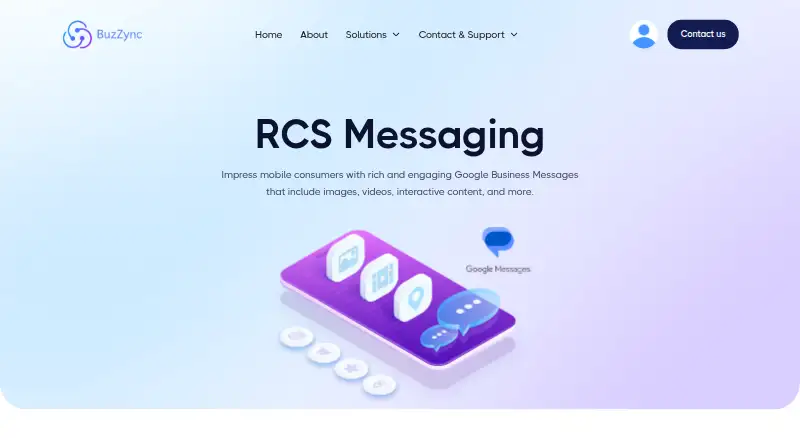 6.9 BuzZync RCS Messaging See plans price on the maker's page
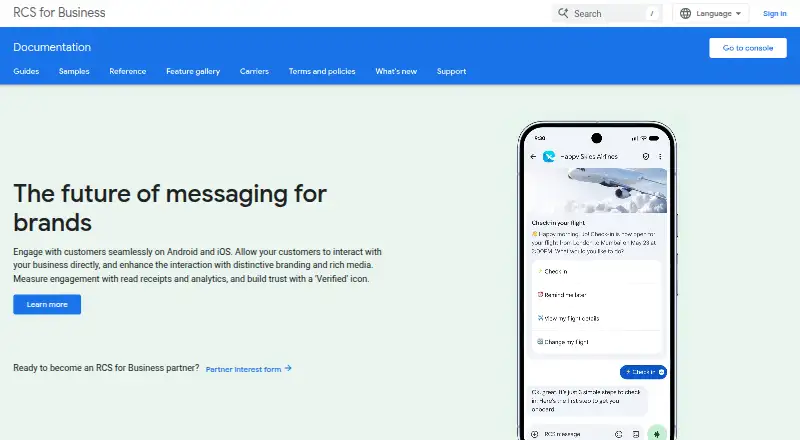 6.8 Google RCS for Business See plans price on the maker's page
Where it ranks on Inferse
Sources
- telesign.com/company· checked 30 Sept 2026
- telesign.com/products/messaging· checked 30 Sept 2026
- telesign.com/products/sms-api· checked 30 Sept 2026
- telesign.com/developer· checked 30 Sept 2026
- telesign.com/contact· checked 30 Sept 2026
- telesign.com/security· checked 30 Sept 2026
- telesign.com/partners· checked 30 Sept 2026
- telesign.com/products/communications-platform· checked 28 Sept 2026